There was a moment midway through the fourth quarter of Game 5 when the memories of Game 1 threatened to come roaring back. Oklahoma City had led by as many as 18 points. The crowd was pulsing. The ball was moving. But suddenly, that lead was down to two. Pascal Siakam had just drained a three, capping a furious Indiana surge, and the sense of déjà vu was palpable inside Paycom Center.
But this time, the ending was different.
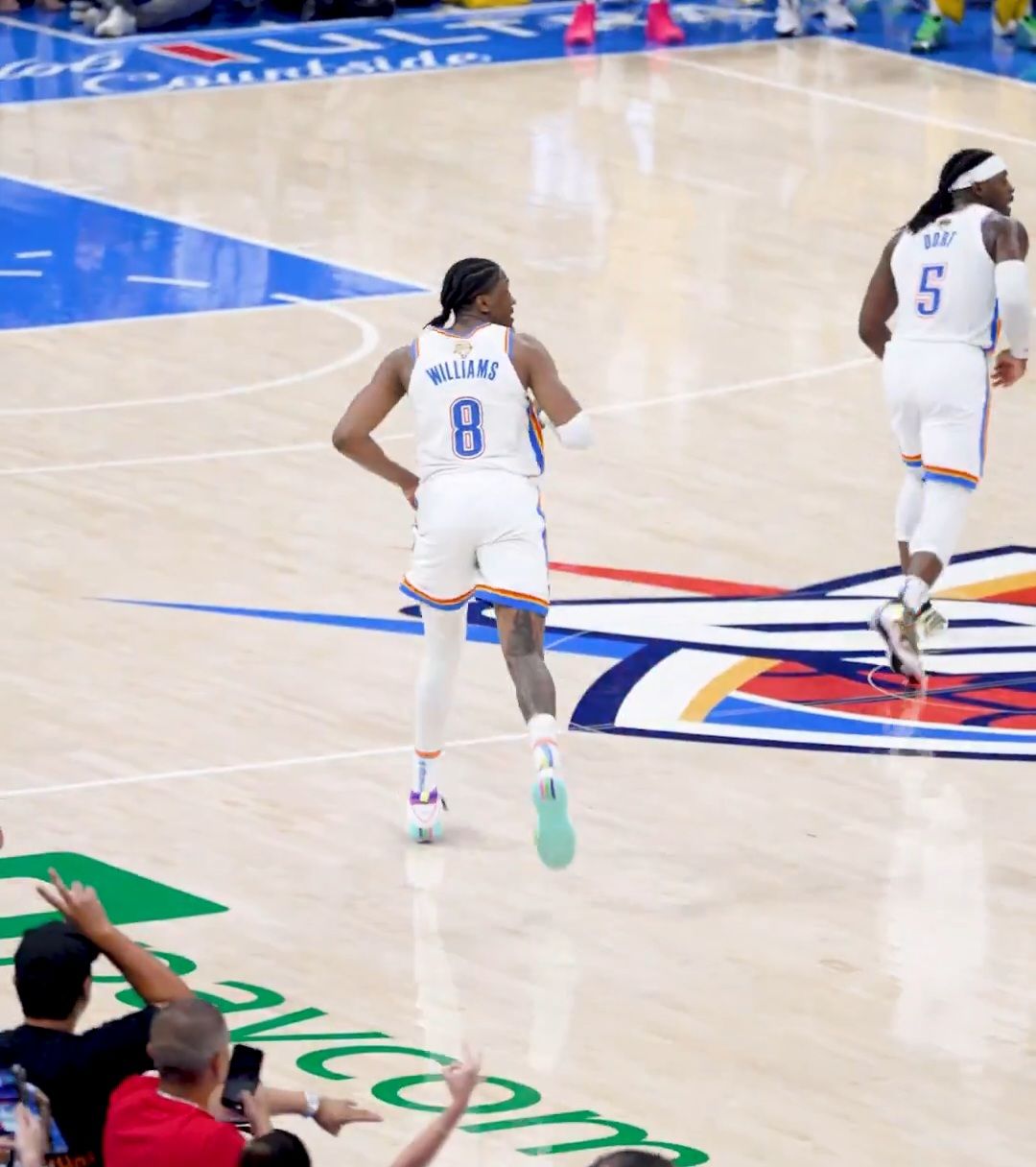
With everything teetering, the Oklahoma City Thunder responded—not with panic, but with poise. Cason Wallace corralled an offensive rebound after a missed layup, reset the offense, and found Jalen Williams on the right wing. Without hesitation, Williams rose and buried a cold-blooded three to push the lead back to five. Moments later, Wallace picked off a pass and coasted in for a layup. The run was halted. The crowd exhaled. And the Thunder never looked back.
By the time the final buzzer sounded, Oklahoma City had secured a 120-109 victory and a 3-2 lead in the NBA Finals. One win now separates them from the first NBA championship in franchise history since relocating from Seattle in 2008.
And at the center of it all was Jalen Williams.
In the biggest game of his young career, Williams was masterful, erupting for a playoff career-high 40 points on 14-for-25 shooting, along with six rebounds, four assists, and a steal. It was the kind of performance that elevates a player’s stature in real-time. It wasn’t just the scoring—it was the timing. Every time the Pacers threatened to swing the momentum, it was Williams who had the answer.
“That was honestly the same exact game as Game 1,” Williams said after the win. “Learning through these Finals, that’s what makes a team good.”
Learning. Responding. Maturing. That’s the through-line of this Thunder playoff run. What was once one of the NBA’s youngest rosters has grown into a battle-tested unit capable of withstanding playoff pressure. In Game 1, they crumbled under that weight. In Game 5, they used it as fuel.
The Thunder’s response began with their stars. Williams and Shai Gilgeous-Alexander—who added 31 points, 10 assists, four blocks, and two steals—combined for 71 points. It marked the tenth time this season the duo eclipsed 70 points in a game, but none were bigger than this. Gilgeous-Alexander, Oklahoma City’s undisputed leader and League MVP, controlled the tempo with surgical precision. He relentlessly attacked mismatches, got to the line (13-for-14), and kept the offense humming with his playmaking.
“It wasn’t a perfect game at all, and there’s a lot of room for growth,” head coach Mark Daigneault admitted postgame. “But our improvement from Game 4 to Game 5 was critical.”
That improvement was most evident on the defensive end and in their attention to detail. After being burned in Game 1 by careless turnovers and stagnant offense late in the game, the Thunder made sure not to repeat those mistakes. They forced 23 Indiana turnovers—seven in the opening quarter alone—and turned them into 32 points. They limited their own giveaways to just 11, keeping the Pacers from gaining easy transition opportunities.
Role players stepped up as well. Wallace finished with 11 points, four steals, and two rebounds off the bench. Aaron Wiggins added 14 points on 4-for-7 shooting from three. Luguentz Dort, as always, brought defensive intensity and chipped in three triples of his own.
Meanwhile, Indiana once again proved its mettle by nearly staging another remarkable comeback. The Pacers have built a reputation throughout this postseason as the comeback kings, recording five wins after trailing by 15 points or more. On Monday, they nearly did it again.
Despite losing Tyrese Haliburton early to an aggravated calf injury—he finished scoreless from the field and was clearly hobbled—Indiana clawed back into the game. T.J. McConnell sparked the run with 13 points in the third quarter. Siakam carried it from there, scoring 12 of Indiana’s first 14 points in the fourth, including a steal-and-slam and back-to-back threes.
“It kind of went away from us,” Siakam said afterward. “But the fight was there.”
Still, the margin for error shrinks quickly in the NBA Finals, especially when your star point guard is operating at half-speed. Haliburton managed just four points and six assists in 32 minutes and took only one shot after halftime. Without his usual playmaking, Indiana was forced to rely on isolation scoring and transition pushes—neither of which could sustain them down the stretch.
Now, with the series shifting back to Indiana for Game 6, all the pressure is on the Pacers. Historically, teams that win Game 5 of a Finals series tied 2-2 go on to win the series 74% of the time. Teams with a 3-2 lead have closed out the championship 82% of the time. The Thunder know what’s at stake, but they’re not getting ahead of themselves.
“There’s still a lot of work to do,” Gilgeous-Alexander said. “We’ve got to stay in the moment. Game 6 is going to be a fight.”
And it will be. The Pacers have shown time and again that they won’t go quietly. Siakam has found a rhythm, McConnell continues to give them quality minutes off the bench, and Andrew Nembhard has emerged as a steady contributor. If Haliburton can return to something close to full strength, Indiana still has a puncher’s chance.
But make no mistake—Oklahoma City has seized control of this series. They have the stars, the system, and now, the belief. Monday night wasn’t about revenge for Game 1. It was about evolution. The Thunder didn’t just survive the moment—they owned it.
On Thursday night in Indianapolis, they’ll have a chance to turn that growth into history.
Follow us on Instagram