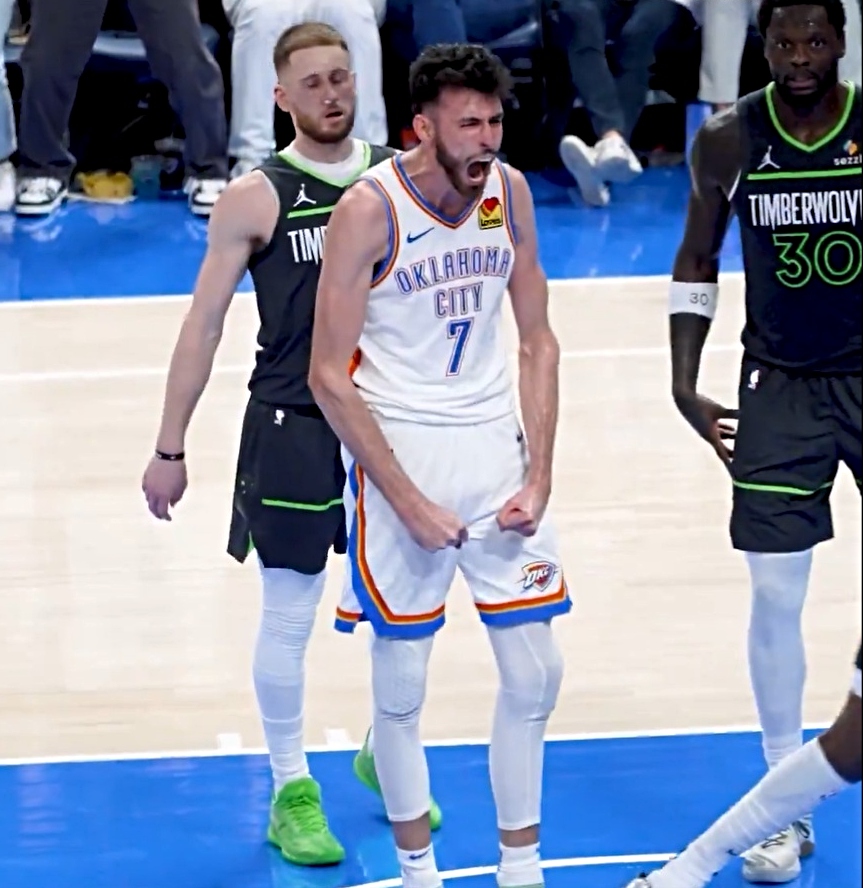
By locking in Chet Holmgren to a five-year, $250 million rookie max extension, the Oklahoma City Thunder have sent a clear message to the rest of the NBA: their championship run in 2025 was no fluke — and they’re building a dynasty around a young core they believe in.
On its face, a quarter-billion dollars for a player who’s yet to make an All-Star team — and who has played just over a season and a half due to two significant injuries — might feel excessive. Skeptics will raise fair questions. Can Holmgren hold up physically? Is he worth $50 million per year when he hasn’t even had a full healthy campaign? But dig deeper, and it becomes clear: this deal is not just a show of faith, it’s a strategic investment — one that aligns with Oklahoma City’s vision, timeline, and culture.
This isn’t just about rewarding Holmgren’s talent; it’s about betting on what he’s becoming.
A Champion Built on Defense
For all the spotlight on Shai Gilgeous-Alexander’s MVP brilliance and Jalen Williams’ ascent to All-NBA status, Chet Holmgren was the Thunder’s defensive spine during their historic playoff run. He didn’t need to lead the team in scoring or star in flashy highlight reels. His dominance came in the margins — contesting shots, deterring drives, and controlling space.
Holmgren’s defensive stats from the postseason are staggering: five blocks in Game 7 of the NBA Finals against Indiana, the most ever in a Finals Game 7. The lowest field goal percentage allowed (33%) by any player defending at least 40 shots in the Finals. A league-best plus-169 playoff plus-minus. And, per GeniusIQ, he led the NBA last season in field goal percentage allowed at the rim among players contesting 100+ layups and dunks.
These are the kinds of contributions that don’t always make headlines but win championships. His presence helped elevate Oklahoma City’s defense to one of the most efficient in playoff history. When Chet was on the floor, OKC became a fortress.
Overpay or Smart Hedge?
Holmgren’s extension begins in 2026-27, with his salary jumping from $13.7 million to over $41 million. That might sound steep for a player with no All-Star nods, but consider the context. The salary cap is rising. Star big men like Nikola Jokic, Joel Embiid, and Karl-Anthony Towns are already earning similar figures. And Holmgren, if healthy, has the potential to rival their impact.
Still, the risks are real. Holmgren missed his entire rookie season due to a Lisfranc fracture in his foot and sat out three months this past year with a hip injury. His slight frame and aggressive playing style raise durability concerns that Oklahoma City’s front office undoubtedly considered.
But this is where the Thunder’s organizational confidence shows. Sam Presti and his staff aren’t paying Holmgren for what he’s done — they’re paying him for what they believe he will do. And in their eyes, he’s only scratching the surface.
Holmgren averaged 15.0 points, 8.0 rebounds, and 2.2 blocks while shooting nearly 38% from three in limited regular-season action. His offensive role will likely expand as he continues to regain rhythm and confidence. There’s evidence to suggest he’s capable of becoming a 20-10 player who stretches the floor and anchors a top-five defense — a rare archetype in today’s NBA.
Building a Core the Right Way
In the past month, the Thunder have handed out over half a billion dollars in extensions: Shai Gilgeous-Alexander for four years and $285 million, and now Holmgren for five years and $250 million. Jalen Williams is likely next. Critics might call it reckless — committing long-term money before all the awards and accolades. But this is precisely how Oklahoma City built a championship roster: by believing early.
Gilgeous-Alexander was a bench player at Kentucky, a throw-in to the Paul George trade. Jalen Williams came out of Santa Clara with little fanfare. Holmgren, despite being a top-two pick, had his share of doubters due to his frame and injuries. But the Thunder aren’t chasing stars in free agency or waiting for consensus validation. They’re building around character, fit, and upside — and doing it from within.
The franchise is proving that loyalty, culture, and development can still be winning ingredients in a league increasingly driven by player movement and short-term gain.
Holmgren’s Ceiling Justifies the Gamble
Few players possess Holmgren’s combination of skill, size, and smarts. He’s not just a shot blocker — he’s a 7-foot floor spacer who can switch on defense, pass out of the short roll, and play within a system. His ability to play alongside multiple styles — whether in a fast-paced, spacing-heavy scheme or a grind-it-out half-court war — gives Oklahoma City flexibility as the league evolves.
And perhaps most importantly, Holmgren fits their timeline. At 23, he is locked in through the 2030-31 season, aligning perfectly with SGA and Williams. The Thunder don’t just have a championship core; they have it secured for the next six years.
That matters. Continuity breeds chemistry. Stability breeds greatness. The Thunder have now created both.
Final Word
There’s no such thing as a perfect contract, especially for a player with Holmgren’s injury history. But in the context of Oklahoma City’s trajectory, culture, and identity, this deal makes sense. It’s not just a reward for Holmgren’s potential — it’s an affirmation of who he is: a selfless competitor, a defensive savant, and a player willing to fit into a team-first structure.
The Thunder won the 2025 NBA title by doing things their way. And by extending Chet Holmgren, they’ve doubled down on that philosophy — with eyes fixed on more banners, not just balance sheets.
Follow us on Instagram