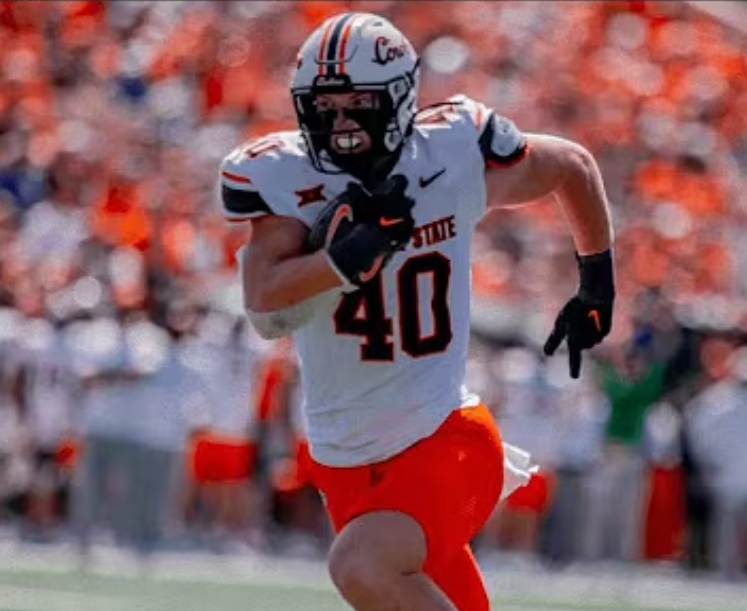
For nearly a decade, Oklahoma State fans grew used to hearing the term Cowboy Back—a quirky, hybrid position Mike Gundy created in 2015 that combined tight ends and fullbacks under one umbrella. The idea was simple: merge the physicality of a blocker with the pass-catching skills of a tight end to create mismatches. In practice, it often meant the Cowboys never fully committed to using tight ends as primary receiving threats.
That era is over. In 2025, Oklahoma State is going back to a more traditional offensive structure—tight ends are once again their own room, fullbacks have their own job description, and the offense is getting a fresh set of eyes under new offensive coordinator Doug Meacham.
This change might seem minor on paper, but it could be one of the most important storylines of the Cowboys’ season. Why? Because Oklahoma State’s tight ends—long an afterthought in the passing game—now have the chance to become a true X factor.
A Clean Slate for a Struggling Offense
The 2024 season was, by just about any measure, a disaster. The Cowboys limped to a 3–9 record, struggled to move the ball consistently, and lacked the kind of offensive creativity that had once been their calling card under Gundy. Now, Meacham, known for his wide-open passing concepts and ability to maximize skill position talent, has the challenge of rebuilding confidence and production.
Tight ends could be his hidden weapon. For years, the position has been used sparingly in Stillwater, often relegated to blocking or occasional short-yardage catches. That’s not necessarily a bad thing in the right system—but it left OSU one-dimensional in certain situations, especially in the red zone.
This year, the pieces are there to change that narrative. Between proven transfers, intriguing underclassmen, and a fresh offensive philosophy, the tight end group has as much upside as any position on the roster.
Transfers Bring Instant Credibility
Oklahoma State’s offseason portal work at tight end might be one of the most underrated roster rebuilds in the Big 12. The headliners are Oscar Hammond (North Texas) and Will Monney (Utah State), both of whom bring real, recent production to the table.
Hammond is coming off a 2024 season with 19 catches for 238 yards and a touchdown. Monney added 11 catches for 138 yards and a score of his own. These aren’t jaw-dropping numbers, but they are meaningful—especially when you consider that OSU’s entire tight end room combined for just 11 receptions a year ago.
If their production translates from Conference USA and the Mountain West to the Big 12, the Cowboys will instantly have a far more dynamic group than they’ve had in years.
Then there’s Josiah Johnson, a UMass transfer who logged 24 catches for 163 yards last season. He’s a physical 6-foot-5 target who can body up defenders in the red zone—a skill OSU desperately needs after ranking near the bottom of the Big 12 in touchdown percentage inside the 20-yard line.
And while Ian Edenfield (California University of Pennsylvania) comes from the Division II ranks, he has size (6-5, 272) and hands (18 catches, 153 yards, and a touchdown last season) that could make him a sneaky rotational option.
Returning Talent Still Matters
While the incoming transfers have generated most of the offseason buzz, the Cowboys also return a couple of tight ends who could make an impact in 2025.
Josh Ford, now a sophomore, caught 10 passes for 92 yards and a touchdown last season—numbers that put him near the top of OSU’s returning production at the position. His blend of athleticism and size makes him an intriguing fit in Meacham’s offense.
Quinton Stewart, a redshirt senior, only caught one pass for two yards in 2024, but he has significant playing experience and could thrive if given more opportunities. And Tabry Shettron, the younger brother of wide receiver Talyn Shettron, has the pedigree and skill set to develop into a legitimate receiving threat after a quiet freshman year.
The End of the Cowboy Back Experiment
The philosophical shift away from the Cowboy Back isn’t just cosmetic—it’s strategic. By separating tight ends and fullbacks, Gundy and Meacham are making it clear that tight ends will have a defined, specialized role in the offense.
That could mean more two-tight-end sets in short-yardage situations, more seam routes to exploit mismatches with linebackers, and more red zone targets where height and body positioning can turn contested throws into touchdowns.
It also means that tight ends won’t be competing with fullbacks for snaps in certain personnel groupings. Instead, they’ll have packages designed to get them involved both as blockers and as primary receiving options.
The Potential to Be a Top Big 12 Unit
Now comes the bold part: Oklahoma State’s tight ends could finish the season as a top-three unit in the Big 12.
That’s not hyperbole—it’s based on the combination of proven production from the transfer additions, the athletic upside of the returners, and the likelihood that Meacham will design an offense that actually uses them. The Big 12 isn’t exactly overflowing with dominant tight end groups heading into 2025, which means OSU doesn’t need elite, All-American production to be in that conversation. They just need steady, consistent contributions in both the passing and run games.
The tight ends could also play a critical role in fixing OSU’s run game, which ranked near the bottom of the conference last season. Better blocking on the edge and at the second level could open lanes for the running backs, while the threat of a pass-catching tight end forces defenses to stay honest.
Keys to Unlocking the Potential
For this optimistic projection to become reality, a few things need to happen:
- Defined Roles: Meacham must figure out early which tight ends fit best in which situations—Hammond as the steady possession target, Monney as the vertical seam option, Johnson as the red zone specialist, Edenfield as the extra blocker.
- Consistent Targets: If OSU falls back into the habit of ignoring tight ends for entire halves, the group’s potential will be wasted. They need to be a regular part of the passing script.
- Health and Chemistry: With so many new faces, building timing and trust with the quarterbacks is crucial. Injuries could derail the momentum before it starts.
Final Word
Oklahoma State’s tight end group has been overlooked for too long—both by opponents and, frankly, by the Cowboys themselves. In 2025, that could change.
With a revamped roster, a fresh offensive vision, and a clear separation from the Cowboy Back experiment, this is a position group that could go from afterthought to asset in just one season. If Meacham uses them creatively, there’s no reason the Cowboys’ tight ends can’t be one of the most improved—and most impactful—units in the Big 12.
In a year where OSU desperately needs offensive playmakers, they might find their most reliable ones lined up next to the tackle.
Matt Hofeld is a college football analyst and contributor covering the Big 12. Follow him for more Oklahoma State and conference-wide analysis throughout the 2025 season.
Follow us on Instagram
One Reply to “Oklahoma State’s Tight Ends Could Be the Big 12’s Surprise Weapon in 2025”