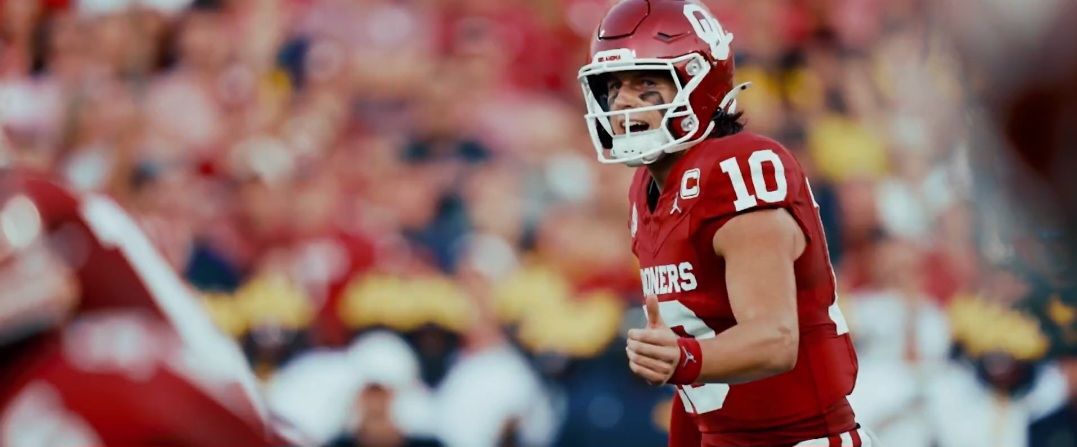
When John Mateer entered the 2025 season as one of the freshest quarterback stories in college football, expectations were lofty. The Washington State transfer came to Norman with the pedigree of a dynamic passer and runner, an offense already designed around his dual-threat ability under offensive coordinator Ben Arbuckle. Through four games, he lived up to that promise: 1,215 passing yards, six touchdowns, three picks, and 190 rushing yards with five more scores. He wasn’t just producing — he was propelling Oklahoma into contention and generating whispers of Heisman candidacy.
Then came the blow. In the first quarter against Auburn, Mateer injured his throwing hand (right thumb), a damage that would require surgery and force him to miss at least one game. Suddenly, what had been a quarterback-driven narrative became a test of system, depth, and identity.
The Injury: Biology, Timeline, and Ambiguity
The timeline is murky, and that ambiguity is intentional. Mateer had surgery during the bye week (Sept. 24) under a leading hand specialist. Coaches have been careful not to push expectations. As Brent Venables recently said, “He’s doing no good-on-good work” right now, referring to live QB drills. He’s walking the fine line: optimistic enough to leave room for a return, but unwilling to guarantee anything until he has medical confirmation. “I don’t know when John Mateer will be back,” Venables added. “He’s on a progression through however long it takes those injuries to heal.”
Despite that, external reporting suggests Mateer is “pushing” to return for the Red River game against Texas. Some sources believe medical feedback is positive and his recovery is within reason. But the key word remains: could. There is no final call yet.
This is a crucial moment. Rushing back too early risks re-injury, shortened shelf life, or subpar performance. But waiting too long or letting the offense adjust too far without him carries its own risks. The balance between short-term gain and long-term feasibility is delicate.
Michael Hawkins & the Offense in Transition
The spotlight shifts now to Michael Hawkins Jr., who stepped into the breach against Kent State and delivered when asked to. He threw for 162 yards and ran for 33 more — a tidy, mistake-free performance that preserved Oklahoma’s unblemished record. But Hawkins’ game was built more on control than fireworks. The passing numbers were modest, the rush game relied heavily on structure, and the offense wasn’t explosive. That’s not a knock — it’s a reality.
Here’s what Hawkins must prove if he’s going to keep the reins (temporarily or long-term):
- Continuity, not chaos: He must manage the game, continue to avoid turnovers, and sustain drives, rather than trying to force spark plays.
- Complementing the defense: Oklahoma’s real strength is its defense — Hawkins must play in a way that lets that unit breathe.
- Growth under pressure: The upcoming Red River Rivalry game will test his mettle. Performing well there changes narratives.
If Hawkins thrives, it not only softens the blow of Mateer’s absence — it forces the defense-first perception of Oklahoma to expand into quarterback depth.
What Oklahoma’s Program Is Being Asked to Prove
This stretch is more than a quarterback injury story. It’s a proving ground for the Oklahoma program itself. Is it resilient enough, flexible enough, deep enough to weather injuries to its marquee signal-caller and still compete at the top?
Several variables will factor in:
- Offensive identity vs. system strength. Can the offense function without Mateer, or is it too tightly built around his play style? If OU leans heavily on defense and run, it risks becoming one-dimensional.
- Confidence & continuity. If the team plays undeterred amid uncertainty, that builds culture. If it stumbles, people will question if it revolved too much around Mateer.
- Future recruiting and perception. If talent sees Oklahoma as a one-QB show, injuries like this create hesitation. If they see Hawkins or others step up, OU looks like a program, not a quarterback.
My Take: Oklahoma Needs Mateer — But They Won’t Collapse Without Him
Here’s where I stand: Oklahoma’s ceiling remains highest with John Mateer healthy. His dual-threat output, command, and production give the Sooners offensive flexibility few in the country possess. But this injury — painful as it is — might uncover a new truth: that Oklahoma isn’t tethered to one man.
If Hawkins handles the game management, if the run game can produce quietly, and if the defense stays dominant — well, the team can maintain its forward momentum. It won’t fully shine without Mateer, but it won’t collapse either.
The ideal scenario: Mateer returns in Dallas — strong, trusted, but not rushed. The kind of return that’s uphill, but not impossible. That’s the version that maximizes OU’s potential.
Because this season isn’t defined by one injury; it’s defined by how the program responds to it. If Oklahoma treats this as adversity rather than inflection, we may look back and call this the moment they matured. If not, this could be a sign of over-reliance.
In short: yes, Oklahoma needs Mateer. But they must also prove that they no longer depend on Mateer exclusively. That’s how powerhouse programs evolve. And if they can do that — even with him out — they’re far closer to being a team that transcends one season.
Matt Hofeld is a college football & softball analyst and contributor covering the SEC. Follow him for more Oklahoma and conference-wide analysis throughout the 2025 season.
Follow us on Instagram & Facebook