Every great team eventually meets its first punch in the mouth.
For the Oklahoma City Thunder, that moment came in Portland.
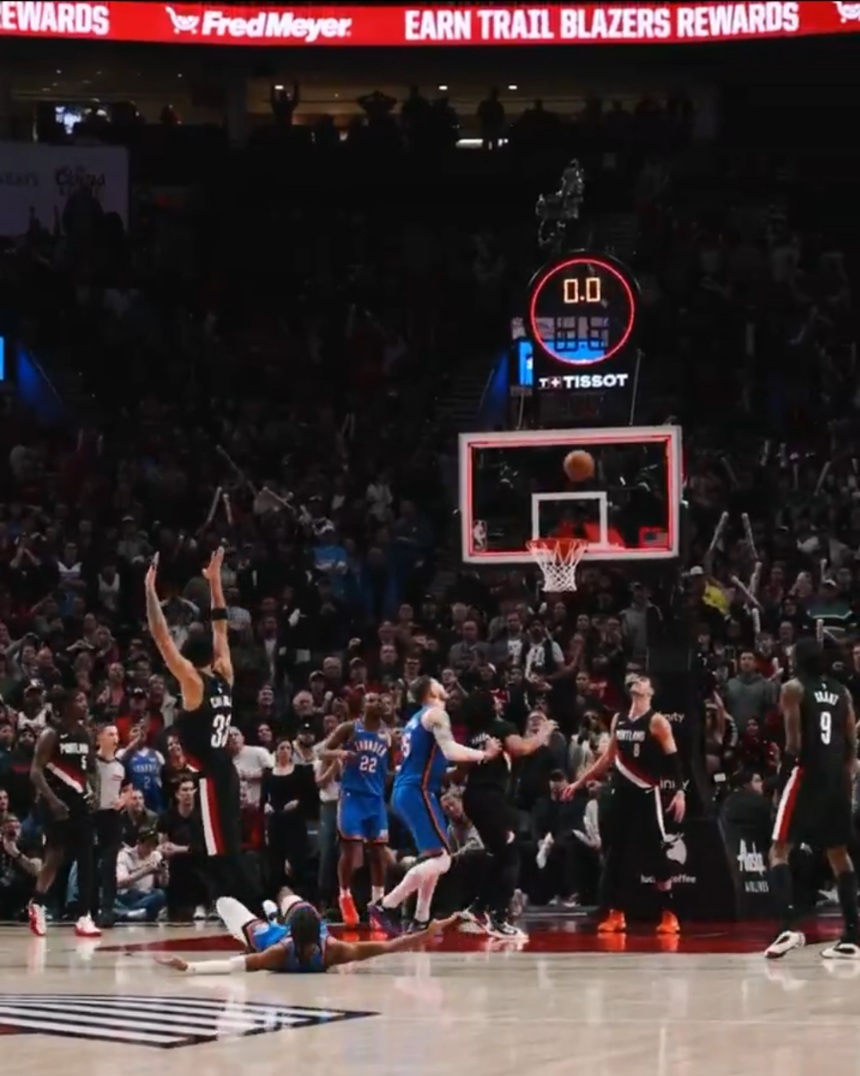
On Wednesday night, the defending NBA champions watched a 22-point first-quarter lead vanish in a stunning 121-119 loss to the Trail Blazers — a game that felt less like an upset and more like a reminder. A reminder that even the most polished teams can lose their edge when discipline wavers.
The Thunder weren’t outclassed. They were out-executed.
Oklahoma City opened the night looking like a team still drunk on momentum.
They exploded for 41 points in the first quarter, turned defense into transition offense, and looked every bit the well-oiled machine that began the season 8-0.
Then came the unraveling.
Over the next three quarters, the Thunder were outscored 100–78. Their early ball movement stalled, transition points dried up, and their signature defensive intensity turned reckless. Portland didn’t just chip away — they methodically dismantled Oklahoma City’s rhythm.
By the final minute, a game that once looked like a coronation became a scramble. Shai Gilgeous-Alexander poured in 35 points, and Aaron Wiggins erupted for 27 on seven made threes, but their heroics couldn’t undo the damage done by a team that lost its composure long before the buzzer.
After the game, Thunder coach Mark Daigneault didn’t sugarcoat it.
“We had some controllable stuff — fouls, turnovers, second-chance points — that really hurt us,” Daigneault said. “You can’t let a team back in with mistakes like that.”
It wasn’t Portland’s star power that undid OKC; it was Portland’s poise.
The Thunder have built their defensive identity on aggression. They swarm ball handlers, switch everything, and pressure passing lanes with surgical energy. But on Wednesday, that intensity crossed the line into chaos.
All five Thunder starters picked up at least three fouls, leading to 32 Portland free-throw attempts. The Blazers, who started 0-for-10 from the field, found rhythm at the line before finding rhythm anywhere else.
That’s the danger with a defense that thrives on disruption: when the whistle starts blowing, the whole system stalls.
Oklahoma City still forced 17 turnovers, but those gains were wiped out by fouls and mental lapses. A late backcourt violation, a missed rotation, an over-aggressive closeout — every small crack widened as the game wore on.
The loss wasn’t about ability. It was about control.
And as Daigneault often preaches, control is the Thunder’s true superpower.
With Lu Dort, Chet Holmgren, and Alex Caruso all sitting out, Ajay Mitchell earned his first start of the regular season — and gave Thunder fans another glimpse of why his rise has been one of the season’s early stories.
Mitchell scored 21 points on 7-of-11 shooting, flashing the same composure and craft that have defined his breakout start. But he also turned the ball over four times, including a costly bad pass late in the fourth that helped Portland stretch its lead to eight.
Afterward, Mitchell didn’t deflect. He owned it.
“Obviously, a lot to learn from today,” he said. “Me, as a guard, have to take care of the ball. That’s a big takeaway for me. In those games, it’s about detail — being better in every detail.”
That’s the kind of reflection that turns potential into staying power.
Mitchell, the 2024 second-round pick who’s averaging over 16 points per game through nine contests, has become more than a spark — he’s a symbol of Oklahoma City’s next wave. He’s learned the system, earned Daigneault’s trust, and proven he can thrive in real minutes against real competition.
But Wednesday showed what experience still teaches: details decide close games.
If there was a silver lining to the Thunder’s first loss, it was Aaron Wiggins.
Pressed into a starting role amid injuries, Wiggins delivered one of the best performances of his career — 27 points, three steals, and 7-of-10 from deep.
Wiggins has made a habit of thriving when opportunity calls. He doesn’t demand shots, but he makes every possession count. In a game where fatigue and foul trouble forced Daigneault to get creative with lineups, Wiggins was the constant.
His two-way play gave OKC a spark when most of the roster looked gassed. He’s not a household name, but nights like this remind the league why the Thunder’s depth is their greatest asset.
Still, no single player could mask the underlying issue: Oklahoma City’s margin for error isn’t as big as it looks.
For a franchise that’s prided itself on maturity beyond its years, Wednesday night was a regression — but a useful one.
The Thunder didn’t lose because they were missing Chet Holmgren or Lu Dort. They lost because the habits that usually separate them — focus, composure, discipline — cracked for just long enough to let a hungry team back in the door.
You could see it in the second quarter, when their 20-point cushion began to shrink.
You could feel it in the third, when defensive rotations broke down and fouls piled up.
And you could measure it in the final possessions, when an intentional missed free throw and a frantic tip attempt symbolized the night perfectly: a team that suddenly looked rushed, reactive, and human.
That’s not a flaw — that’s fuel.
Teams that go through seasons untouched by adversity tend to crumble when it finally arrives. Oklahoma City now has something to respond to — and that’s a good thing.
The Thunder’s first eight games were about dominance. This one was about discipline.
And in a season where expectations are higher than ever, this kind of loss may prove more valuable than another win.
They still have the league’s MVP candidate in Gilgeous-Alexander. They still have depth most teams envy. They still have the best young core in basketball.
What they didn’t have Wednesday night was their standard — the one that says no lead is safe until the buzzer, no possession is wasted, and no detail is too small.
Daigneault summed it up perfectly last year when describing his team’s identity:
“We don’t want to be results-driven — we want to be standard-driven.”
That’s what Wednesday reminded them of. The results slipped. The standard can’t.
If history is any guide, Oklahoma City won’t let it.
Because this team doesn’t just play to win games — it plays to grow through them.
And every champion needs a wake-up call.
The Thunder just got theirs.
Follow us on Instagram & Facebook
One Reply to “The Thunder’s First Loss Wasn’t About Talent — It Was About Discipline”