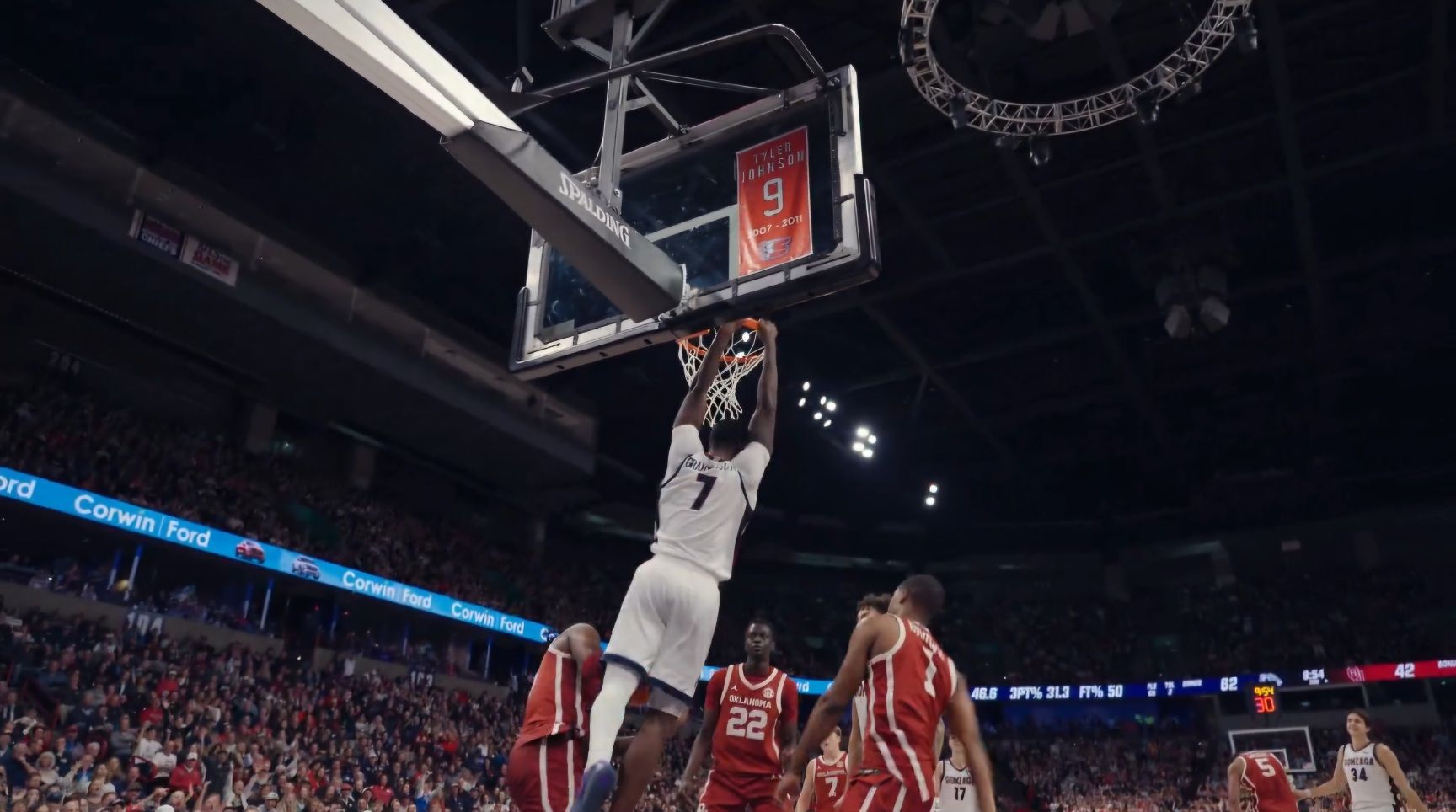
Porter Moser didn’t need a stat sheet to know what went wrong in Spokane. The numbers told the story well enough — 58 points allowed in the paint, 46-39 rebounding disadvantage, zero second-chance points in the first half.
No. 21 Gonzaga bullied Oklahoma 83–68 on Saturday night in the Bad Boy Mowers Series, and the Sooners’ first road test of the season revealed exactly where they stand in this early chapter of a rebuild.
It’s not that Oklahoma lacked effort. Nijel Pack poured in 20 points on 7-of-15 shooting, Xzayvier Brown added 19, and sophomore Derrion Reid showed flashes of offensive versatility. But against a Gonzaga team featuring two veteran bigs in Graham Ike and Braden Huff — both with skill, strength, and patience — OU’s lack of interior presence was glaring.
The Bulldogs didn’t outshoot the Sooners so much as they outmuscled them.
After a 102–66 blowout win over Saint Francis in the opener, Oklahoma looked like a new, deeper, more athletic version of last year’s team — one that could score from anywhere and defend with energy. Saturday was a reminder that progress is rarely linear.
In front of a sellout Spokane crowd, Gonzaga (2-0) set the tone early. Ike and Huff sandwiched layups and dunks around Oklahoma’s missed threes, fueling a 12–3 run that broke open the game less than five minutes in.
By halftime, the Zags had shot 54% from the field, grabbed 10 offensive rebounds, and scored 11 second-chance points. Oklahoma? Zero.
When Gonzaga wasn’t finishing at the rim, it was controlling tempo and grinding down possessions until OU broke down defensively. The result: a 49–30 halftime deficit that felt larger than the scoreboard.
“We guarded the dribbler better [in the second half],” Moser said postgame. “We just settled down and did so many more things aggressively.”
The improvement was real — Oklahoma outscored Gonzaga 38–34 after halftime — but the damage had been done.
The Sooners’ glaring weakness was no mystery: the paint.
Gonzaga outscored Oklahoma 38–4 in the lane in the first half alone, and finished the night with a 58–20 advantage down low.
That’s not a typo. That’s a domination.
Mohamed Wague, the senior big expected to anchor OU’s frontcourt, spent most of the night on the bench with foul trouble. He logged just five minutes in the first half, picking up three quick fouls before halftime. Freshman Kai Rogers, still nursing an injury that limited him last week, looked overmatched physically in his six minutes of play.
With both unavailable to neutralize Ike and Huff, Moser went small, using lineups built around speed and switching. It worked briefly in transition but only deepened Oklahoma’s interior problem in the half court.
Every Gonzaga possession looked like a clinic in positioning and patience — post seals, slip cuts, second-chance rebounds. Ike finished with 19 points and 11 rebounds. Huff added 13 and six. Jalen Warley, playing guard, somehow grabbed five offensive rebounds.
That’s effort. But it’s also evidence of a mismatch.
The Sooners’ backcourt wasn’t the problem — and that’s the encouraging part.
Pack and Brown were composed, attacking Gonzaga’s defense in waves, combining for 39 points on 50% shooting. They each hit contested midrange jumpers and tried to draw contact at the rim when the threes stopped falling.
But Gonzaga’s length on the perimeter eventually stifled them. The Zags’ 6-foot-7 wings, like Emmanuel Innocenti and Tyon Grant-Foster, switched onto Pack and Brown, denying clean looks and forcing Oklahoma to rely on isolation possessions late in the shot clock.
The Sooners’ ball movement — crisp in the opener — slowed to a crawl.
Oklahoma had 10 first-half turnovers, most of them the product of over-dribbling or forced passes into collapsing defenders. The Zags turned those miscues into transition buckets, finishing with 14 points off turnovers and eight steals.
Mark Few’s defense, long overshadowed by his team’s offensive reputation, looked elite.
“It’s not a shock to see Gonzaga dominate on the glass,” Few told reporters. “But doing it against an SEC team, that’s a good sign for us.”
It was also a warning shot for Oklahoma — and a challenge.
After a dazzling 18-point debut against Saint Francis, redshirt freshman Kuol Atak struggled to find rhythm in Spokane.
He went 0-for-3 from the field in the first half and never seemed comfortable against Gonzaga’s size. The 6-foot-9 forward’s perimeter face-up game was neutralized by the Bulldogs’ switching defense, and the lanes that existed in Norman a week earlier weren’t open this time.
That’s not a reason for concern — it’s an expected growing pain.
Atak’s athleticism and versatility are undeniable, but games like these show why experience still matters. He’ll have easier nights, but this was a glimpse of what life in the SEC will be like: physical, punishing, and unforgiving when finesse replaces force.
Porter Moser’s challenge this season isn’t talent — it’s chemistry. The Sooners have enough scoring. They have depth at guard. They have effort.
What they don’t yet have is an identity.
Gonzaga exposed that.
The Bulldogs knew exactly who they were: a veteran, inside-out team that punishes mistakes and owns the glass. The Sooners, meanwhile, are still experimenting — small-ball one possession, double-big the next, trying to find which combinations can hold up physically while maintaining spacing and tempo.
In fairness, that’s normal for November.
But the lesson is clear: Oklahoma can’t live on jump shots alone.
The Sooners attempted 14 threes in the first half, making only three. When the perimeter dried up, there was no counter. Without Wague or Rogers anchoring the post, Oklahoma’s offense flattened into one-on-one basketball.
For a Moser team, that’s uncharacteristic.
Expect adjustments quickly — because the Sooners’ next game, against Arkansas-Pine Bluff, offers a chance to reset and reestablish the balance between pace and presence.
For all the frustration, Oklahoma’s second-half resilience mattered. The Sooners didn’t fold. They outscored Gonzaga 38–34 after halftime, moved the ball better, and defended with more pride.
Pack’s 20 points and Brown’s confidence as a secondary scorer were legitimate bright spots. Reid, too, showed toughness attacking the rim late when Gonzaga’s defense relaxed.
Those are building blocks — not consolation prizes.
And perhaps the most encouraging takeaway: even in defeat, Oklahoma’s guards looked like they belonged. Against one of the nation’s most experienced teams, they never backed down.
Lopsided as it looked early, this was the kind of loss that can shape a season.
Gonzaga didn’t just beat Oklahoma — it exposed the blueprint for how the Sooners must grow. You can’t play small for 40 minutes in the SEC. You can’t rely on guards to carry the scoring load when the paint is closed. And you can’t let physicality dictate confidence.
Saturday night wasn’t about failure. It was about framing reality.
Oklahoma’s backcourt is legitimate. Its wings are athletic. Its ceiling is high. But the Sooners’ success will depend on whether their frontcourt — Wague, Rogers, and yes, Atak — can mature fast enough to handle the power and precision of elite competition.
That’s the next step.
For now, the scoreboard may show a 15-point loss. But for a program reinventing itself inside the SEC, it was also a map of what must change — and what can be built.
Follow us on Instagram & Facebook