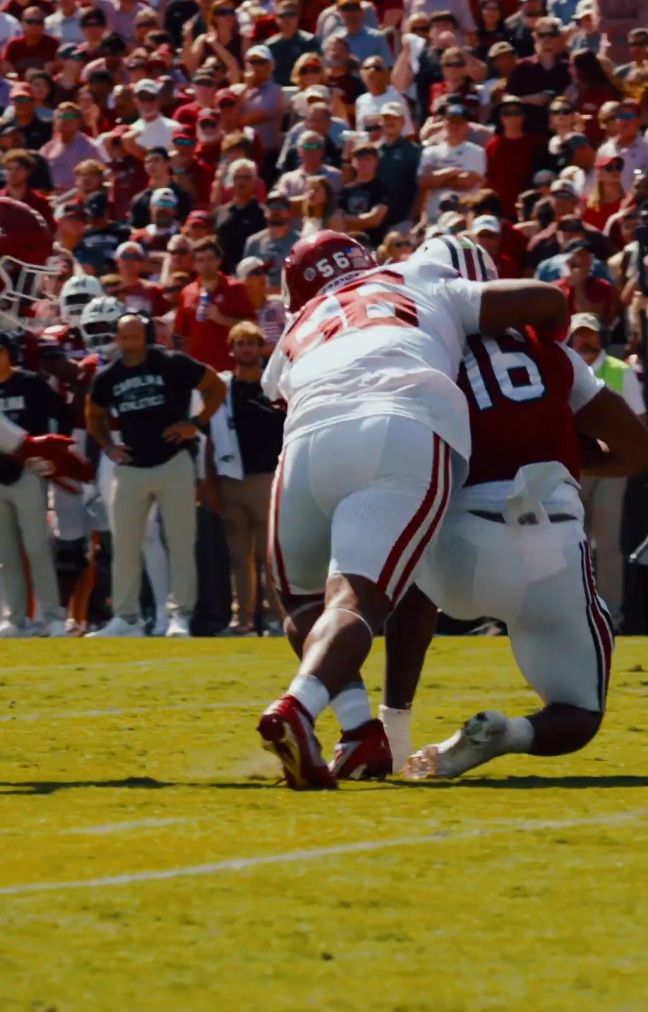
When Oklahoma takes the field inside Bryant-Denny Stadium on Saturday afternoon, the crowd noise, the crimson haze, and the echo of “Rammer Jammer” will all be part of the environment. But for the Sooners, this game is less about the setting and more about the start — how they dictate tone, tempo, and toughness from the very first snap.
If Oklahoma wants to keep its playoff hopes alive, setting the tone early against Alabama isn’t optional — it’s essential.
The Sooners (7-2, 3-2 SEC) enter Week 12 rested after their second bye week of the season, while No. 4 Alabama (8-1, 6-0) is coming off a businesslike 20-9 win over LSU. According to BetMGM, the Crimson Tide are a touchdown favorite, a sign that oddsmakers still lean toward the Tide reclaiming its revenge after last year’s stunning 24-3 upset in Norman.
That victory — arguably Brent Venables’ signature win to date — was built on physicality and control. Oklahoma didn’t just outplay Alabama; they out-toughed them. They ran the ball for 257 yards, limited Bama’s offense to three points, and turned the second half into a clinic in complementary football.
If the Sooners want history to repeat itself, they must rediscover that same identity — one that starts with tone-setting drives, physical defense, and disciplined execution.
Make no mistake: this is a fork-in-the-road game for Oklahoma.
Win, and the playoff path remains wide open. Lose, and the Sooners will need chaos to have any chance of climbing back into the playoff conversation. But more than postseason positioning, this game is about proving that Oklahoma has matured as an SEC program — capable of sustaining intensity week after week and asserting itself in the league’s most hostile environments.
Venables knows it. His players know it. And perhaps no one understands it better than offensive coordinator Ben Arbuckle, who emphasized this week how much the Sooners’ growth has been tied to their ability to set the tone early and stay steady late.
“I thought [John Mateer] did really good things in the Tennessee game and during the bye week,” Arbuckle said. “I think the South Carolina game helped because that’s not an easy place to play. That prepared John for another test. He was clean and played efficient football.”
Efficiency — that’s the buzzword for Oklahoma’s offense heading into Tuscaloosa.
Mateer has been quietly stabilizing the Sooners since returning from injury. While he hasn’t produced gaudy box scores, his decision-making and leadership have grown in rhythm with the offense’s late-season surge. Against Tennessee, his poise under pressure and mobility on key downs extended drives and silenced a raucous Neyland Stadium crowd. Those are the tone-setting moments Oklahoma must recreate this Saturday.
“John attacked his footwork, his communication, his consistency [during the off week],” Arbuckle added. “He’s a process-driven kid. Great leader throughout the bye week. Excited to see him play more football.”
If Mateer is the composure Oklahoma needs, then Xavier Robinson is the attitude they must unleash.
Robinson’s rise from rotational back to tone-setter has mirrored Oklahoma’s evolution on the ground. Over the first six games, the Sooners averaged just 122.3 rushing yards per game. In their last three, that number has jumped to 166.3 — a product of confidence, cohesion, and a maturing offensive line.
“The efficiency of when we are running the ball has just been getting better and better,” Venables said this week. “By design and by a lot of hard work with the guys.”
Robinson has been the difference-maker in that turnaround, posting 282 yards and four touchdowns over his last three games. His blend of power and patience gives Oklahoma the kind of between-the-tackles stability that can neutralize Alabama’s defensive front. It’s no coincidence that his breakout came in last year’s meeting against the Tide, when he gashed them for 107 yards and two scores — setting the tone for one of OU’s most complete performances in the Venables era.
“Second half you figure out coverages, the blitzes, the blitz patterns, and the spaces,” Venables explained. “The coaches do. The players do. You start to get into a nice rhythm. But it all starts with having success, getting on schedule, early-down efficiency.”
That rhythm will be tested by Alabama’s front seven. Linebackers Justin Jefferson and Yhonzae Pierre have combined for eight sacks and over 70 tackles, and defensive lineman LT Overton’s disruption has been a key factor in Alabama’s recent surge. If Oklahoma’s young offensive line — anchored by freshmen Michael Fasusi, Ryan Fodje, and redshirt freshman Eddy Pierre-Louis — can withstand early pressure and establish the run, they can quiet the Tuscaloosa crowd and control the game’s tempo.
Pierre-Louis, who has emerged as a tone-setter up front, credits the group’s improvement to focus and fundamentals.
“We’ve been working on the small details about hands, eyes and feet,” he said. “That has been the main thing about playing offensive line… just communicating and having an idea of which way the ball is going, how to leverage blocks.”
That kind of detail-driven mentality will be vital against Alabama’s complexity on defense. Setting the tone in this matchup means dictating how the Tide react, not the other way around.
Of course, setting the tone isn’t only about offense.
Venables’ calling card remains defense, and Oklahoma’s resurgence on that side of the ball will be central to Saturday’s outcome. Last year, the Sooners smothered Jalen Milroe and Alabama’s passing attack, holding the Tide without a touchdown. That’s unlikely to happen again, given Ty Simpson’s growth into a Heisman-caliber quarterback — 21 touchdowns to just one interception — but the blueprint remains the same: pressure, contain, and tackle.
OU’s defensive front, led by David Stone and Jayden Jackson, must collapse the pocket without sacrificing gap integrity. Alabama’s offense thrives on explosive plays, particularly when Simpson has time to find his deep threats Germie Bernard and Ryan Williams. If Oklahoma can limit those windows, they can dictate the tone of the game by forcing Alabama into longer, grind-it-out drives.
That’s where Venables’ defense has found its identity in recent weeks — bending, not breaking, and making timely stops in hostile environments like Columbia and Knoxville.
And against Alabama, it’ll come down to the same principle Venables has preached since his return to Norman: controlled aggression.
For Oklahoma, “setting the tone” in Tuscaloosa isn’t about one big play. It’s about the accumulation of small, disciplined moments that add up over four quarters — winning first downs, tackling cleanly, communicating on the line, and playing with purpose on every snap.
This is the kind of game that reveals whether the Sooners’ SEC transition is more than symbolic. They’ve proven they can hang. Now, they must prove they can dictate.
The 2024 win over Alabama was a statement. Saturday is a test of sustainability. Can Oklahoma build a reputation not just as an underdog capable of stunning giants, but as a program that expects to set the tone in games like this — on the road, against the best, with everything on the line?
Venables believes so. The players believe so. And if the Sooners can start fast, stay physical, and match Alabama’s intensity, the rest of the college football world might have no choice but to believe it, too.
Because in Tuscaloosa, tone is everything — and Oklahoma’s playoff hopes depend on how they set it.
Follow us on Instagram & Facebook