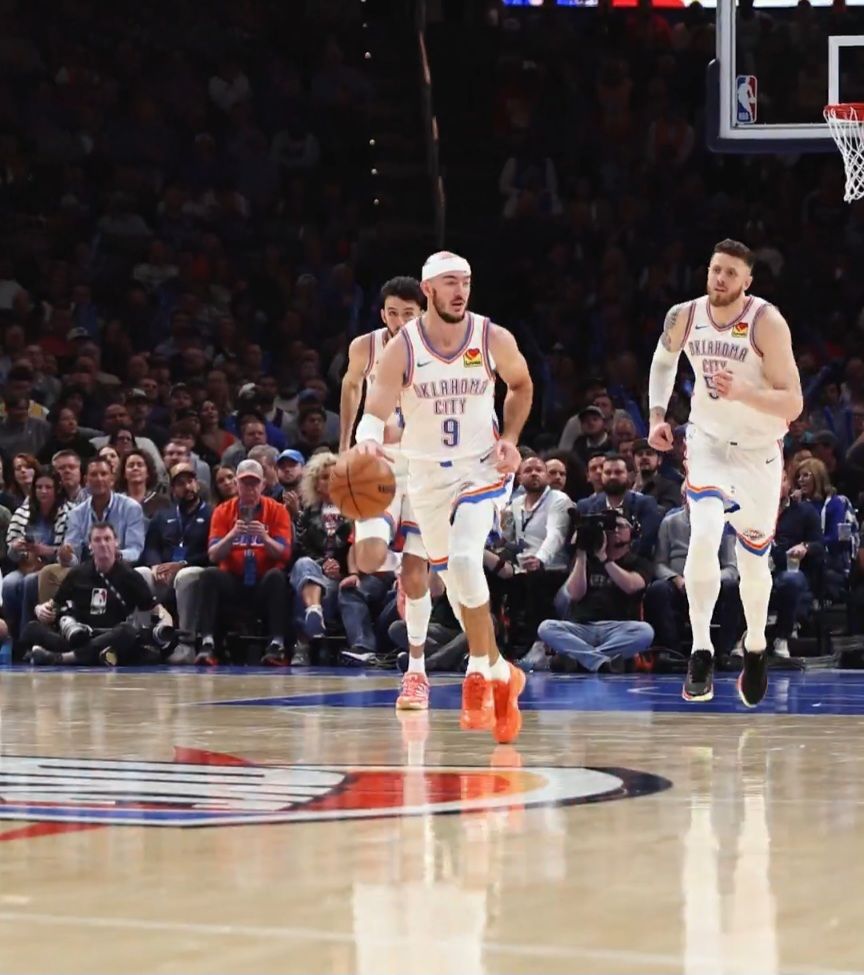
Some teams play hard. Some teams play smart. Then there’s the Oklahoma City Thunder — a team that does both so efficiently, it’s becoming unfair. Wednesday night was another example of why the rest of the Western Conference should be watching closely. The Thunder didn’t just beat the Los Angeles Lakers; they dismantled them.
The 121–92 final wasn’t just a reflection of superior talent. It was proof that Oklahoma City has something even rarer: a system that works no matter who’s on the floor.
Shai Gilgeous-Alexander was once again the engine, dropping 30 points and nine assists in just three quarters — a casual MVP-level performance for a player who’s making dominance look routine. “We got our ass kicked,” Lakers guard Marcus Smart admitted bluntly afterward. “And we got to bounce back.”
Smart’s honesty told the story. Because for the second straight night, Oklahoma City didn’t simply outscore their opponent — they outclassed them.
What made this win remarkable wasn’t just that OKC blew out a Western Conference rival. It’s that they did it without Lu Dort, Jalen Williams, and Aaron Wiggins — three key rotation pieces — and didn’t miss a beat.
Isaiah Joe poured in 21 points off the bench. Cason Wallace played mature, controlled minutes. And players like Ajay Mitchell gave head coach Mark Daigneault meaningful contributions that kept the defensive pressure constant.
That’s the theme of this Thunder team: next man up, same intensity.
Even without their defensive anchor in Dort, OKC’s rotations were airtight. Luka Doncic — who came into the game averaging 37.1 points — was held to just 19 on 7-for-20 shooting. It’s the kind of team-wide defensive effort that speaks to preparation, communication, and buy-in from every player on the roster.
Daigneault has turned a young roster into a unit that looks like it’s been together for years. Everyone knows their role. Everyone plays within it. And that’s exactly why Oklahoma City continues to thrive no matter who’s available.
The first half told the entire story.
The Thunder led 30–18 after one quarter, then opened the second with an eight-minute defensive stranglehold that left the Lakers without a single field goal during that span. By the time Los Angeles finally scored again, OKC had turned a manageable deficit into a blowout. The halftime score — 70–38 — looked more like a summer league mismatch than a battle between supposed conference contenders.
How did they do it? Two simple things: defensive pressure and offensive discipline.
By halftime, Oklahoma City had 18 points off turnovers compared to zero for the Lakers. The Thunder forced 11 turnovers before the break and finished the game with 20 overall. That’s not by accident — it’s a reflection of how Daigneault’s team weaponizes defense into offense.
They don’t just contest shots. They close passing lanes. They read the floor like a veteran playoff squad. And when they get out in transition, they’re devastating.
Those quick-hit scoring bursts — often led by Shai’s vision and Joe’s shooting — demoralize opponents faster than any run of isolation plays ever could.
If one play summed up the Thunder’s swagger, it came at the end of the third quarter. With the clock ticking down, Shai drove toward the lane, drew multiple defenders, then flicked a behind-the-back pass to Isaiah Joe in the corner. Joe drilled a three as the buzzer sounded.
That sequence wasn’t just flash — it was rhythm. Trust. Chemistry.
The bench erupted. The crowd exploded. And the Lakers, trailing 100–64, could only stare in disbelief.
Moments like that aren’t built overnight. They’re forged in film sessions, practice reps, and belief in a system where everyone contributes. It’s why the Thunder can look so composed on nights when other teams would fade.
It’s fair to note that the Lakers were without LeBron James, who practiced earlier in the day with their G League affiliate but didn’t suit up. Yet even his presence wouldn’t have changed the tone of the game.
Los Angeles looked disjointed from the opening tip. Austin Reaves, averaging 30.3 points per game entering the matchup, finished with just 13 on 4-for-12 shooting. The Lakers’ vaunted offense — which had scored at least 116 in every game this season — never found daylight against OKC’s pressure, shooting just 40.3% from the field.
Head coach JJ Redick didn’t sugarcoat the performance. “I don’t think it’s been a great road trip for us, just in terms of how we played,” he said. “Atlanta and tonight, I don’t think are reflective of who the group is going to be, but it clearly is who the group is right now.”
Translation: the Lakers were exposed.
And that’s not an overstatement. The Thunder didn’t just beat them because they were undermanned — they beat them because they were better prepared.
If there’s a “problem” in Oklahoma City right now, it’s this: there may not be enough minutes to go around when everyone’s healthy.
Ajay Mitchell, Cason Wallace, and Joe have stepped up brilliantly in extended roles. But when Dort, Jalen Williams, and Wiggins return, Daigneault will have to juggle rotations to keep rhythm players engaged.
It’s the kind of challenge every contender dreams of — too much production, not enough minutes.
Still, it speaks to the franchise’s long-term success. Sam Presti has quietly built one of the deepest, most balanced rosters in basketball. They have youth, they have chemistry, and they have a reigning MVP leading the charge.
Oklahoma City didn’t just win their 12th game of the season; they made a statement.
They played a back-to-back, lost multiple starters, and still crushed one of the league’s marquee franchises by nearly 30 points. That’s not “hot start” energy — that’s contender energy.
It’s the kind of disciplined, ruthless play that defines great teams in March and April, not November.
Shai continues to operate at a level few guards in the world can match. Chet Holmgren’s defensive presence keeps opponents from ever feeling comfortable. And Daigneault’s adaptability — both tactically and culturally — has given this team something rare: a collective confidence that no deficit, no lineup change, and no opponent can shake.
There was a time when Oklahoma City was the young, fun team that played above its age. That time is gone.
Now, they’re simply better than the rest of the league — and they’re proving it night after night.
Wednesday’s win over the Lakers wasn’t just about one star’s brilliance or a struggling opponent. It was about a team that’s learned how to dominate by committee. The Thunder defend, they share the ball, and they finish.
And as they keep piling up statement wins, one thing becomes clearer: this isn’t just a rebuild anymore. It’s a reckoning.
Follow us on Instagram & Facebook