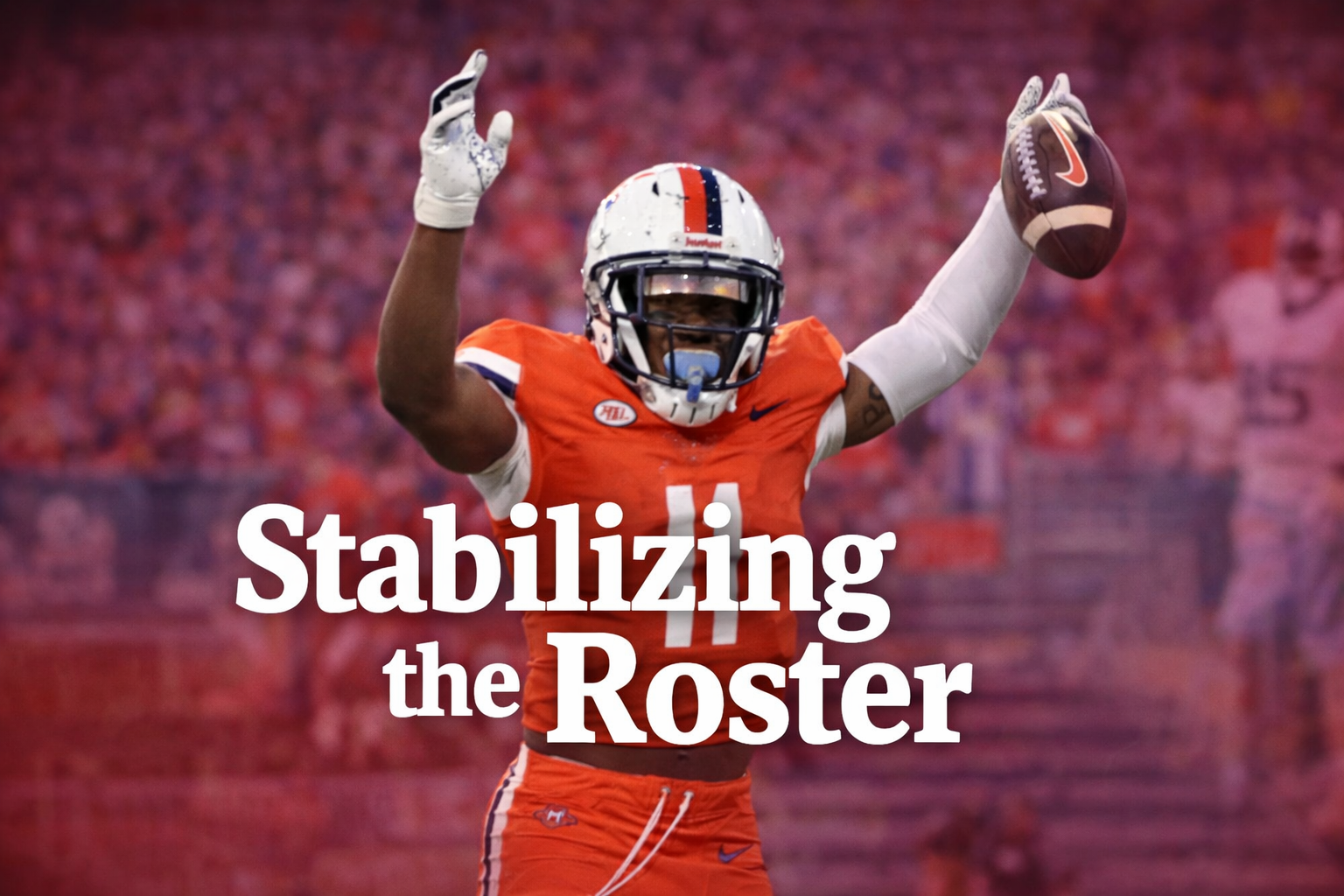
The transfer portal has become college football’s most volatile marketplace, and on Monday, Oklahoma made it clear it has no intention of being a passive participant. In a single day, the Sooners added five new players via the portal, pushing their total to six commitments since the window opened and marking one of the most aggressive single-day portal pushes of the Brent Venables era.
For a program transitioning deeper into the demands of the SEC while navigating significant roster turnover, the message was unmistakable: Oklahoma identified its weaknesses, moved decisively, and targeted experience over projection. This was not about upside alone. This was about stabilizing a roster that lost contributors, shoring up depth in the trenches, and adding proven production at skill positions.
The six-player class—headlined by an SEC-tested offensive lineman, a proven ACC wide receiver, and multiple versatile offensive weapons—represents a calculated response to attrition rather than a splashy rebuild. And while the portal window remains open, January 5 may ultimately be remembered as the day Oklahoma established its foundation for the 2026 season.
Building the Line First: Experience Over Experimentation
No position group demanded immediate attention more than the offensive line. Oklahoma lost six reserve offensive linemen to the portal, a level of attrition that can cripple depth charts if left unaddressed. The Sooners responded by adding two linemen with starting experience: E’Marion Harris from Arkansas and Caleb Nitta from Western Kentucky.
Harris is the most proven of the two. Over the past two seasons at Arkansas, he started 24 games, including 11 starts at right tackle during the 2025 season. He also logged starts at left guard in 2024, giving Oklahoma rare positional flexibility along the front. SEC experience matters, especially in a league where edge rushers are relentless and depth is tested weekly. Harris projects as an immediate contender for the starting right tackle job and raises the floor of the entire unit in pass protection.
Nitta, meanwhile, fills a different but equally critical role. A former Virginia Tech lineman, he transferred to Western Kentucky and emerged as a steady presence at center in 2025. Over 650 snaps, Nitta allowed just two sacks while starting nine games. With two years of eligibility remaining, he provides Oklahoma with reliable depth at center and guard—positions where continuity and communication are often more important than star power.
Together, Harris and Nitta represent a philosophical shift in Oklahoma’s portal approach up front: fewer developmental bets, more proven reps.
Rebuilding the Tight End Room from the Ground Up
Perhaps no position group has been more thoroughly overhauled than tight end. Oklahoma lost its top four tight ends from the 2025 season, creating both a void and an opportunity. The Sooners answered by adding two very different—but complementary—players: Hayden Hansen from Florida and Rocky Beers from Colorado State.
Hansen committed on January 4, becoming the first transfer addition for the Sooner, and his presence looms large over this class. At 6-foot-8 and 269 pounds, Hansen brings prototype SEC size and extensive experience, having started 34 games over his Florida career. Known primarily as a blocker—over 70 percent of his snaps at Florida came in blocking situations—he also brings reliable hands and a massive catch radius. Hansen did not allow a sack in pass protection during the 2024 season, a stat that immediately earns trust from any offensive staff.
Beers, on the other hand, arrives as a proven receiving threat. In 2025, he caught 31 passes for 388 yards and seven touchdowns, setting a Colorado State program record for tight ends. At 6-foot-5, 250 pounds, Beers offers athleticism and red-zone reliability, giving Oklahoma a different look within the same position group.
Together, Hansen and Beers give the Sooners flexibility they lacked in recent seasons: the ability to stay multiple without sacrificing either blocking integrity or passing-game effectiveness.
Skill Positions Reloaded: Proven Production Joins the Fold
Oklahoma’s portal success on Monday extended beyond the trenches. The addition of Trell Harris, Lloyd Avant, and Dakoda Fields addressed immediate needs at wide receiver, running back, and defensive back.
Trell Harris arrives from Virginia after a breakout 2025 season in which he earned Third Team All-ACC honors. He caught 59 passes for 847 yards and five touchdowns, emerging as a legitimate vertical threat. With Deion Burks departing for the NFL Draft, Oklahoma needed a receiver capable of stretching defenses and winning contested catches. Harris fits that role cleanly and is expected to compete for a starting job immediately. His college journey—beginning at Kent State before flourishing at Virginia—suggests a player who has steadily grown with opportunity.
Avant brings versatility to the running back room. At Colorado State, he functioned as an all-purpose weapon in 2025, rushing for 417 yards and five touchdowns while adding 24 receptions for 261 yards and another score. He also returned 11 kickoffs, underscoring his value on special teams. With Jovantae Barnes and Taylor Tatum both transferring out, Oklahoma needed depth and flexibility behind its top backs. Avant provides both and gives the offense another chess piece.
The lone defensive addition of the day, Dakoda Fields from Oregon, marked Oklahoma’s first defensive portal commitment of this window. Fields arrives with three years of eligibility remaining and is viewed as a strong schematic fit for the defensive staff. He is expected to step immediately into the cornerback rotation, a critical need in a league that stresses coverage as much as the SEC.
A Clear Trend Emerges
The first six portal commitments all skew heavily toward experience and immediate usability. Five of the six are offensive players, reflecting Oklahoma’s prioritization of stabilizing the offense first. The addition of Fields suggests defensive reinforcements are coming, but the early emphasis has been clear: protect the quarterback, establish physicality, and surround the offense with reliable veterans.
This is not a portal class built on hype. It is built on starts, snaps, and production.
Oklahoma did not “win” headline recruiting battles for these players in a public sense. In fact, several commitments—most notably Hayden Hansen—came quickly, without prolonged speculation or reported finalists. The Sooners sold opportunity, proximity, and clarity of role, and that message resonated.
What Comes Next
As of publishing time on January 5, Oklahoma has six transfer commitments and a roster that looks far more balanced than it did at the start of the window. Depth concerns along the offensive line have been addressed. The tight end room has been rebuilt. Skill positions have been reinforced with proven production.
There is still work to be done, particularly on the defensive side of the ball, but this surge signals a staff operating with urgency and precision. Oklahoma did not wait for the market to come to them. They identified the players they needed and moved decisively.
In the modern era of college football, that may be the most important skill of all.
Follow us on Instagram & Facebook