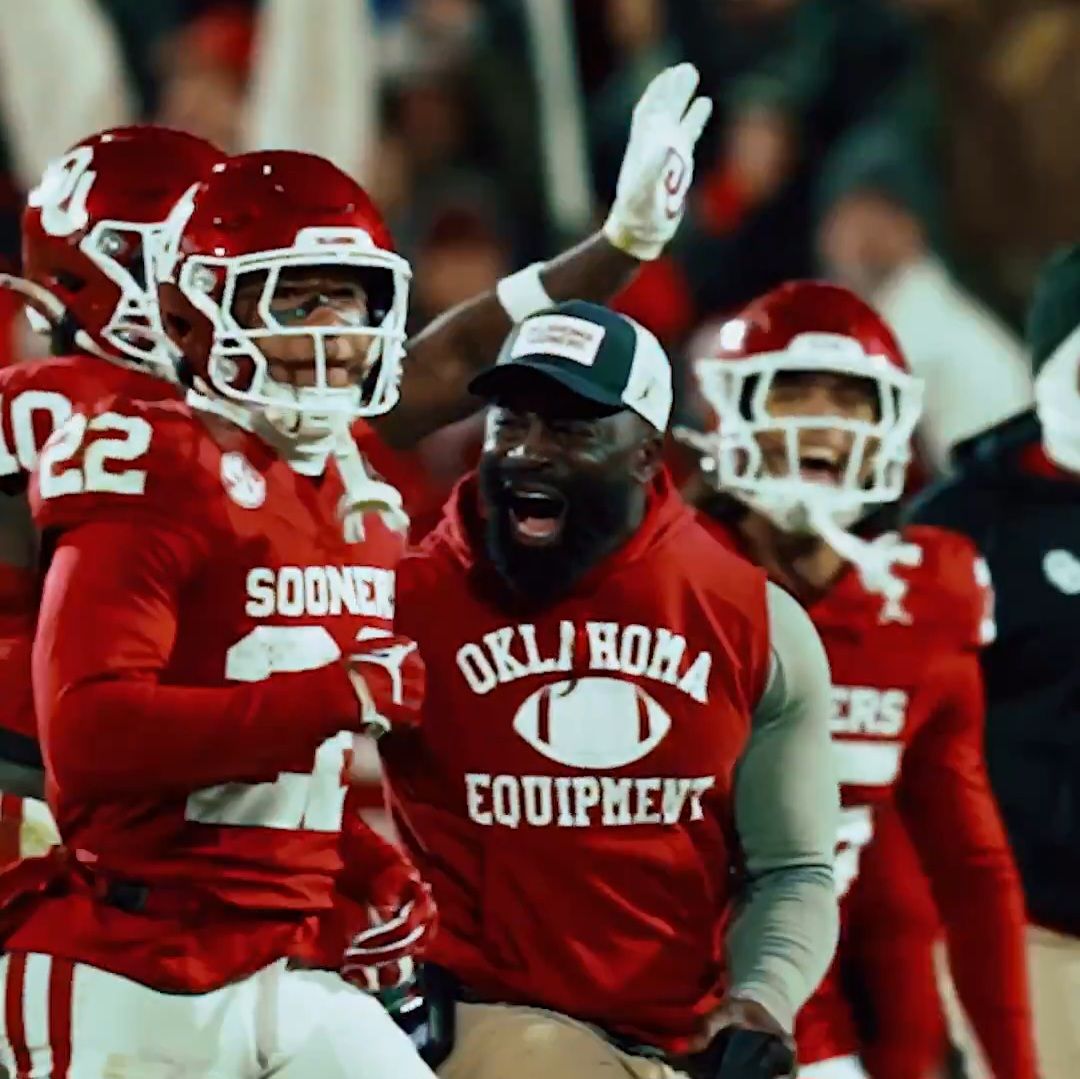
Oklahoma is not just recruiting well for the 2027 cycle — the Sooners are recruiting with intent, direction, and a level of early-cycle control that few programs nationally can match. As of mid-January 2026, Oklahoma sits atop the national recruiting rankings for the 2027 class with 13 verbal commitments, a No. 1 ranking built on elite in-state talent, national reach, and a defensive identity that continues to define the Brent Venables era.
It is still early. Everyone involved in recruiting understands that rankings this far out are fluid, volatile, and subject to heavy attrition. But dismissing what Oklahoma has done so far would miss the larger story. This is not a class thrown together by accident or inflated by volume alone. This is a class assembled with purpose — and it reflects where Oklahoma football believes it is headed as it cements itself in the SEC.
A Defensive Identity Comes Into Focus
The most telling aspect of Oklahoma’s 2027 class is how clearly it mirrors Venables’ long-term vision. Defense is not an accessory to this recruiting cycle; it is a pillar. The Sooners’ most recent surge to No. 1 nationally was fueled by defensive commitments made on a national stage during the Navy All-American Bowl on January 10.
Taven Epps was the headline grabber. A consensus four-star linebacker/EDGE hybrid from Tustin, California, Epps is widely regarded as a top-10 linebacker nationally and ranked just outside the top 100 overall. His commitment was significant not just because of his ranking, but because of where he came from. Epps was previously committed to Texas before flipping to Oklahoma, a move that reverberated through the recruiting landscape.
Epps fits Venables’ defensive mold almost perfectly. He plays with explosive first-step quickness, has the length to set the edge, and the range to operate in space. At the high school level, he is used as a chess piece — rushing the passer, scraping over the top against the run, and dropping into coverage when asked. Oklahoma sees him as a modern second-level defender who can blur the lines between linebacker and edge rusher, a role that has become increasingly valuable in SEC defenses.
Paired with Epps was Deven Robertson, a three-star defensive tackle from Hattiesburg, Mississippi. While Robertson does not carry the same recruiting buzz, his value to the class is substantial. He is a space-eater by trade, a player who thrives in the trenches by clogging running lanes and freeing up linebackers to make plays. Oklahoma has made a point to recruit defensive linemen with different skill sets, and Robertson fits the “dirty work” profile that every elite defense needs.
Together, those two commitments widened the gap between Oklahoma and other early recruiting leaders like Penn State and Miami, pushing the Sooners into sole possession of the No. 1 spot.
In-State Dominance Still Matters
As national as Oklahoma’s recruiting footprint has become, the backbone of the 2027 class remains firmly rooted in the state of Oklahoma. That starts with Cooper Hackett, the crown jewel of the class and one of the most important in-state commitments the program has landed in years.
Hackett, a five-star offensive tackle from Fort Gibson, Oklahoma, is ranked No. 13 nationally in the composite and is widely viewed as one of the top offensive linemen in the country. At 6-foot-7 and around 260 pounds, Hackett combines elite length with rare athleticism, aided by his background as a basketball player. His footwork, balance, and ability to mirror pass rushers are already advanced for his age.
Hackett’s recruitment was a major win for Oklahoma not only because of his ranking, but because he flipped from Texas Tech in September 2025, choosing to stay home despite significant NIL interest elsewhere. For a program that has made the transition fully into SEC life, keeping elite in-state linemen home is critical. Hackett’s commitment sent an immediate signal that Oklahoma could still lock down its borders while recruiting nationally.
He is joined by Kaeden Penny, another highly regarded offensive tackle from Bixby, Oklahoma, ranked No. 30 overall nationally. Penny gives Oklahoma two potential bookends in the same class, an almost unheard-of luxury. Together, Hackett and Penny form the foundation of the class and ensure that the offensive line will remain a strength several years down the road.
National Reach, West Coast Pipeline
Beyond Oklahoma’s borders, the 2027 class reflects a program comfortable recruiting coast to coast. California, in particular, has emerged as a productive pipeline. Wide receiver Demare Dezeurn (No. 102 nationally) from Palisades, California, brings speed and polish to the offensive skill group, while defensive lineman Elija Harmon (No. 152) from Inglewood gives the Sooners another versatile front-seven piece.
EDGE rusher Krew Jones from Millville, Utah (No. 135 nationally) adds to a growing stable of edge defenders, and cornerback Mikhail McCreary from San Antonio, Texas (No. 220) continues Oklahoma’s emphasis on length and physicality in the secondary.
The class breakdown currently includes two five-star recruits, five four-stars, and six three-stars — a healthy distribution that suggests Oklahoma is balancing elite talent with developmental prospects rather than chasing stars alone.
Momentum Breeds Momentum
One of the biggest drivers behind Oklahoma’s early success is momentum, both on and off the field. The Sooners’ strong 2025 season, highlighted by a 4–0 start and a College Football Playoff appearance, has translated directly into recruiting credibility. Recruits are buying into the idea that Oklahoma is not merely surviving the SEC transition, but positioning itself to thrive in it.
Venables’ messaging has been consistent: defense travels, depth wins championships, and development matters as much as early playing time. That message has resonated, particularly with defensive recruits who see Oklahoma as a place where their skill sets will be maximized.
What Comes Next
Holding the No. 1 class in January of a recruiting cycle is impressive, but Oklahoma’s staff knows the work is far from finished. Several high-profile targets are trending toward the Sooners, including linebacker Cooper Witten, cornerback Juju Johnson, and in-state standouts Gabriel Osborne Jr. and Case Alexander. If even a portion of those projections materialize, this class could grow from impressive to overwhelming.
The reality of modern recruiting is that flips, decommitments, and late-cycle battles are inevitable. But Oklahoma has positioned itself with margin — margin in numbers, margin in talent, and margin in relationships. That is the hallmark of elite recruiting operations.
For now, the Sooners sit at the top not because of hype, but because of alignment. The 2027 class looks like Oklahoma football: tough in the trenches, fast on defense, and anchored by elite local talent. If this trajectory holds, the class won’t just be remembered for where it ranked — it will be remembered for what it became.
Follow us on Instagram & Facebook