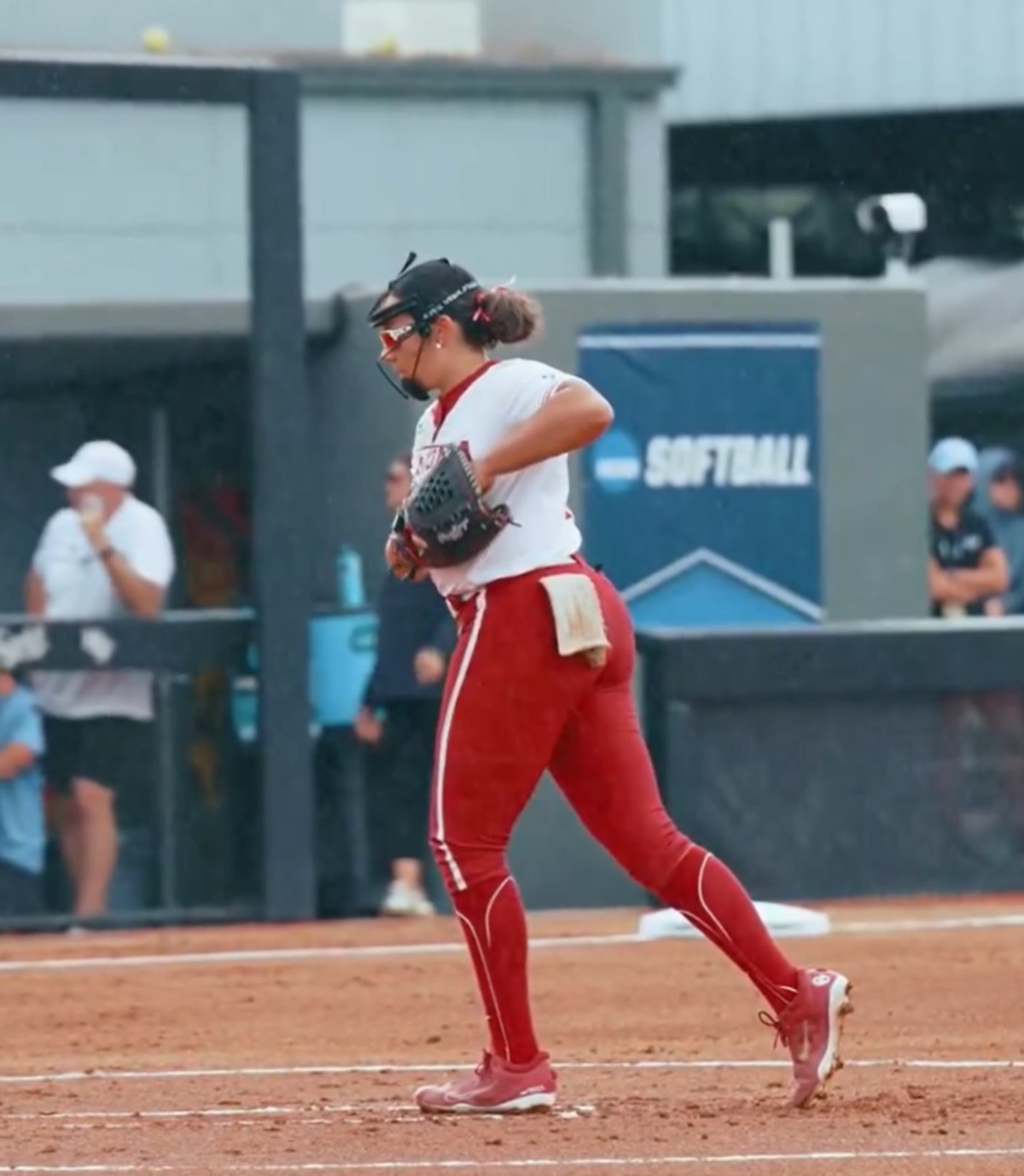
There is a temptation, when previewing Oklahoma softball’s pitching staff for 2026, to start at the top. To circle the transfer portal names in red ink. To ask who the ace is, who gets the ball on Friday night, and whether this staff has that pitcher—the one who can bend an entire postseason around her will.
That temptation misses the point.
The story of Oklahoma’s 2026 pitching staff is not about a single arm. It’s about architecture. About how Patty Gasso and Jennifer Rocha have quietly built one of the most adaptable, resilient, and strategically flexible pitching rooms in the country at a moment when college softball no longer rewards simplicity.
This staff wasn’t assembled to dominate in one way. It was built to survive everything.
A Program in Transition—By Design
For the first time in years, Oklahoma enters a season without a clearly program-grown ace entrenched at the top of the depth chart. That’s not a flaw. It’s a reflection of how the sport—and Oklahoma’s place within it—has evolved.
The days of riding one pitcher for 70 percent of the innings are over. The SEC doesn’t allow it. The Women’s College World Series punishes it. Gasso has acknowledged this shift openly, emphasizing that Oklahoma is now firmly committed to a staff-oriented approach—one where no pitcher is asked to carry the load alone.
That philosophy defines the 2026 staff.
Multiple pitchers. Multiple styles. Overlapping roles. Built-in redundancy. It’s less about hierarchy and more about leverage.
The Anchors: Kierston Deal and Audrey Lowry
Every great staff needs ballast—pitchers who steady the room when everything else is in motion. For Oklahoma, that stability comes from Kierston Deal and Audrey Lowry.
Deal enters her senior season as the last true link to Oklahoma’s recent championship past. She owns national title rings. She understands the expectations, the grind, and the emotional economy of pitching at Oklahoma. Her numbers—10–2 with a 3.42 ERA in 2025—don’t leap off the page in an era obsessed with velocity and strikeouts, but her value has never been captured fully by a stat line.
Deal offers predictability. Calm. Trust.
She works edges, induces weak contact, and allows an elite defense to function at its best. In a staff filled with max-effort arms, her presence isn’t just useful—it’s strategic. She changes pace, disrupts timing, and gives Oklahoma an option when the moment demands control rather than power.
Lowry, meanwhile, represents the bridge between stability and growth.
As a freshman in 2025, she quietly posted a 6–0 record with a 3.09 ERA, often working in relief roles that demanded poise rather than dominance. What separated Lowry wasn’t raw stuff—it was composure. She slowed games down. She navigated traffic. She didn’t unravel when innings tightened.
Those traits tend to matter more in May than February.
Entering 2026, Lowry looks less like a complementary arm and more like a trusted problem-solver—someone Rocha can turn to when momentum needs to be arrested. In a deep staff, that role is invaluable.
The Accelerators: Sydney Berzon and Miali Guachino
If Deal and Lowry anchor the room, Sydney Berzon and Miali Guachino redefine its ceiling.
Berzon arrives from LSU as one of the most decorated transfers Oklahoma has added in recent memory. A two-time All-American with deep SEC experience, she brings something Oklahoma needed after the graduation of Sam Landry: innings that don’t feel volatile.
Berzon’s game is built on efficiency. She lives low in the zone, trusts her drop ball, and understands how to pitch deep into games without chasing strikeouts. Her 18–8 record and 2.46 ERA in the SEC weren’t compiled against soft schedules—they were earned in one of the most unforgiving environments in the sport.
At Oklahoma, Berzon doesn’t need to be heroic. She needs to be reliable. That’s where she thrives.
Guachino offers the contrast.
Where Berzon works south, Guachino attacks north. The former Ole Miss standout is a strikeout pitcher by nature, armed with a rise ball that forces uncomfortable decisions. Her freshman All-American campaign signaled not just talent, but competitiveness. She’s already pitched through failure, adjustment, and SEC pressure.
Together, Berzon and Guachino give Oklahoma a pairing few teams can prepare for in a single weekend. Hitters adjusting to ground-ball pressure one day are forced to recalibrate eye levels the next. Over a series, that variability compounds fatigue and erodes confidence.
This isn’t about replacing Jordy Bahl’s dominance. It’s about creating sustained discomfort.
Take a Deeper Dive With Our 2026 Oklahoma Softball Preview
Available exclusively on our Facebook subscription page
– Pitching Staff: The Biggest Variable
– New Faces, New Roles
– Leadership & Experience
The Depth That Makes It Work
What separates Oklahoma’s staff from most isn’t just the top-end talent—it’s what that talent allows the program not to do.
With Berzon and Guachino capable of handling front-line responsibilities, the Sooners can manage innings intelligently. Deal doesn’t have to overextend. Lowry can grow without being rushed. Freshmen can develop within structure instead of chaos.
That’s where Allyssa Parker and Berkley Zache enter the picture.
Parker arrives as one of the most highly touted recruits in the country, the kind of pitcher who could accelerate timelines if needed. Zache brings a different look entirely—a tempo disruptor with a changeup that profiles as a postseason weapon. Neither is being asked to save a season. Both are being developed with intention.
That patience is a luxury most programs don’t have.
Redefining the “Weekend Option”
The real question facing Oklahoma in 2026 isn’t how many pitchers it has. It’s how many true weekend options emerge.
A true weekend option isn’t defined by ERA alone. It’s a pitcher who can start against elite lineups, navigate adjustments, handle pressure, and respond when Plan A fails. History suggests you need three—maybe four—of those pitchers to win a championship without flirting with disaster.
Oklahoma doesn’t need eight weekend aces. It needs clarity by May.
Berzon projects as one. Guachino could certainly be another. Deal and Lowry offer situational answers. Someone else—perhaps Parker—may force her way into the conversation.
Depth isn’t the destination. It’s the vehicle.
Built for the SEC Grind
Nothing about this staff makes sense without context. The SEC offers no off weekends. No series where innings can be stolen. Every lineup is dangerous. Every road trip feels like a test.
Oklahoma’s response hasn’t been to outmuscle the league. It’s been to outthink it.
Different starters across a weekend. Matchup-based bullpen usage. Rotations designed to peak in June rather than dominate April. Health, not headlines, is the priority.
In that environment, predictability is a liability. Oklahoma has eliminated it.
The Bigger Picture
This pitching staff isn’t built for nostalgia. It’s built for now.
It values adaptability over star power, roles over resumes, and sustainability over spectacle. It’s designed to absorb adversity, pivot without panic, and arrive at the postseason with options instead of questions.
That’s how championships are won in modern softball.
Oklahoma doesn’t need one pitcher to be great. It needs several to be ready.
In 2026, that might be the most dangerous thing in the sport.