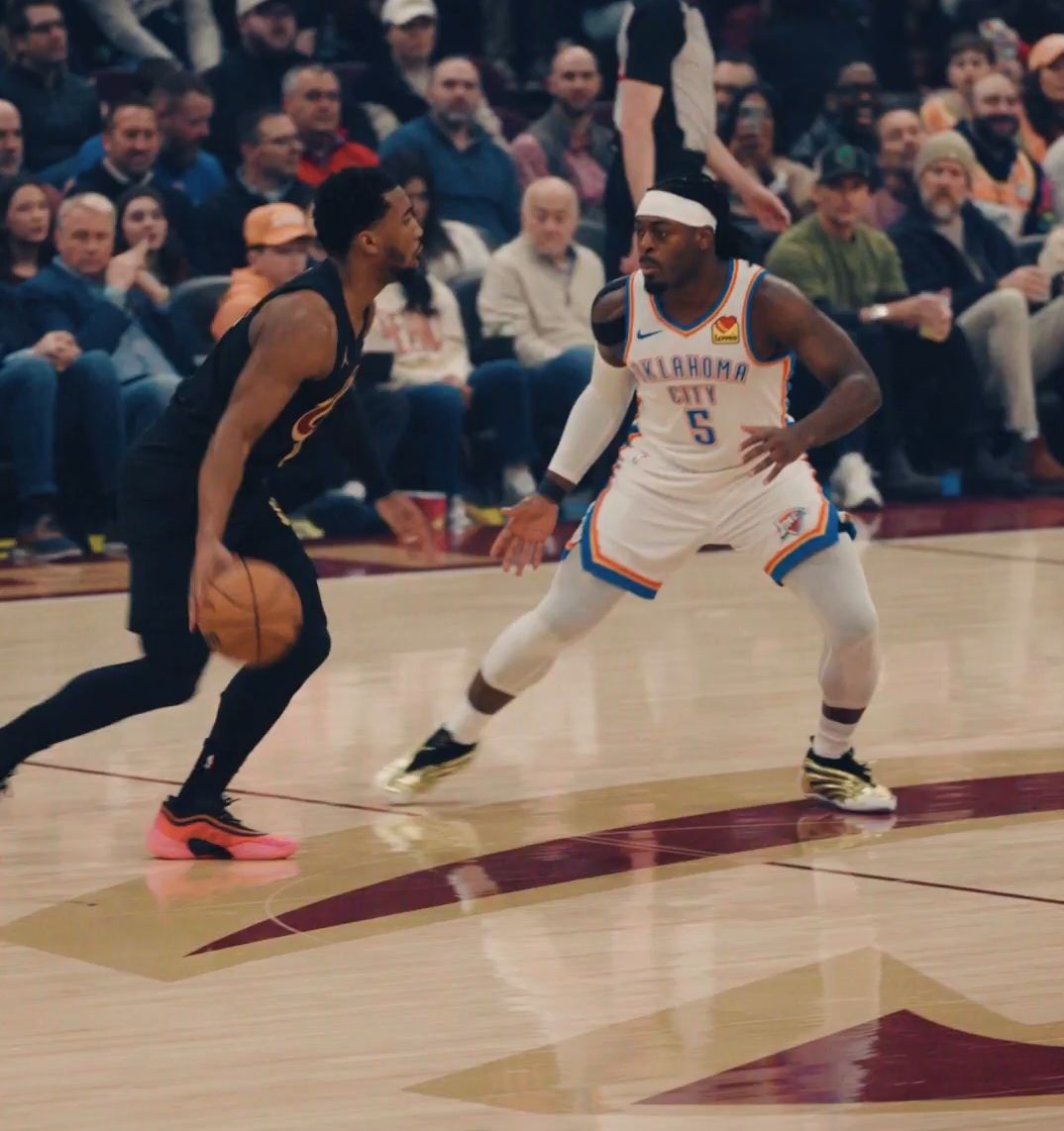
Blowouts are easy to dismiss in January. They’re supposed to happen, especially when one team is injured, tired, or caught on the wrong night. But every so often, a lopsided score doesn’t just reflect a bad game by one side — it reveals something structural about the other.
Monday afternoon in Cleveland was one of those nights.
The Oklahoma City Thunder didn’t just beat the Cavaliers 136–104. They exposed a gap in identity, habits, and organizational clarity that matters far more than the 32-point margin. Because when you strip away the shooting percentages and the highlight runs, what this game really showed is that Oklahoma City is no longer experimenting with who it wants to be.
It already knows.
The Fourth Quarter Wasn’t Hot Shooting — It Was Inevitable
A 45-point fourth quarter jumps off the box score. A season-high 23 made three-pointers demands attention. But neither tells the full story on its own.
The Thunder didn’t suddenly catch fire in the final 12 minutes. They tightened the screws.
Cleveland entered the fourth quarter down 12 — uncomfortable, but manageable. In the NBA, that’s still a game. What happened next wasn’t randomness. It was the result of a team that understands how pressure compounds.
Oklahoma City outscored the Cavaliers 45–25 in the final frame. Seven of its last ten shots from deep went down. The ball never stuck. The spacing never collapsed. The pace never slowed.
That’s not luck. That’s muscle memory.
When the Thunder unleashed their decisive 23–5 run over the final 3:33, the arena felt it immediately. Possessions shortened. Cleveland’s shooters hesitated. Defensive rotations came a half-second late. The gap widened with every decision.
Great teams don’t just capitalize on mistakes — they manufacture them.
The Three-Point Barrage Was a Statement, Not a Reliance
It would be easy to frame this game as “live by the three, die by the three.” Oklahoma City hit 23 triples on nearly 49 percent shooting. Cleveland hit fewer than 23 percent of its own attempts from deep.
That disparity matters. But the reason it happened matters more.
The Thunder didn’t take difficult threes. They created inevitable ones.
The ball movement was surgical. Shai Gilgeous-Alexander collapsed the defense without over-dribbling. Chet Holmgren punished help rotations from the perimeter. Isaiah Joe and Luguentz Dort spaced with intent, not hope.
Every three felt like the final step of a sequence, not a bailout.
Contrast that with Cleveland, where Donovan Mitchell finished 1-of-9 from beyond the arc, often forced into late-clock attempts against a set defense. That’s not just cold shooting — that’s an offense running uphill.
Oklahoma City wasn’t just making shots. It was dictating the geometry of the game.
Shai and Chet Are No Longer “Emerging” — They’re Driving
Shai Gilgeous-Alexander scored 30 points on 60 percent shooting. It was his 30th 30-point game of the season. That should be absurd. Instead, it feels routine.
What stood out wasn’t the scoring — it was the restraint.
Shai didn’t hunt numbers. He hunted advantages. He allowed the game to bend before he asserted himself, and when Cleveland adjusted, he trusted the system to punish them elsewhere.
That’s superstar maturity.
Chet Holmgren’s 28 points and eight rebounds carried just as much weight. Four made threes from a seven-footer who also anchors your defense is not a luxury — it’s a structural advantage. Cleveland couldn’t decide whether to treat him like a big or a wing, and that hesitation turned into space.
When your two foundational pieces can both punish you without dominating the ball, the floor becomes a chessboard.
Short-Handed, Fully Formed
One of the most overlooked aspects of this win is that Oklahoma City didn’t arrive at it at full strength. Injuries forced rotation adjustments. Roles shifted slightly.
Nothing broke.
That’s the mark of a team whose identity is larger than its lineups.
The Thunder defended with collective purpose, forcing 21 Cleveland turnovers. They communicated through switches. They rebounded well enough to keep their transition game alive. They didn’t play “perfect” basketball — they played connected basketball.
Cleveland, by contrast, looked like a team still searching for its offensive north star. Missing Darius Garland and Max Strus hurt, but injuries alone don’t explain 21 turnovers or a shooting night that collapsed under pressure.
The Thunder didn’t just exploit Cleveland’s weaknesses. They amplified them.
Habits Are the Difference Between Contenders and Participants
This game wasn’t about standings. It was about habits.
Oklahoma City’s habits showed up in how it closed the second quarter with a 16–6 run after Cleveland cut the lead to five. They showed up in how it never allowed the Cavaliers’ third-quarter push to gain emotional traction. They showed up in how the fourth quarter didn’t drift — it detonated.
Habits are why the Thunder could turn a competitive game into a rout without panic or theatrics.
Cleveland’s habits, on the other hand, showed up in rushed decisions, late rotations, and possessions that felt heavy the moment Oklahoma City applied pressure.
That doesn’t mean the Cavaliers are broken. It means they’re unfinished.
The Thunder are not.
This Is What the League Is Actually Dealing With
At 36–8, Oklahoma City owns the NBA’s best record. That stat alone demands respect. But Monday explained why that record is sustainable.
This team can win slow.
It can win fast.
It can win ugly.
It can win by avalanche.
It doesn’t rely on one mechanism. It layers them.
The shooting will fluctuate — it always does. But the process that created those shots is repeatable. The defensive pressure that forced turnovers is portable. The composure that turned a 12-point lead into a 32-point statement travels.
That’s not a hot streak. That’s a blueprint.
The Loudest Message Wasn’t the Score
The loudest message from Cleveland wasn’t the final margin. It was the quiet realization that the game slipped away before the fourth quarter ever began.
Oklahoma City didn’t wait for permission to take control. It took it. Then it applied pressure until the other side cracked.
That’s what elite teams do in January — not because January matters most, but because habits don’t take nights off.
This wasn’t just a win.
It was a reminder.
The Thunder aren’t building toward something anymore.
They’ve already arrived.
Follow us on Instagram & Facebook