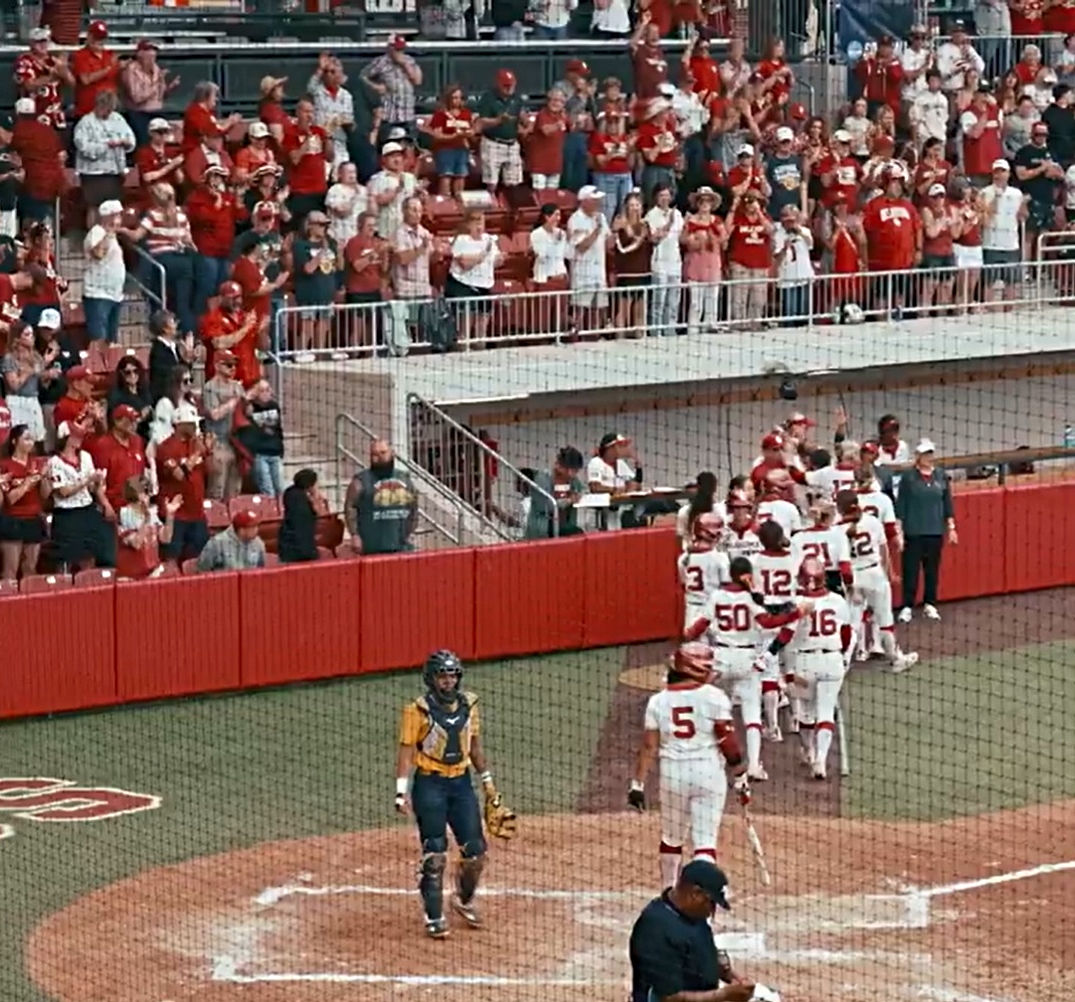
At Oklahoma, the conversation never really resets. It just evolves.
Most programs spend entire seasons trying to reach relevance. Oklahoma spends every season trying to sustain it. National championships are no longer the aspiration — they’re the operating standard. And as the Sooners enter the 2026 season, the most important storyline isn’t who they lost, who they added, or even where they’re ranked.
It’s how the next generation is already positioned to carry the weight of a dynasty.
That next generation begins with the historic 2025 recruiting class — the No. 1 class in the nation — but it doesn’t end there. It extends into how those players are being integrated, how responsibility is being handed down, and how Patty Gasso continues to build something that looks less like a roster and more like a living system.
Oklahoma softball doesn’t rebuild. It regenerates.
The 2025 Recruiting Class That Redefined the Baseline
The headline number still feels surreal: four of the top five recruits in the entire country chose Oklahoma.
In an era where elite prospects scatter across the country, that level of consolidation is almost unheard of. It’s not just a recruiting win — it’s a statement about identity. These players didn’t pick Oklahoma because it was trendy. They picked it because they knew exactly what it demands.
This six-player class is geographically diverse, positionally balanced, and stacked with national accolades. But what makes it historically significant isn’t the rankings — it’s the fit. Every player in the class aligns with the same core traits Oklahoma has prioritized for a decade: athleticism, positional flexibility, competitive edge, and emotional resilience.
This isn’t a class built to flash. It’s a class built to function.
Kai Minor: The Future That Feels Like the Present
Every great class has a gravitational center. For Oklahoma, that player is Kai Minor, the consensus No. 1 recruit in the nation.
Minor is the type of player who feels custom-designed for Oklahoma’s system. She brings elite speed, advanced outfield instincts, and a polished offensive profile built on contact, pressure, and situational awareness. She doesn’t just hit for average — she bends defenses.
What separates Minor isn’t just talent. It’s usability. She fits anywhere in the lineup, defends premium space, and immediately alters how opponents structure game plans. In practical terms, she looks less like a future star and more like a Day One contributor.
There is a very real scenario where Minor is starting in the outfield by the end of February.
And at Oklahoma, that’s not radical — it’s normal.
Kendall Wells: When a Catcher Changes Lineups
If Minor represents Oklahoma’s athletic blueprint, Kendall Wells represents its strategic disruption.
Power-hitting catchers are rare. Power-hitting catchers who can also manage elite pitching staffs are almost nonexistent. Wells enters Norman as the No. 1 catcher in the class and a top-five national recruit — and her bat alone makes her difficult to keep off the field.
The fall season saw her produce multiple home runs in limited scrimmage action, which only reinforced what the staff already believed: Wells is not a long-term project. She’s an immediate weapon.
The complication is roster math. Isabela Emerling is experienced, trusted, and defensively sound. But Oklahoma doesn’t bench elite offense. Wells may not catch every game early, but she will hit — whether as a designated player, rotation catcher, or matchup starter.
Long-term, she feels like the next great Oklahoma catcher. Short-term, she feels like a lineup problem for opposing pitchers.
Allyssa Parker and the Two-Way Equation
Every elite recruiting class has one player who breaks the system. For Oklahoma, that player is Allyssa Parker.
Parker arrives as the No. 2 overall player nationally and the top-ranked pitcher in the class. She’s also the 2024 Gatorade Oklahoma Player of the Year — a rare homegrown superstar with national-level upside.
What makes Parker fascinating isn’t just her arm. It’s her bat.
Parker projects as a legitimate two-way threat, capable of contributing in the circle and in the lineup. That creates roster flexibility Oklahoma rarely gets. She can pitch. She can hit. She can do both in the same weekend.
In the short term, Parker enters a crowded pitching room behind Sydney Berzon, Kierston Deal, Miali Guachino, and Audrey Lowry. But her ceiling is unmistakable. By midseason, she feels like the type of freshman pitching in high-leverage SEC moments.
And by next year, she may be anchoring the staff.
Take a Deeper Dive With Our 2026 Oklahoma Softball Preview
Available exclusively on our Facebook subscription page
– Pitching Staff: The Biggest Variable
– New Faces, New Roles
– Leadership & Experience
Depth as a Competitive Weapon
Oklahoma doesn’t survive on stars. It survives on layers.
Berkley Zache fits the archetype of the postseason specialist — elite changeup, command-first, rhythm disruptor. She may not headline series in February, but she profiles as the kind of arm that wins you two innings in a super regional or kills momentum in a championship setting.
Lexi McDaniel brings middle-of-the-order power and infield versatility that brings positional coverage across nearly the entire field. She’s not a fringe piece — she’s a functional chess piece in Gasso’s lineup construction.
Not every freshman starts. But at Oklahoma, nearly every elite freshman plays.
That depth doesn’t just protect against injuries — it creates internal competition. And competition is Oklahoma’s real engine.
Why Freshmen Thrive in Norman
The reason Oklahoma can integrate elite freshmen so seamlessly has little to do with talent — and everything to do with structure.
Patty Gasso doesn’t shelter stars. She empowers them.
She has never believed in delaying readiness. If a player earns it, she plays. Age is irrelevant. What matters is emotional control, defensive reliability, and the ability to fail without fracturing.
Gasso’s track record with freshmen is unmatched because she understands something most coaches don’t: pressure can’t be removed — it has to be normalized.
That’s why Oklahoma freshmen rarely look overwhelmed. They’re not micromanaged. They’re trusted.
The Culture That Makes It All Work
Talent brings players to Oklahoma. Culture keeps them evolving.
Gasso’s philosophy is rooted in holistic development — what she famously calls turning “girls into women.” Her one-on-one meals with players, often at places like IHOP, aren’t about softball. They’re about identity, confidence, and emotional grounding.
Players describe her love as unconditional — whether they go 4-for-4 or strike out three times. That emotional security creates freedom. And freedom creates performance.
Team bonding under Gasso goes deeper than chemistry drills. Players are asked to share personal histories, vulnerabilities, and struggles. Reading assignments like The Forgiveness Book, voluntary Bible studies, and structured group conversations all serve the same purpose: connection.
Because Gasso believes teams that trust each other as people compete harder as athletes.
The Blue-Collar Standard
Despite Oklahoma’s national dominance, Gasso is relentless about humility.
Her infamous “blue-collar day” — where players cleaned facilities instead of practicing — wasn’t punishment. It was calibration. A reminder that nobody is above the work.
That mindset traces back to her early days, where she once required six-mile runs not for conditioning, but for mental endurance. The lesson was never about lungs. It was about resilience.
At Oklahoma, effort is non-negotiable. Reputation is meaningless. Every player — All-American or walk-on — is expected to grind.
That’s why entitlement never survives in Norman.
The Portal Without the Panic
In the modern era, most elite programs stockpile transfers. Oklahoma doesn’t.
Gasso is selective by design. She calls unnecessary transfers “progress-stoppers” — players who block elite young talent without raising the program’s ceiling.
That’s why Oklahoma added only two portal pitchers in 2025 despite a heartbreaking postseason exit. It wasn’t restraint. It was strategy.
Gasso recruits to develop, not to patch.
The Real Reason Oklahoma Keeps Winning
Oklahoma’s dominance isn’t built on cycles. It’s built on continuity.
The 2025 recruiting class isn’t a reset. It’s a continuation. The freshmen aren’t a future core — they’re a present one. The culture isn’t inherited — it’s actively reinforced.
And that’s the real secret.
Oklahoma doesn’t chase championships.
It builds systems that make them inevitable.
Every year, the names change.
The standard never does.
Follow us on Instagram & Facebook