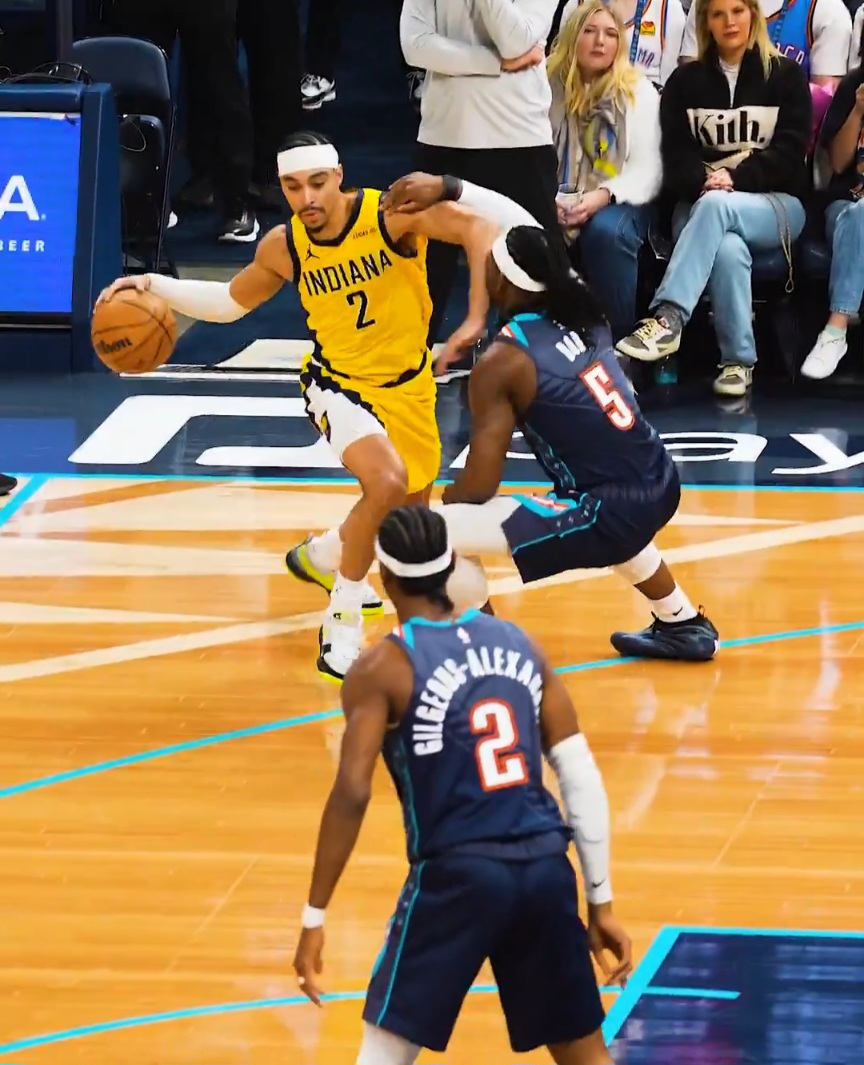
There are nights when a loss feels like a malfunction. Something breaks, something goes sideways, and you file it away as an anomaly. And then there are nights when a loss feels more like a message — not loud, not dramatic, but persistent in what it reveals.
Friday night against Indiana was the second kind.
The Oklahoma City Thunder didn’t lose because they were careless. They didn’t lose because Shai Gilgeous-Alexander was quiet. They didn’t even lose because the Pacers played some once-in-a-season miracle game.
They lost because the modern NBA punishes imbalance, no matter how brilliant your best player is.
Shai scored 47 points. At home. In a building where Oklahoma City rarely loses. Against a Pacers team missing its franchise star and sitting near the bottom of the Eastern Conference standings.
And it still wasn’t enough.
That’s not an indictment of Shai. It’s a warning about everything around him.
The Illusion of Control
On paper, this game looks close. A three-point loss. A missed corner three at the buzzer. A late rally that nearly stole it. The kind of box score that invites moral victories and “if one shot falls” narratives.
But the truth is more uncomfortable.
Indiana led for 97 percent of the game.
Not “most of the night.” Not “wire-to-wire with a scare.” Ninety-seven percent. The Thunder spent almost the entire evening trying to reclaim a game they never actually controlled.
That matters, because control is what elite teams usually impose on inferior ones. Oklahoma City is supposed to be the team that dictates tempo, spacing, energy. Instead, they were reacting — chasing shooters, closing late, scrambling to cover mistakes that kept multiplying.
The Pacers didn’t steal the game at the end.
They managed it from the beginning.
When Greatness Turns Into Gravity
Shai was extraordinary. There’s no other way to describe 47 points on 17-of-28 shooting, including nine in the final two minutes. He attacked mismatches, lived in the midrange, punished switches, and bent Indiana’s defense until it nearly snapped.
But something subtle happened over the course of the game.
The Thunder offense started orbiting him.
Not in the healthy way, where he draws attention and others feast. In the gravitational way, where everything collapses toward one solution because nothing else is consistently working.
Chet Holmgren gave them 25 and 13 with three blocks. After that, the drop-off was steep. The rest of the roster shot under 40 percent combined. The spacing narrowed. The reads got slower. Possessions became more predictable.
By the fourth quarter, Indiana wasn’t trying to stop Oklahoma City’s offense.
They were trying to survive Shai.
And they did.
Not because he failed — but because the Thunder had no secondary pressure to keep the Pacers honest.
The Three-Point Gap That Broke the Game
This wasn’t a loss decided by one missed shot. It was decided by 19 missed threes over 48 minutes.
Indiana went 16-of-38 from deep. Oklahoma City went 7-of-26.
That’s a 27-point swing in a three-point game.
In a league where spacing is currency, Oklahoma City went broke.
And it wasn’t just about shooting percentages. It was about how those shots were generated. The Pacers moved the ball side-to-side, forced rotations, created clean looks from inside-out action. Oklahoma City took a steady diet of late-clock attempts, semi-contested kick-outs, and emergency releases after initial actions failed.
The Pacers played with offensive structure.
The Thunder played with offensive dependence.
That distinction is the difference between a team that controls variance and a team that becomes vulnerable to it.
Injuries Aren’t an Excuse — They’re a Test
Yes, Oklahoma City was shorthanded. No Jalen Williams. No Alex Caruso. No Isaiah Hartenstein. No Aaron Wiggins. That’s a brutal list, especially for a team built on depth, defensive versatility, and connective pieces.
But this is the point in the season where contenders don’t get graded on availability.
They get graded on adaptability.
Championship teams don’t just survive injuries — they reveal how resilient their identity really is when the margins disappear. And on Friday night, Oklahoma City’s identity shrank.
Their defense slipped just enough to allow 42 percent three-point shooting. Their rebounding cratered, giving up 14 offensive boards. Their bench produced 12 points.
The Thunder didn’t lose their talent.
They lost their balance.
And balance is what allows great teams to absorb chaos without becoming reliant on one outcome or one player.
The Shot Everyone Will Remember (But Shouldn’t)
Isaiah Joe’s missed corner three will live on the highlight reel. The open look. The clean pass. The ball rattling out as the horn sounds.
It’s the kind of ending that invites mythology.
But that shot didn’t decide the game.
The game was decided when Oklahoma City allowed Indiana to build a double-digit cushion and spend the entire night playing downhill. It was decided when the Thunder couldn’t close out shooters without over-rotating. It was decided when the offense became linear instead of layered.
The final shot was just the last chapter.
The story had already been written.
This Is the Real Gap Between “Best Team” and “Champion”
Oklahoma City still has the best record in the league. They’re still young, still dangerous, still loaded with long-term upside. Nothing about this loss changes their ceiling.
But it does clarify the difference between being dominant and being complete.
Right now, the Thunder are devastating when the system is intact.
They are more fragile when the system is compromised.
That’s not a flaw. It’s a phase.
Every contender goes through the same transition: from talent-driven success to structure-driven inevitability. From winning because you’re better to winning because you’re harder to disrupt.
This loss showed that Oklahoma City is still in the middle of that evolution.
They can produce a 47-point MVP performance and still lose to a bottom-tier team because the ecosystem around that performance isn’t yet immune to pressure.
That’s not a panic signal.
It’s a development marker.
Why This Loss Actually Matters More Than Most
The danger with a season like Oklahoma City’s is that the wins start to blur together. Blowouts. Road dominance. Statistical excellence. It all reinforces the idea that the process is already finished.
Friday night was a reminder that it isn’t.
The Thunder didn’t lose because they lacked heart, effort, or execution.
They lost because modern basketball demands multiplicity — multiple creators, multiple threats, multiple ways to punish a defense that commits to taking something away.
Indiana took away everything except Shai.
And Oklahoma City couldn’t make them pay for it.
That’s not a crisis. But it is a preview.
Because in April and May, no one will let Shai beat them alone.
And the real question for this Thunder team isn’t whether their MVP can carry them.
It’s whether their structure can survive when he can’t.
Follow us on Instagram & Facebook