There was a moment Saturday night inside Lloyd Noble Center when the past felt close enough to touch.
No. 24 rose toward the rafters. The crowd stood. Phones lifted. Applause swelled into something deeper than noise — it became memory.
Buddy Hield smiled, waved, and embraced the building that once belonged to him. For a few minutes, Oklahoma basketball wasn’t defined by its present frustration. It was defined by certainty. By excellence. By identity.
And then the game resumed.
And everything that has haunted this program for the past two months returned with it.
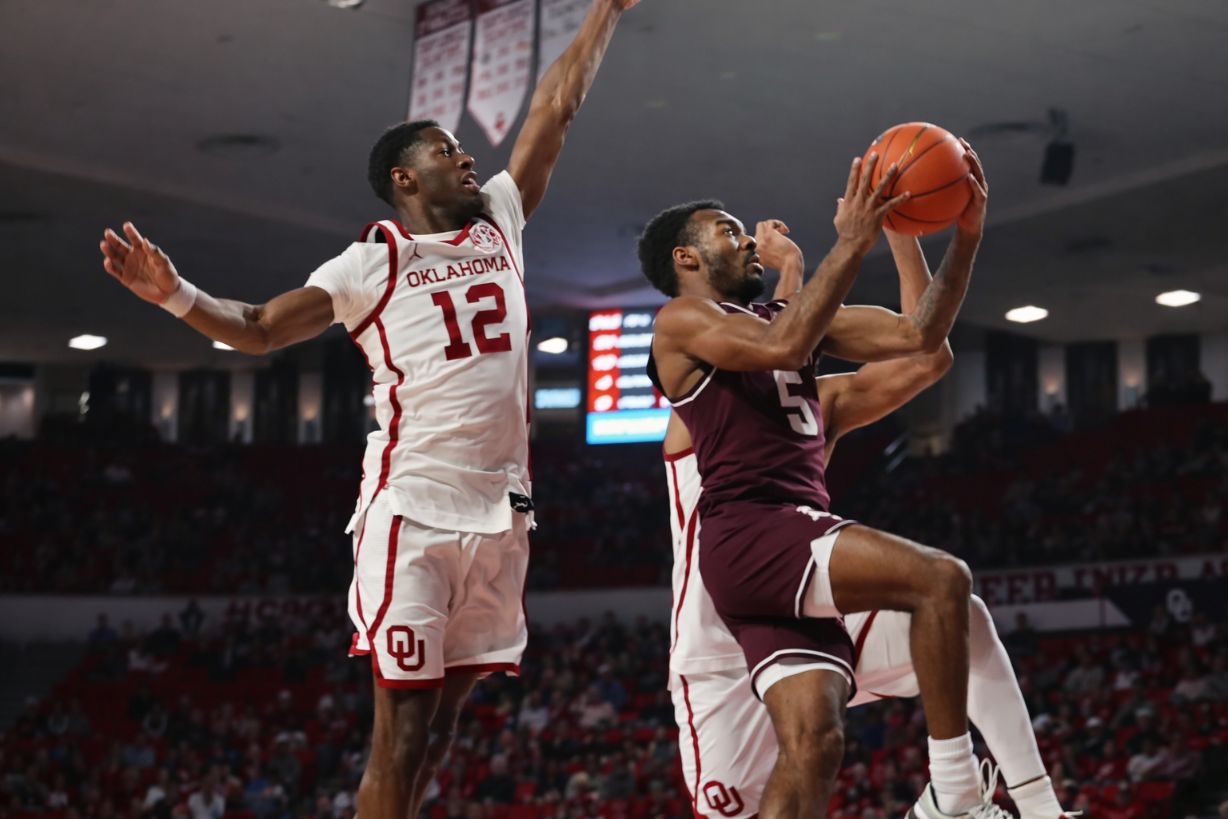
The 75–71 loss to Texas A&M Aggies wasn’t the most lopsided defeat Oklahoma has suffered this season. It wasn’t the most embarrassing. It wasn’t even the most painful in isolation.
It was worse than all of those things.
It was symbolic.
Because on the very night Oklahoma honored what it once was, it showed exactly what it currently is not.
This isn’t about effort. That’s important to continue saying. Effort was there. Pride was there. Fight was there. Oklahoma clawed back late. Dayton Forsythe played fearlessly. Mohamed Wague battled inside. The Sooners cut a nine-point deficit to one with 26 seconds left.
They cared.
But caring is not the same as controlling.
And controlling is what winning programs do.
From the opening tip, Oklahoma was reacting instead of dictating. Texas A&M opened the game on an 8–0 run. When Oklahoma briefly grabbed momentum early in the second half, the Aggies responded with a 13–4 punch that reestablished order. Even Oklahoma’s late rally felt more like resistance than authority.
The Aggies led for 95 percent of the game.
That number is damning, not because Oklahoma didn’t compete, but because it never imposed itself.
This has become the defining trait of this team.
Oklahoma doesn’t collapse.
It erodes.
It loses games in increments. In possessions. In missed box-outs and contested jumpers and defensive rotations that are half a step too late. It loses games not because it stops trying, but because it never fully seizes control in the first place.
Saturday was the clearest example yet.
Texas A&M outscored Oklahoma 32–12 in the paint. That statistic alone tells you everything you need to know about how this game was played — and how Oklahoma’s season has unfolded.
The SEC is not a finesse league. It is a force league.
And right now, Oklahoma is still adjusting to that reality.
This isn’t the Big 12 Oklahoma left behind. This is a conference where guards are bigger, forwards are stronger, and defensive schemes are designed to suffocate your first option and punish your second.
Texas A&M didn’t just defend Oklahoma. It steered Oklahoma. Its no-middle defensive scheme pushed the Sooners toward the sidelines, toward uncomfortable angles, toward contested threes that felt more like concessions than choices.
Oklahoma finished shooting just 33 percent from the field.
That number isn’t just a cold shooting night. It’s a reflection of offensive uncertainty.
Great offenses generate good shots even when they aren’t falling. Oklahoma too often generates difficult shots even when it desperately needs easy ones.
That’s an identity problem.
And identity, more than talent, is what separates Oklahoma’s past from its present.
When Hield played here, Oklahoma knew exactly who it was. It was ruthless offensively. It spaced the floor with purpose. It attacked weaknesses without hesitation. Every possession felt intentional.
This Oklahoma team feels hopeful, but not inevitable.
That distinction matters.
Because hope keeps you close.
Identity helps you finish.
To be fair, there are reasons for optimism buried inside this loss.
Forsythe’s emergence matters. His late-game poise, his willingness to take responsibility, his refusal to disappear in the moment — those are foundational traits. He looks like someone capable of becoming more than a contributor. He looks like someone capable of becoming a pillar.
Wague’s toughness matters too. Thirteen rebounds against a physically imposing opponent is not an accident. It’s a signal. Oklahoma needs more players willing to live in uncomfortable spaces.
But individual development does not erase collective reality.
And the reality is this: Oklahoma has now lost 11 of its last 13 games.
That is not a slump.
That is a verdict.
Which brings the conversation, inevitably, to Porter Moser once again.
This is not about assigning blame in emotional terms. It’s about confronting trajectory in honest ones.
Moser is a respected coach. His teams play hard. They defend. They represent the program with professionalism.
But at some point, professionalism must translate into progress.
And progress, at this level, is measured in results.
This loss dropped Oklahoma to 3–11 in SEC play. It pushed the Sooners further from NCAA Tournament relevance. It continued a pattern that has defined the past five seasons: competitiveness without breakthrough.
The most dangerous place a program can live is in between.
Not bad enough to collapse.
Not good enough to ascend.
Just close enough to believe change is near.
Just far enough that it never arrives.
Saturday night exposed that tension with painful clarity.
Because while Oklahoma honored a team that reached the NCAA Final Four, it currently looks like a program fighting just to stay afloat.
The crowd felt it.
You could sense it in the quiet that followed Forsythe’s missed three with 11 seconds left. Not anger. Not outrage.
Recognition.
Recognition that Oklahoma had been here before.
Recognition that moral victories have expiration dates.
Recognition that effort alone cannot carry a program where expectation still lives in the rafters.
The cruelest part of Legacy Night wasn’t the loss itself.
It was the reminder.
The reminder of what Oklahoma basketball once felt like.
Certainty.
Authority.
Belief not just that Oklahoma could win — but that it would.
That feeling doesn’t live here right now.
But it isn’t gone forever.
Programs don’t rediscover themselves through ceremonies. They rediscover themselves through decisions. Through recruiting. Through player development. Through building a roster capable of imposing its will instead of absorbing someone else’s.
The path forward won’t be defined by Saturday’s loss.
But Saturday made one thing unmistakably clear:
Oklahoma is still searching for the version of itself worthy of the banners it celebrates.
And until it finds it, nights like this will continue to feel less like tributes to greatness — and more like reminders of distance.
Follow us on Instagram & Facebook