There is a moment every contender eventually reaches—a moment when circumstance forces revelation.
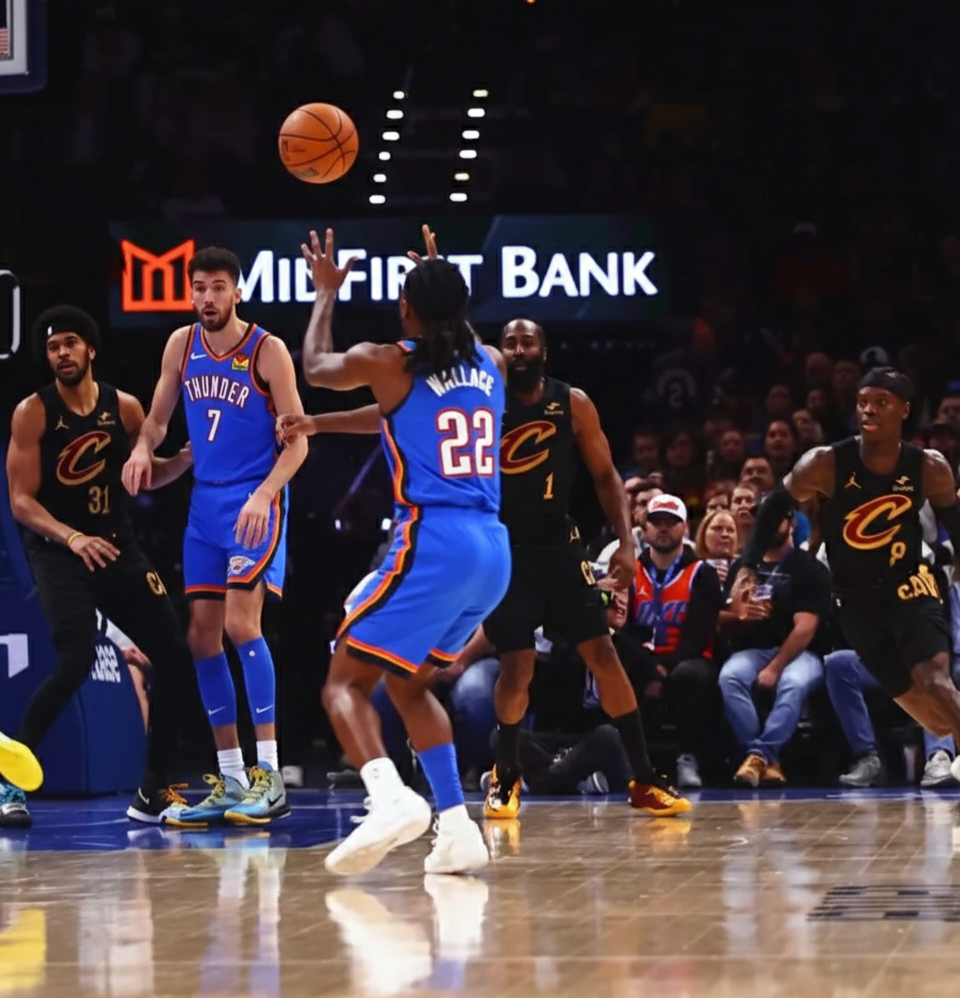
For the Oklahoma City Thunder, that moment came Sunday night at Paycom Center, in a game they were not supposed to control, against a Cleveland Cavaliers team that had not lost in the month of February, without the two players who define their offensive gravity.
No Shai Gilgeous-Alexander.
No Jalen Williams.
No margin for error.
And yet, by the end of a 121–113 victory over one of the Eastern Conference’s elite, the Thunder had discovered something far more valuable than a single win in February.
They discovered scalability.
They discovered sustainability.
They discovered that what they’ve built is no longer fragile.
It is inevitable.
This Wasn’t a Hot Shooting Night. It Was a Structural Victory.
The surface explanation will point to the shooting. Oklahoma City made 21 three-pointers on 41 attempts, a blistering 51 percent from beyond the arc. Those numbers jump off the page, the kind typically accompanied by phrases like “unsustainable” or “outlier.”
But that interpretation misses the truth entirely.
This wasn’t randomness.
It was engineering.
From the opening tip, Oklahoma City weaponized spacing in a way that dismantled Cleveland’s defensive identity. The Cavaliers rely on size—Jarrett Allen and Evan Mobley form perhaps the most intimidating interior defense in basketball. Their presence usually shrinks the court, forcing opponents into difficult perimeter shots late in the clock.
The Thunder reversed that geometry.
By deploying a five-out alignment featuring Cason Wallace, Isaiah Joe, Lu Dort, Aaron Wiggins, and Chet Holmgren, Oklahoma City forced Allen into uncomfortable territory. Instead of protecting the rim, he was pulled into space. Instead of anchoring the defense, he was reacting to it.
In the first nine minutes, Cleveland’s defensive rating ballooned to an astonishing 142.1 against that lineup.
The result was immediate and devastating: a 28–5 opening run that effectively redefined the game’s terms.
This is the paradox Oklahoma City creates. Their shooting isn’t just accurate. It’s inevitable, because of how they manufacture it.
They don’t take threes because they’re open.
They create openness because they take threes.
Cason Wallace Just Changed His Career Trajectory
If this season has been about Gilgeous-Alexander’s ascension, once again, into MVP territory, Sunday night may be remembered as the moment Oklahoma City’s long-term offensive ecosystem expanded.
Cason Wallace didn’t merely step in.
He initiated.
His stat line—20 points, 10 assists, one turnover—only begins to capture the significance of what unfolded. This was Wallace operating not as a complementary guard, but as an offensive conductor.
Cleveland’s defensive strategy relied on drop coverage, with Allen retreating into the paint to deter drives. Wallace dismantled that approach with surgical precision.
Each time he turned the corner off a high screen from Isaiah Hartenstein, he forced Allen into a decision with no correct answer. Step up, and Wallace delivered a pocket pass to Hartenstein for an uncontested finish. Stay back, and Wallace attacked the midrange or extended the possession until Cleveland’s rotations fractured.
Hartenstein scored 10 of his 13 points in the fourth quarter almost entirely from this action.
This wasn’t accidental chemistry. It was recognition.
Wallace recognized leverage.
And exploited it relentlessly.
For a player once projected primarily as a defensive specialist, this represented something larger than a career night. It represented expansion.
When Gilgeous-Alexander returns, Wallace won’t stop being a creator. Oklahoma City now knows he can be one.
And that knowledge will reshape their postseason offense.
The Defensive Possessions That Actually Won the Game
While the shooting defined the game’s rhythm, Oklahoma City’s defense defined its outcome.
Cleveland briefly took a one-point lead late in the third quarter, the inevitable push every elite team eventually makes. This was the moment where Oklahoma City could have fractured—where the absence of its primary star might finally matter.
Instead, they responded with discipline.
The Thunder employed a stunt-and-recover defensive scheme designed specifically to disrupt James Harden’s decision-making. Lu Dort, Kenrich Williams, and Wallace executed it flawlessly.
Each time Harden initiated offense, help defenders flashed aggressively toward him—not fully committing, but clouding his vision. Passing lanes disappeared. Driving angles closed.
Then, just as quickly, they recovered to their assignments.
The effect wasn’t dramatic. It was cumulative.
Harden finished with five turnovers.
Cleveland’s offense stalled.
Momentum died quietly.
This is what elite defensive teams understand: disruption doesn’t require steals. It requires hesitation.
And Oklahoma City created hesitation everywhere.
Isaiah Joe and the First Quarter That Changed Everything
The game’s emotional tone was set long before the final minutes.
It was set by Isaiah Joe.
His five steals in the first quarter weren’t just statistically remarkable. They were psychologically destabilizing. Each deflection accelerated Oklahoma City’s pace, creating transition opportunities where the Thunder averaged an astonishing 1.35 points per possession.
Those transition possessions weren’t chaotic.
They were precise.
Seven of Oklahoma City’s 21 three-pointers came directly from live-ball turnovers, before Cleveland’s defense could establish itself.
Joe’s performance embodied Oklahoma City’s defensive identity: opportunistic, anticipatory, relentless.
He didn’t just create points.
He erased Cleveland’s comfort.
This Team Is No Longer Dependent on Circumstance
The most dangerous realization from Sunday night isn’t that Oklahoma City can win without its stars.
It’s that their system improves when forced to evolve.
The Thunder posted a 64.2 percent true shooting percentage—an elite mark by any standard, and almost unthinkable without two players responsible for more than 50 points per game.
This wasn’t replacement production.
It was redistributed production.
Thirty-two assists on 42 made field goals reflected an offense functioning not through hierarchy, but through connectivity.
Everyone touched the system.
Everyone sustained it.
This is how championship infrastructure is built—not around individual brilliance, but collective adaptability.
The Playoff Implications Are Quietly Enormous
With the win, Oklahoma City improved to 44–14, maintaining control of the Western Conference’s top seed and strengthening its path toward home-court advantage throughout the playoffs.
More subtly, they secured the season sweep over Cleveland—a detail that may not matter until June.
But if it does, it could matter more than anything.
Because it would mean the Finals would begin in Oklahoma City.
This is how championship positioning happens. Not in dramatic moments, but in disciplined February victories that alter June geography.
The Thunder’s Most Dangerous Trait Isn’t Talent. It’s Certainty.
Every great team eventually confronts the same question: What happens when the variables change?
What happens when injuries remove certainty?
What happens when comfort disappears?
Sunday night provided Oklahoma City’s answer.
They didn’t hesitate.
They didn’t regress.
They expanded.
Wallace grew into initiation responsibility. Hartenstein became a fourth-quarter closer. Joe transformed defense into offense. Holmgren anchored everything behind them.
Nothing about the system broke.
Because nothing about the system depends on one player.
This is the lesson Oklahoma City is learning in real time.
They are not a contender because of who they have.
They are a contender because of what they’ve built.
And that reality should terrify the rest of the league.
Because the Thunder are discovering they don’t need perfect conditions to win.
They just need themselves.
Follow us on Instagram & Facebook