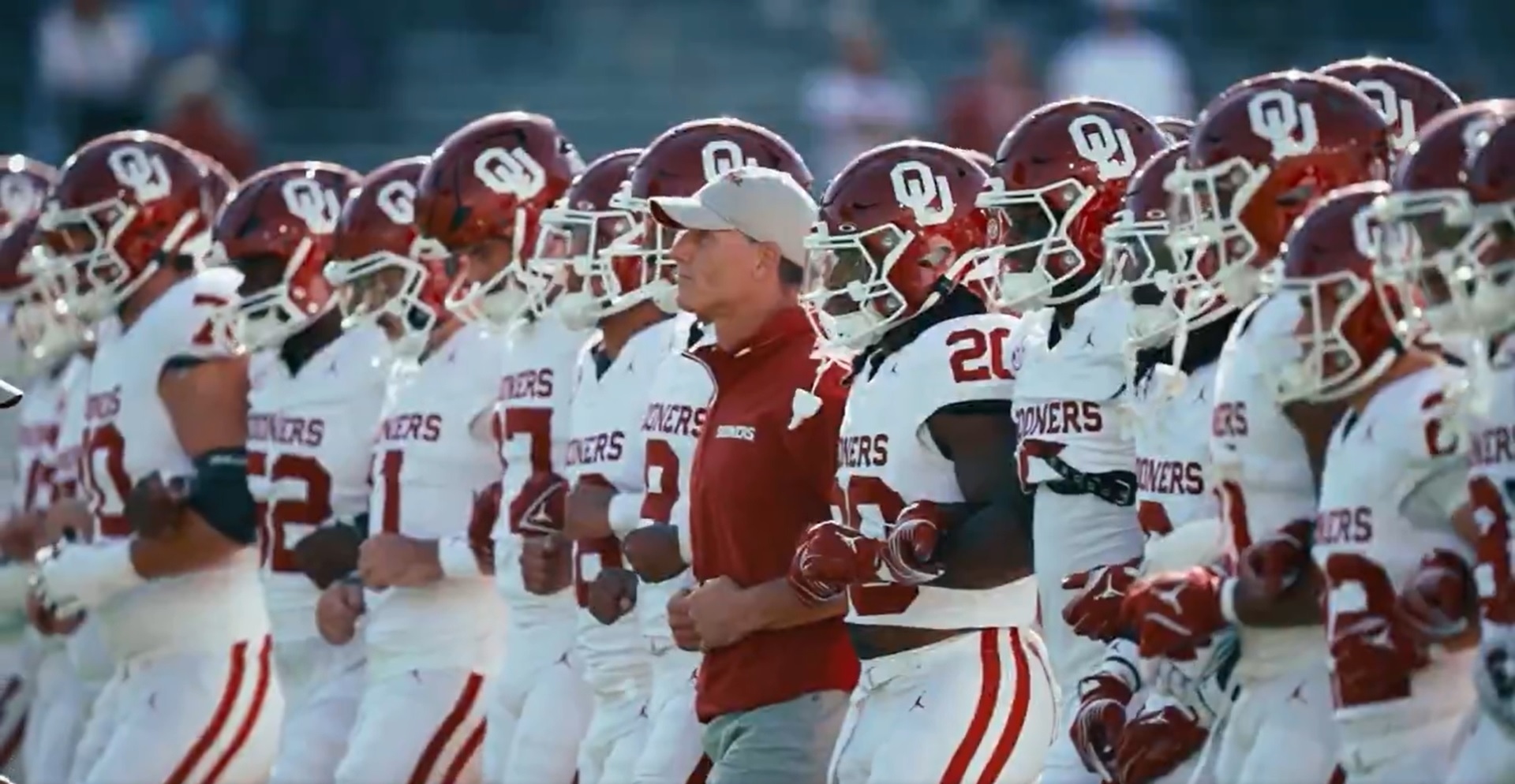
When Brent Venables announced the addition of Jason Witten as Oklahoma’s tight ends coach in January, the reaction across college football was immediate but somewhat surface level. Fans saw a Hall of Fame-caliber NFL name joining the staff and assumed the benefit would be simple: recruiting buzz, name recognition, maybe a pipeline into Texas high school football.
That’s true.
But it misses the real story.
The real story is that the “Witten Effect” may fundamentally change how Oklahoma plays offense in the Southeastern Conference — and possibly determine whether the program stays on its upward trajectory after last season’s breakthrough.
Because this hire wasn’t about celebrity.
It was about solving a problem.
And Oklahoma had one.
The Position That Lagged Behind
For years, the tight end position in Norman has existed more as a theoretical piece of the offense than a true weapon.
Under former offensive structures, the Sooners thrived on wide-open spacing, elite quarterback play, and explosive receivers. Tight ends often felt like accessories rather than engines.
But the move into the SEC changed the equation.
Physical football wins in that league. Edges matter. Blocking matters. Controlling the middle of the field matters.
And in 2025, Oklahoma’s run game exposed the gap.
The Sooners still won — finishing 10–3 and reaching the College Football Playoff — but the ground attack never reached the physical consistency required to dominate the SEC week after week.
Too often the tight ends struggled with technical blocking.
Too often the edge of the line collapsed.
Too often second-and-four became third-and-seven.
That’s where Witten enters the picture.
Because if there was one trait that defined his legendary NFL career, it wasn’t just durability or hands.
It was physical precision.
During his 17-year career with the Dallas Cowboys, Witten built a reputation as one of the most complete tight ends in football history — a relentless blocker, a technician in the run game, and a quarterback’s security blanket.
He wasn’t flashy.
He was dependable.
And those are the exact traits Oklahoma needs at the position.
A Remodel, Not a Renovation
Venables didn’t just hire Witten and hope things improved organically.
The program aggressively rebuilt the entire room.
Two veteran transfers arrived immediately.
Rocky Beers came from Colorado State with proven production and strong blocking metrics.
Hayden Hansen arrived from Florida bringing SEC experience and rare physical size.
Suddenly the Sooners went from a thin tight end room to one built around 6-foot-5 and 6-foot-7 veterans who have played real football in real games.
That matters.
But the coach matters more.
Because talent at tight end only works if the details are right — leverage, angles, hand placement, timing.
Those are the subtle mechanics Witten mastered over nearly two decades in the NFL.
And they are the exact details that translate directly to winning football in the SEC.
Take A Deeper Dive Into Oklahoma Football
Exclusively on our subscription page.
– Future Freaks Weekend – Oklahoma’s Recruiting Engine Roars Back to Life
– New Voices, New Vision – How Oklahoma’s Coaching Overhaul Could Reshape The Sooners’ SEC Future
– The Venables Blueprint – Why 5-Star Cooper Witten is the Strategic Key to Oklahoma’s 2027 Defensive Revolution
The Arbuckle Connection
The other piece of this story sits in the offensive film room.
Ben Arbuckle is entering a pivotal second season as Oklahoma’s offensive coordinator, and his system is built around versatility.
Multiple formations.
Tempo.
Misdirection.
But none of that works if defenses know what’s coming.
The addition of Witten — combined with the new personnel — opens the door to something Oklahoma hasn’t consistently utilized in years: multiple tight end sets that can both run and pass without substituting.
Imagine a formation with Hansen in-line and Beers flexed into the slot.
The defense has to respect the run.
But the middle of the field suddenly becomes vulnerable.
For a quarterback like John Mateer, who thrives attacking intermediate windows, that’s a schematic dream.
In other words, Witten isn’t just coaching a position group.
He’s unlocking part of the playbook.
Recruiting Gold
Of course, the recruiting story is impossible to ignore.
When Witten joined the staff, one immediate question followed him to Norman: his son.
Cooper Witten is widely regarded as the No. 1 linebacker prospect in the 2027 recruiting class, and his recent commitment to Oklahoma sent a ripple through the national recruiting landscape.
But the assumption that the Sooners landed him simply because of his father misses an important detail.
Oklahoma offered Cooper long before the elder Witten joined the staff.
The relationship already existed.
The hire simply strengthened it.
And the recruiting implications extend far beyond one player.
Witten spent years coaching high school football in the Dallas–Fort Worth area — arguably the most talent-rich recruiting territory in the country.
His reputation there is massive.
For Texas prospects, he isn’t just an NFL legend.
He’s a coach they trust.
That credibility can open doors across the region.
And in the SEC, talent pipelines are everything.
The Cultural Impact
Here’s the part that might matter most.
Jason Witten is not coming to Norman as a celebrity assistant.
He’s coming as a standard setter.
At Liberty Christian in Texas, where he coached high school football before joining Oklahoma, Witten built a reputation for demanding accountability and physicality.
Players describe his style as intense but infectious.
Energy mixed with expectation.
That aligns perfectly with the culture Venables is trying to build.
Because the Oklahoma head coach has been clear about the program’s identity.
Relentless effort.
Physical toughness.
Competitive discipline.
Those values define championship teams.
And they are the same traits that defined Witten’s entire career.
The Bigger Picture
Spring practice begins March 9.
And there will be plenty of storylines to watch for the Sooners.
The development of Mateer at quarterback.
The arrival of explosive transfer receivers.
The looming early-season road trip to Michigan Wolverines football.
But the most important storyline might be the one that doesn’t dominate highlight reels.
Watch the tight ends.
Watch the run blocking.
Watch the way Oklahoma attacks the middle of the field.
If the position group transforms the way the staff believes it can, the offense becomes harder to defend.
More balanced.
More physical.
More SEC-ready.
And if that happens, the hire of Jason Witten may end up being remembered as the most important offseason move Oklahoma made.
Not because of his name.
But because of what it changes.
Great programs evolve when they identify weaknesses and address them with precision.
That’s exactly what Oklahoma did.
The Sooners didn’t just hire a legend.
They hired a solution.
And if the “Witten Effect” plays out the way it looks like it might this spring, Oklahoma’s offense could look very different — and very dangerous — by the time fall arrives.
Follow us on Instagram & Facebook