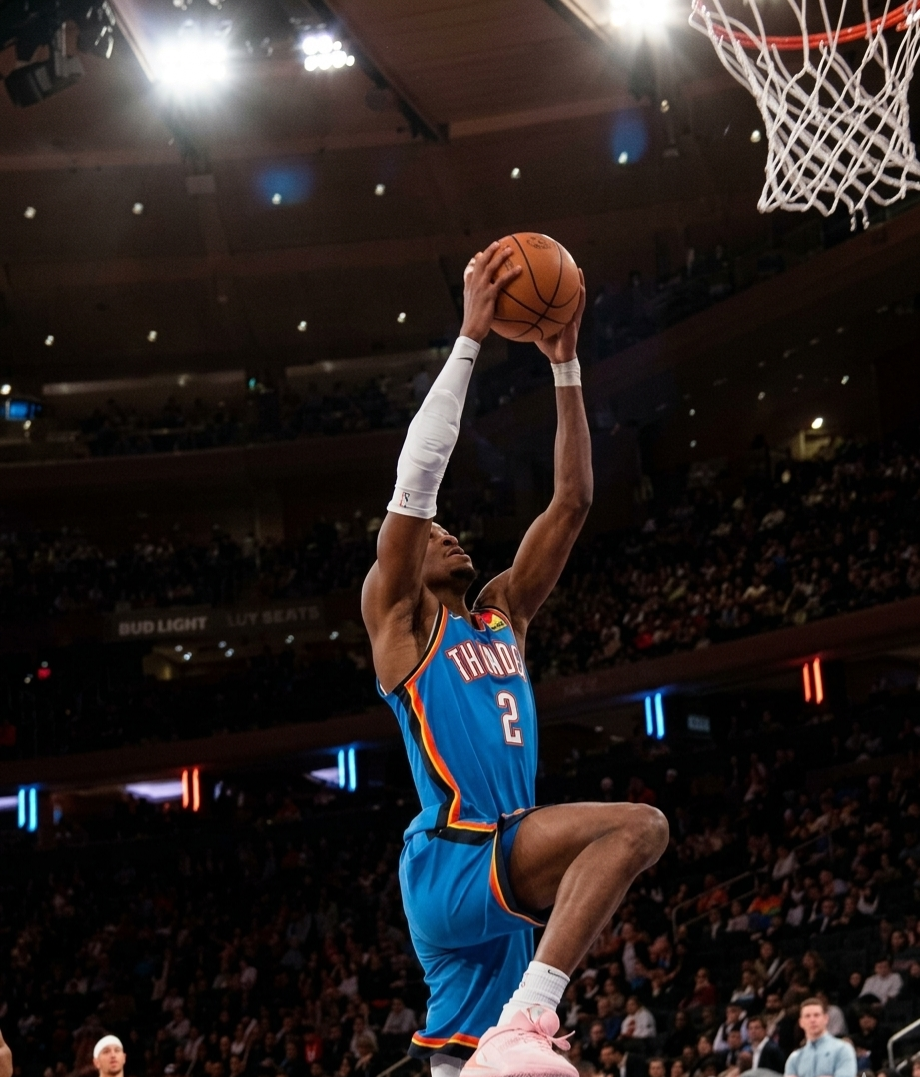
Madison Square Garden has a way of interrogating young teams.
The building doesn’t ask politely. It demands answers.
For decades, the arena at Madison Square Garden has been where momentum shifts feel louder, mistakes echo longer, and every possession seems slightly heavier than the one before it. If a roster has doubt hiding beneath its surface, the Garden tends to find it.
On Wednesday night, the Oklahoma City Thunder walked into that building and showed something important about themselves.
They don’t blink.
Oklahoma City’s 103–100 victory over the New York Knicks was not a flawless performance. It wasn’t even comfortable. In fact, for about twelve minutes in the third quarter, it looked as if the Thunder might lose control of a game they had largely dictated.
But in the final analysis, that’s precisely what made the night revealing.
The Thunder did not panic. They recalibrated.
And in the process, they reinforced the increasingly unavoidable conclusion forming around the league: this team understands exactly who it is.
The Holmgren Evolution
For much of the night, the most imposing player on the floor wasn’t wearing a Knicks jersey, despite the presence of interior force Karl-Anthony Towns.
It was Chet Holmgren.
Holmgren finished with 28 points and eight rebounds while tying a career high with six three-pointers. Those numbers alone would qualify as a strong outing. What mattered more was how he accumulated them.
The Knicks tried different approaches. They switched smaller defenders onto him on the perimeter. They attempted to close space quickly when he drifted beyond the arc. Occasionally they sagged off, hoping to bait him into jump shots.
None of it worked for long.
Holmgren has reached a fascinating point in his development where his presence alone begins to bend defensive geometry. When he steps beyond the three-point line, traditional rim protection disappears with him. When defenders chase him outside, driving lanes quietly appear elsewhere.
That’s the paradox of Holmgren’s skill set.
He stretches the floor like a wing but still influences the paint like a center.
And in a game decided by three points, those inches of space matter.
New York’s Third-Quarter Punch
If the Thunder seemed comfortable early, it didn’t last forever.
The Knicks erupted in the third quarter for 40 points, suddenly transforming a manageable Oklahoma City lead into a knife-edge game. The arena woke up. The crowd surged. Momentum tilted hard toward the home side.
The catalyst was Jalen Brunson.
Even on a difficult shooting night — 5-for-18 from the field — Brunson controlled the tempo with surgical passing. His 15 assists reflected a player probing for weaknesses rather than forcing offense. Every trap the Thunder showed seemed to create another passing angle.
For a stretch, it looked like the Knicks had discovered the formula: pressure the ball, move it quickly, and dare Oklahoma City’s supporting cast to respond.
Against lesser teams, that surge might have been decisive.
But Oklahoma City never fully lost its shape.
Dort and the Invisible Work
The stat sheet rarely captures the full value of Lu Dort.
Sixteen points is respectable production. Yet numbers alone don’t describe the gravitational pull of Dort’s defense — the way his physicality drains an opponent’s rhythm over the course of four quarters.
Brunson eventually finished with strong playmaking totals, but none of those assists came easily. Dort made every catch uncomfortable, every dribble slightly more deliberate.
There’s a cumulative effect to that kind of defense.
By the fourth quarter, the game slows down. Legs feel heavier. Decisions take an extra half-second.
Those are the moments when defensive pressure earlier in the night begins to matter.
The MVP Moment
And then, inevitably, the ball found Shai Gilgeous-Alexander.
The Thunder guard finished with 26 points and eight assists, but the defining sequence came late in the fourth quarter. With New York closing the gap and the Garden growing restless with anticipation, Gilgeous-Alexander created space for a familiar shot.
One dribble. A subtle retreat. A step-back three.
The ball dropped cleanly through the net with just over a minute remaining.
That possession did more than extend Oklahoma City’s lead. It quieted a building that had begun to sense opportunity.
Gilgeous-Alexander has developed a habit of these moments — not dramatic buzzer-beaters, but precise, surgical shots that restore order. The kind that remind everyone on the floor which team controls the rhythm.
There’s a calmness to his game that is easy to overlook because it rarely involves theatrics.
But calmness travels well in hostile environments.
The Closing Test
Even after Gilgeous-Alexander’s dagger, the Knicks had their chances.
Two final three-point attempts — one from Brunson and another from OG Anunoby — could have tied the game in the final seconds. Both rattled away.
That outcome wasn’t luck alone.
The Thunder defended the final possessions with discipline, refusing to overcommit while still contesting cleanly. It’s the type of composure that rarely shows up in highlight packages but frequently decides tight games.
Young teams often crumble in those moments.
Oklahoma City didn’t.
A Different Kind of Contender
What makes this Thunder team interesting isn’t simply its record.
At 49–15, Oklahoma City sits comfortably among the NBA’s elite. But the numbers don’t fully capture the team’s identity.
This roster doesn’t rely on overwhelming star power alone. Instead, it thrives on interconnected pieces — shooters who move without the ball, defenders who switch seamlessly, bigs who can facilitate from the perimeter.
The system encourages adaptability.
One night Holmgren stretches the floor with shooting. Another night Gilgeous-Alexander controls the midrange. On a different evening, the defense dictates the game.
That flexibility becomes especially valuable in March and April, when opponents begin testing every possible weakness.
The Thunder rarely look surprised by those tests.
The Psychological Shift
There was a time, not long ago, when Oklahoma City’s success felt slightly theoretical.
The talent was obvious. The potential was exciting. But youth carries an unavoidable question: what happens when the pressure rises?
Games like Wednesday’s begin to answer that.
Winning at Madison Square Garden requires a specific kind of composure. Momentum swings harder. Noise grows louder. And mistakes feel amplified under the spotlight.
Yet the Thunder handled the chaos with a veteran’s patience.
They absorbed the Knicks’ third-quarter surge. They leaned on their defensive structure. And when the moment demanded a closer, Gilgeous-Alexander delivered.
That’s not just talent.
That’s maturity.
The Message to the League
For the rest of the NBA, the takeaway from Oklahoma City’s road trip should be uncomfortable.
This team doesn’t collapse when momentum shifts. It doesn’t unravel when a hostile crowd senses blood. And it doesn’t need one specific formula to win.
Sometimes it’s defense.
Sometimes it’s Holmgren stretching the floor.
Sometimes it’s Gilgeous-Alexander quietly taking control late.
On Wednesday night, it was all three.
And if a team can survive a 40-point quarter from an Eastern Conference contender in the middle of Madison Square Garden — then calmly close the door anyway — that team has likely moved beyond the “promising” stage.
The Thunder are the defending World Champions.
They’re behaving like it as well.
Follow us on Instagram & Facebook