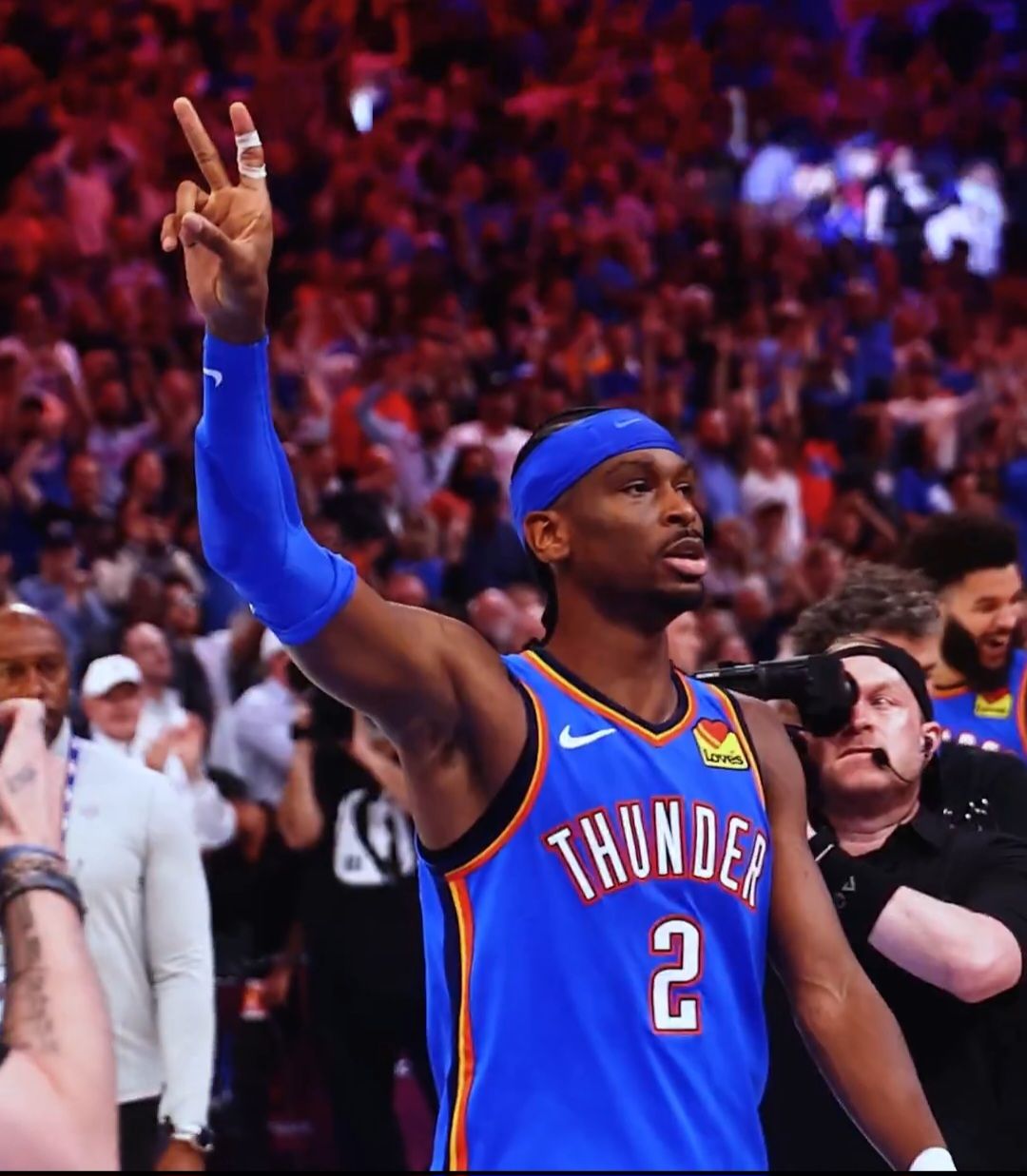
There are nights in the NBA when the story practically writes itself.
A last-second shot.
A star performance.
A sellout crowd roaring as the ball drops clean through the net.
Monday night in Oklahoma City had all of those things when the Thunder escaped with a 129–126 win over the Denver Nuggets. The game ended with Shai Gilgeous-Alexander rising over a defender and drilling a step-back three with 2.7 seconds remaining. It capped a stat line that looked like something from a video game: 35 points, 15 assists, nine rebounds, and—almost impossibly—zero turnovers.
It also tied him with Wilt Chamberlain for one of the most absurd consistency records in league history: 126 consecutive games scoring at least 20 points.
Those are the headlines.
But the part that should make the rest of the Western Conference uncomfortable wasn’t the shot, or the stat line, or even the record. It was the way the Thunder operated all night before that moment ever arrived.
Because the defining trait of Oklahoma City right now isn’t flash.
It’s control.
And Monday’s win over Denver might be the clearest example yet.
The Calm in the Storm
The Nuggets threw plenty at Oklahoma City.
Early in the game, Aaron Gordon came out firing, dropping 19 first-quarter points and bullying his way to the rim. Later, Nikola Jokić delivered the kind of all-around performance that has turned him into a perennial MVP candidate—32 points, 14 rebounds, and 13 assists.
Late in the fourth quarter, the chaos hit its peak.
With Oklahoma City clinging to a narrow lead, Jokić drilled a three. On the same possession, an off-ball foul sent Jamal Murray to the line for a free throw. Four quick points later, the game was tied with 8.5 seconds left.
Momentum? Denver had it.
Emotion? Denver had that too.
But panic never showed up on the Thunder bench.
That’s where the difference was.
The Shai Equation
Gilgeous-Alexander finished with 15 assists and didn’t commit a single turnover.
Pause there for a moment.
The NBA is built on mistakes. Even the best point guards cough the ball up while probing defenses, forcing passes, or getting trapped. Handling the ball that much without a single giveaway requires not just skill, but a level of control that borders on surgical.
Every possession seemed to unfold on his terms.
Denver tried trapping. He slipped passes to shooters.
They sagged into help coverage. He attacked the seams.
They switched defenders. He picked his matchup and went to work.
That’s how a player ends up with both 35 points and 15 assists without looking like he’s forcing either.
And when the final possession arrived, there was never any question whose hands the ball would find.
The play itself wasn’t complicated. No elaborate screen maze. No trick action.
Just a star creating space and trusting his rhythm.
The step-back three floated up. The arena leaned forward.
Swish.
Game over.
The Part Everyone Should Notice
The shot will be replayed all week.
But the deeper story unfolded long before the final seconds.
Oklahoma City walked onto the floor missing three starters: Chet Holmgren, Isaiah Hartenstein, and Jalen Williams.
Against most teams, that’s a manageable inconvenience.
Against Denver—a roster anchored by the most dominant playmaking center in basketball—it could have been a disaster.
Instead, the Thunder adjusted their identity for the night.
Spacing became the weapon.
That’s where Jaylin Williams entered the picture.
Williams delivered the best shooting night of his career: 29 points, 12 rebounds, and seven three-pointers. Those threes weren’t just points—they were strategic pressure. Each one dragged Jokić farther from the paint, opening lanes for Gilgeous-Alexander to dissect the defense.
By the middle of the second quarter, the geometry of the game had changed.
Denver’s size advantage disappeared.
Driving lanes opened.
The Thunder offense started humming.
A Night for the Supporting Cast
Another storyline quietly developed in the background.
Ajay Mitchell, returning after a 20-game absence, poured in 24 points.
Bench units often determine the shape of games like this. Oklahoma City’s reserves didn’t just hold the line—they flipped the momentum.
The Thunder outscored Denver by nine points in the second quarter, turning an early deficit into a halftime lead.
That stretch mattered.
When the final minute arrived and the game tightened, Oklahoma City wasn’t trying to climb back into it.
They were protecting ground they had already taken.
The Western Conference Message
The standings matter in March, and this one moved the needle.
At 51–15, Oklahoma City owns a three-game cushion atop the Western Conference.
But seeding alone doesn’t capture what Monday’s game suggested.
Beating Denver in a close game carries a certain symbolism in the West. The Nuggets represent the league’s most intricate offensive system and one of its most battle-tested cores.
To handle that challenge while shorthanded—and still produce a late-game execution clinic—speaks to something deeper than a single win.
It points to a team that understands itself.
Rotations shift. Lineups change. Injuries appear.
The style remains steady.
The MVP Conversation
Gilgeous-Alexander tying Chamberlain’s 20-point streak record adds another layer to the season he’s putting together.
Chamberlain’s name lives in a statistical universe that modern players rarely approach. When someone intersects with one of those records, it demands attention.
But the streak itself doesn’t fully describe what makes Gilgeous-Alexander unique.
Consistency isn’t just about scoring totals.
It’s about rhythm.
Watch enough Thunder games and a pattern emerges: possessions slow down when he wants them to slow down. Defenses start reacting instead of dictating.
That’s the hallmark of a player who sees the entire floor a beat ahead.
And it’s why nights like Monday don’t feel fluky.
They feel inevitable.
The March Reality Check
March basketball in the NBA can be deceptive.
Veteran teams coast. Playoff contenders manage minutes. Games blur together in the long stretch before April.
But occasionally one snaps into focus.
Thunder–Nuggets had that energy.
The pace was sharp. The physicality felt real. Every possession in the final minutes carried a playoff edge.
Which makes the ending even more telling.
When the clock ticked down and the defense tightened, Oklahoma City placed the game in the hands of its star and trusted the moment.
The ball rose.
The arena held its breath.
And when it dropped through the net, it left behind a simple truth about where this season is heading.
The Thunder aren’t waiting for April to figure out who they are.
Follow us on Instagram & Facebook