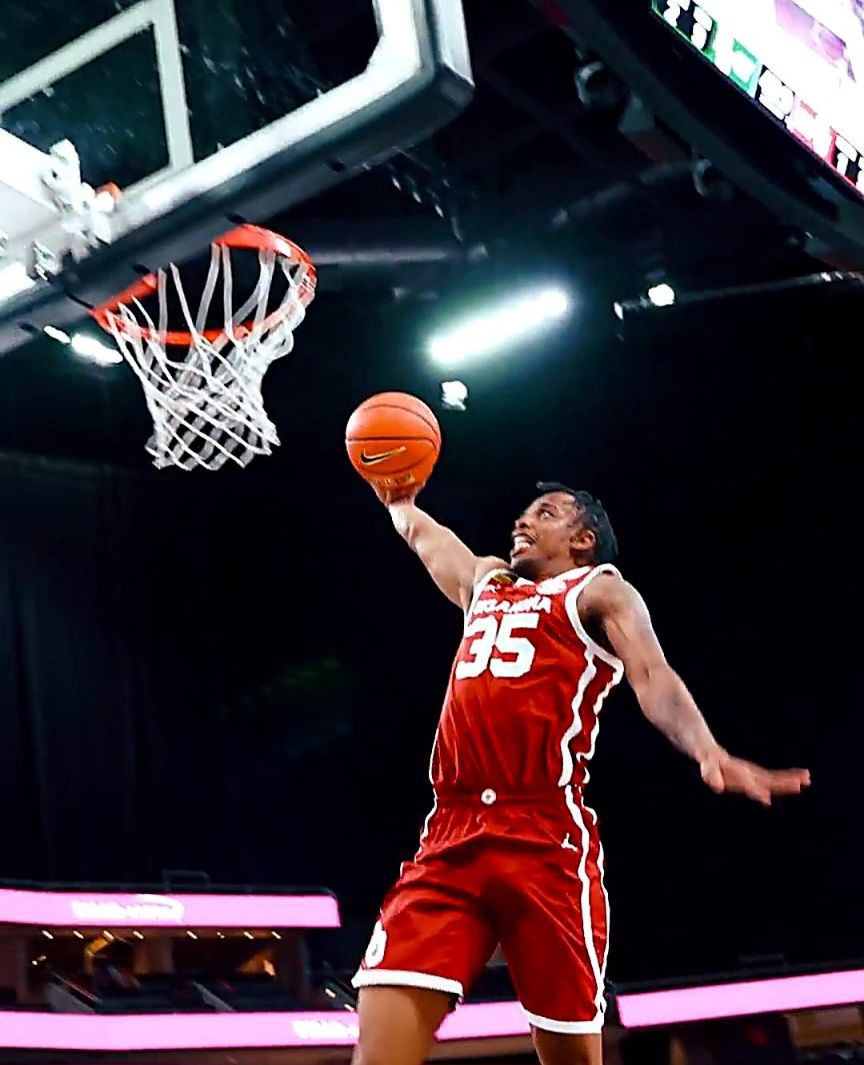
Saturday’s 82–69 semifinal win over Baylor in the College Basketball Crown wasn’t just another postseason victory for Oklahoma. It wasn’t simply a step toward a trophy or a response to being left out of the NCAA Tournament.
It was a declaration.
A line drawn between what Oklahoma basketball was—inconsistent, fragile, and perpetually stuck on the bubble—and what it is rapidly becoming under Porter Moser: resilient, disciplined, and unmistakably dangerous.
For the first time in a long time, this didn’t feel like a team trying to prove it belonged.
It felt like a team that already knows it does.
The Moment That Would Have Broken Them
To understand why this win matters, you have to understand what came before it.
For much of the season, Oklahoma has lived in a familiar—and frustrating—space. Competitive, but not complete. Talented, but not trustworthy late in games. A team that could build leads, but rarely sustain them.
So when Baylor ripped off a 13–3 run early in the second half—erasing a double-digit Oklahoma lead and flipping the momentum—there was a sense of déjà vu.
This is how it used to go.
This is where Oklahoma used to unravel.
But Saturday wasn’t about the past.
Instead of folding, the Sooners responded with a 19–8 closing surge that didn’t just win the game—it controlled it. Possession by possession, Oklahoma reasserted itself with poise, defensive intensity, and an understanding of the moment.
That response is the difference between a team that hopes to win and one that expects to.
And that’s why this felt different.
Smarter, Sharper, More Intentional
Oklahoma didn’t outgun Baylor.
They outthought them.
The Sooners turned Baylor’s mistakes into a landslide advantage, outscoring the Bears 21–2 off turnovers. That’s not luck. That’s preparation meeting opportunity. That’s a team anticipating actions, jumping passing lanes, and turning defense into instant offense.
It’s also a reflection of identity.
For years, Oklahoma has tried to win games by matching opponents shot-for-shot. When the offense stalled, so did everything else. But this version of the Sooners doesn’t rely on being perfect offensively.
They create their own margin.
Holding Baylor to 39% shooting and just 20% from three-point range wasn’t just impressive—it was intentional. Rotations were crisp. Closeouts were disciplined. Effort never dipped.
That’s what sustainable basketball looks like in April.
Because while shooting comes and goes, defense travels.
The Backcourt That Changed Everything
Every program turnaround has a centerpiece.
For Oklahoma, it’s the backcourt.
Xzayvier Brown’s performance against Baylor wasn’t just good—it was transformational. Twenty-one points. Thirty-five minutes. Zero turnovers.
Zero.
Against a Scott Drew defense designed to create chaos, Brown didn’t just survive—he dictated. He controlled pace, made the right reads, and never gave Baylor the easiest path back into the game: live-ball turnovers.
That’s the gold standard.
And alongside him, Nijel Pack continues to provide exactly what every postseason team needs: a steadying force with a scorer’s mentality and a veteran’s composure. His 15 points and three steals weren’t just production—they were timely, disruptive, and essential.
Together, they form something Oklahoma hasn’t consistently had in recent years:
A backcourt you can trust when everything is on the line.
Depth That Signals Something Bigger
Here’s where the conversation shifts from a good team playing well to a program taking a leap.
Oklahoma’s bench outscored Baylor’s 24–13.
That number matters more than it seems.
Because depth isn’t just about rotation—it’s about reliability. It’s about knowing that when the starters sit, the standard doesn’t drop. It’s about sustaining pressure, energy, and execution for 40 minutes.
In the past, Oklahoma’s margin for error was razor thin. If one or two players struggled, the entire structure wobbled.
Now, there’s insulation.
There’s balance.
There’s belief that the next man up won’t just hold the line—but extend it.
That’s how programs move from middle-tier to consistently relevant.
The Psychological Breakthrough
Perhaps the most telling element of this run isn’t tactical.
It’s psychological.
Teams that get left out of the NCAA Tournament often treat secondary tournaments like obligations. The energy dips. The focus wavers. The disappointment lingers.
That hasn’t happened here.
Oklahoma has embraced this stage.
They’ve played with urgency, purpose, and—most importantly—hunger. They aren’t acting like a team that was snubbed. They’re playing like a team with something to prove.
And the results back it up: an average margin of victory of 13.5 points in this tournament isn’t survival—it’s dominance.
That shift in mindset matters.
Because winning breeds identity. Identity builds culture. And culture is what sustains success long after a single season ends.
The NIL Era and a New Reality
There’s another layer to this that can’t be ignored.
With $300,000 in NIL prize money on the line, the stakes in the College Basketball Crown aren’t symbolic—they’re tangible. And Oklahoma’s performance validates the growing investment in the program.
Athletic director support. Resource allocation. Roster construction.
All of it is converging at the right time.
What Porter Moser has talked about for years—the “underdog spirit”—is now being paired with execution, depth, and opportunity. That combination is powerful.
Because in today’s college basketball landscape, belief alone isn’t enough.
But belief backed by structure? That’s how programs rise.
More Than a Run
It would be easy to call this a hot streak.
It would be convenient to frame it as a team catching fire in March after a disappointing regular season.
But that misses the point.
This doesn’t feel temporary.
It feels foundational.
The Sooners aren’t just winning—they’re winning the right way. With defense. With discipline. With guard play that eliminates mistakes and creates advantages.
They’re closing games instead of losing them. They’re dictating tempo instead of reacting to it. They’re playing like a team that understands exactly who it is.
That’s not a streak.
That’s a shift.
The Verdict
Saturday’s win over Baylor wasn’t just a semifinal victory.
It was a turning point.
A program that spent months defined by inconsistency and near-misses is now defining itself through resilience and execution. The Sooners didn’t just beat a high-caliber opponent—they imposed their identity on them.
And in doing so, they answered the biggest question that has hovered over this program:
Can Oklahoma be trusted in big moments?
Right now, the answer is yes.
And if that continues, this won’t just be remembered as a strong postseason run.
It will be remembered as the moment Oklahoma basketball turned the corner—for good.
Follow us on Instagram & Facebook