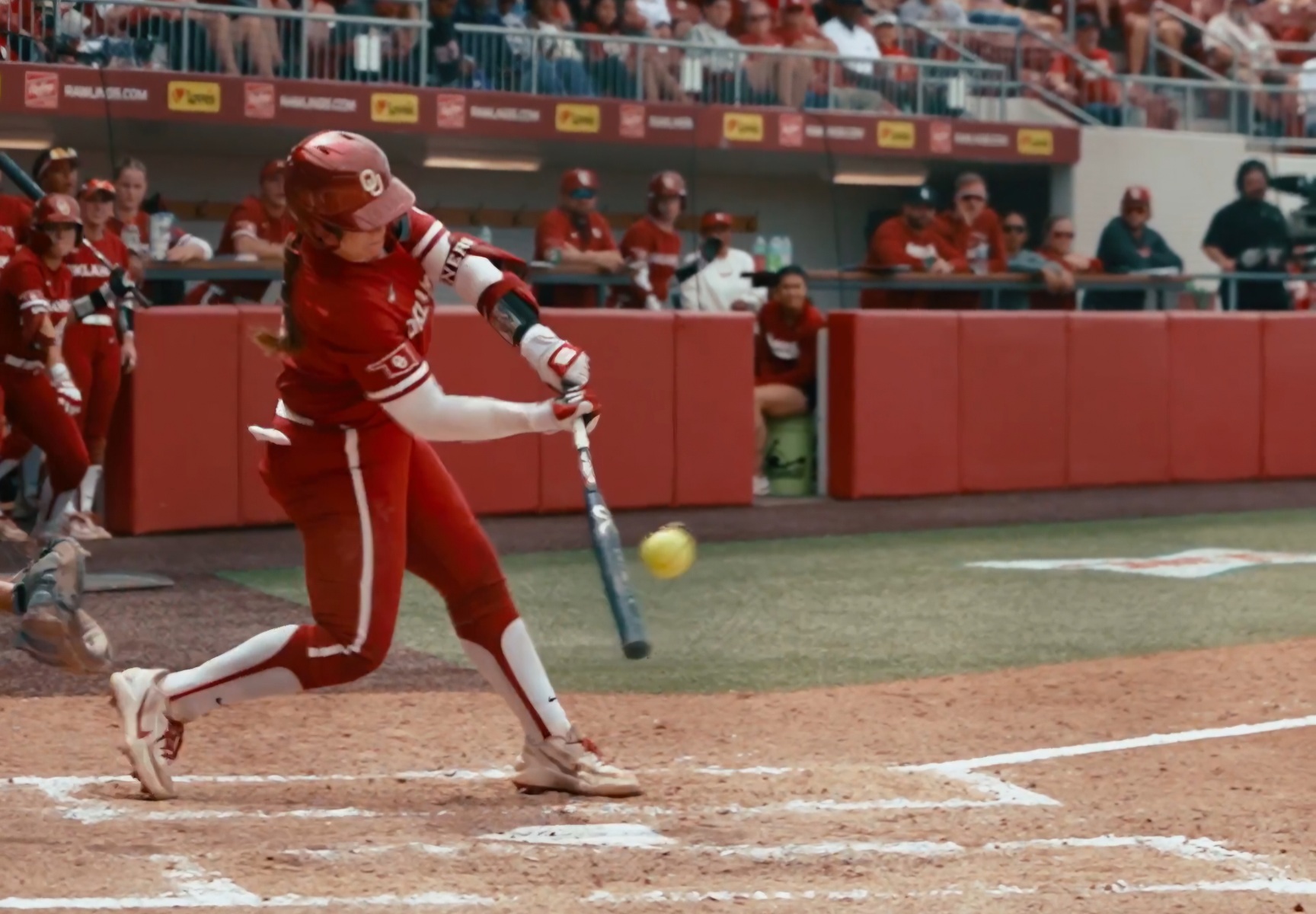
It didn’t take long for the game to turn—but once it did, it turned completely. What started as a brief Kentucky spark quickly became another Oklahoma avalanche, the kind that shows up just as clearly in the stat sheet as it does on the scoreboard.
No. 3 Oklahoma’s 9-1 run-rule victory over Kentucky wasn’t just a continuation of a dominant series—it was a statistical blueprint of why this team is built to overwhelm opponents in layers. From two-out production to freshman impact to pitching efficiency, every number attached to this game reinforces a central truth:
This is a team that doesn’t rely on one path to win—it creates multiple.
Let’s go inside the numbers that defined Oklahoma’s series-clinching performance.
9 Unanswered Runs — The Flip That Defines Them
Start with the most telling number of the afternoon: nine unanswered runs.
For the second straight game, Oklahoma trailed a home run in the top of the first—this time off the bat of Kentucky’s Carly Sleeman. And for the second straight game, that early deficit proved meaningless.
Because what followed wasn’t just a response—it was a takeover.
Nine consecutive runs reflect more than offensive production. They highlight sequencing, discipline, and an ability to compound pressure inning after inning. Oklahoma didn’t rely on one big swing to flip the game. They built it—walk by walk, at-bat by at-bat, mistake by mistake.
By the end of the fourth inning, the scoreboard had completely inverted, and Kentucky was left chasing a game that had already slipped away.
6 Two-Out Runs — The Championship Indicator
If there’s one number that should command the attention of anyone evaluating Oklahoma’s ceiling, it’s this:
Six runs scored with two outs.
That’s not just efficiency—that’s demoralizing execution.
Two-out hitting is often considered the clearest indicator of offensive toughness. It requires focus under pressure, the ability to extend innings, and a refusal to let pitchers off the hook.
Oklahoma did all three—repeatedly.
The Sooners didn’t just capitalize on opportunities; they created them after Kentucky thought it had done enough to escape innings. Every two-out rally extended pressure, forced additional pitches, and compounded defensive stress.
It’s the kind of trait that separates good lineups from elite ones.
And Oklahoma continues to prove it belongs in the latter category.
5 RBIs — Lexi McDaniel’s Signature Performance
There are productive days—and then there are defining ones.
Freshman Lexi McDaniel delivered the latter, finishing with five RBIs in a performance that shaped every critical scoring moment for Oklahoma.
- RBI via walk in the first
- Two-RBI single in the second
- Two-run home run in the fourth
That’s impact across three separate innings, in three different ways.
What stands out most isn’t just the total—it’s the versatility. McDaniel produced with patience, with contact, and with power. She didn’t need the perfect pitch or situation. She created outcomes regardless of context.
For a freshman, that level of situational command is rare.
For Oklahoma, it’s becoming expected.
29 Home Runs — Kendall Wells on the Brink
Another game, another milestone approached.
With her solo shot in the third inning, Kendall Wells reached 29 home runs on the season—just one shy of tying the NCAA freshman single-season record.
Let that settle for a moment.
Twenty-nine home runs. In early April.
And what makes it even more significant is how seamlessly it fits into Oklahoma’s offensive identity. Wells’ power doesn’t disrupt the flow—it enhances it. Her home run on Friday came with no drama, no buildup. Just another swing in a lineup that never stops applying pressure.
That’s what makes her chase historic.
It’s not forced.
It’s inevitable.
4 Walks, 1 Hit — First-Inning Efficiency
The first inning told a story that numbers alone rarely capture this clearly:
Four walks. One hit. Two runs.
Oklahoma needed just a single hit to erase Kentucky’s early lead, using plate discipline to manufacture offense before the bats fully ignited.
This is where Oklahoma separates itself from traditional power-heavy teams. Yes, the Sooners can hit home runs—but they don’t depend on them. They’re just as comfortable taking walks, forcing pitch counts, and letting innings unfold organically.
In Friday’s first inning, patience created production.
And it set the tone for everything that followed.
5 Straight Reaching Base — The Second-Inning Break
The game’s decisive stretch came in the second inning, and it can be distilled into one number:
Five consecutive Sooners reached base.
That sequence turned a manageable game into a runaway.
What makes it more significant is how it started—with a defensive miscue by Kentucky. A dropped fly ball opened the door, and Oklahoma wasted no time kicking it off the hinges.
Five straight batters reaching base is not just a rally—it’s a collapse forced by relentless pressure.
And when Oklahoma senses that moment, it doesn’t hesitate.
It accelerates.
9 Straight Retired — Guachino’s Control
While the offense dominated headlines, Miali Guachino quietly authored one of the most important stretches of the game:
Nine consecutive Kentucky batters retired.
After allowing the leadoff home run, Guachino didn’t just recover—she took control.
Across the middle innings, she neutralized Kentucky’s lineup, eliminating any chance of a counterpunch. No free passes. No extended rallies. Just efficient outs and controlled tempo.
Her final line—4 innings, 3 hits, 1 run, 3 strikeouts, 0 walks—reflects exactly what Oklahoma needs from its pitching staff in 2026:
Consistency over flash. Control over chaos.
And most importantly, the ability to stabilize games while the offense builds separation.
28 Run-Rule Wins — A Program Standard
With Friday’s victory, Oklahoma recorded its 28th run-rule win of the season.
That number is staggering.
Run-rule wins aren’t just victories—they’re declarations. They signify dominance so complete that the game is shortened by rule.
To do it 28 times before the postseason isn’t just impressive—it’s indicative of a program operating at a different level of expectation.
This isn’t about winning close games.
It’s about ending them early.
29 Straight Home Wins — Love’s Field Advantage
Another number that continues to grow:
29 consecutive home victories.
Love’s Field isn’t just a venue—it’s an amplifier.
Opponents walk into an environment where momentum builds quickly and rarely reverses. Once Oklahoma gains control, the combination of crowd energy and on-field execution becomes suffocating.
Friday followed that script exactly.
An early Kentucky lead briefly quieted the crowd. Oklahoma’s response reignited it. And from there, the game took on a familiar rhythm—one that heavily favors the home team.
13 Comeback Wins — Resilience as a Weapon
Finally, consider this:
13 comeback victories this season.
That’s not a coincidence.
It’s a characteristic.
Oklahoma doesn’t just withstand early deficits—it almost seems to expect them. And once they occur, the response is immediate, calculated, and often overwhelming.
Friday’s game was simply the latest example.
Down 1-0 after the top of the first first inning of the game.
Up 6-1 two innings later.
That’s not recovery.
That’s identity.
The Bigger Picture in the Numbers
Add it all together, and the story becomes clear:
- 9 unanswered runs
- 6 two-out runs
- 5 RBIs from a freshman
- 29 home runs from another freshman
- 0 walks allowed by the starting pitcher
- 28 run-rule wins on the season
This isn’t just a team playing well.
This is a team checking every championship box—offense, pitching, defense, depth, and resilience.
And perhaps most importantly, doing it in ways that translate to postseason success.
Because when you can score without hits, extend innings with two outs, shut down momentum in the circle, and end games early—you’re not just beating teams.
You’re breaking them.
On Friday afternoon in Norman, the numbers didn’t just explain Oklahoma’s 9-1 win over Kentucky.
They defined it.