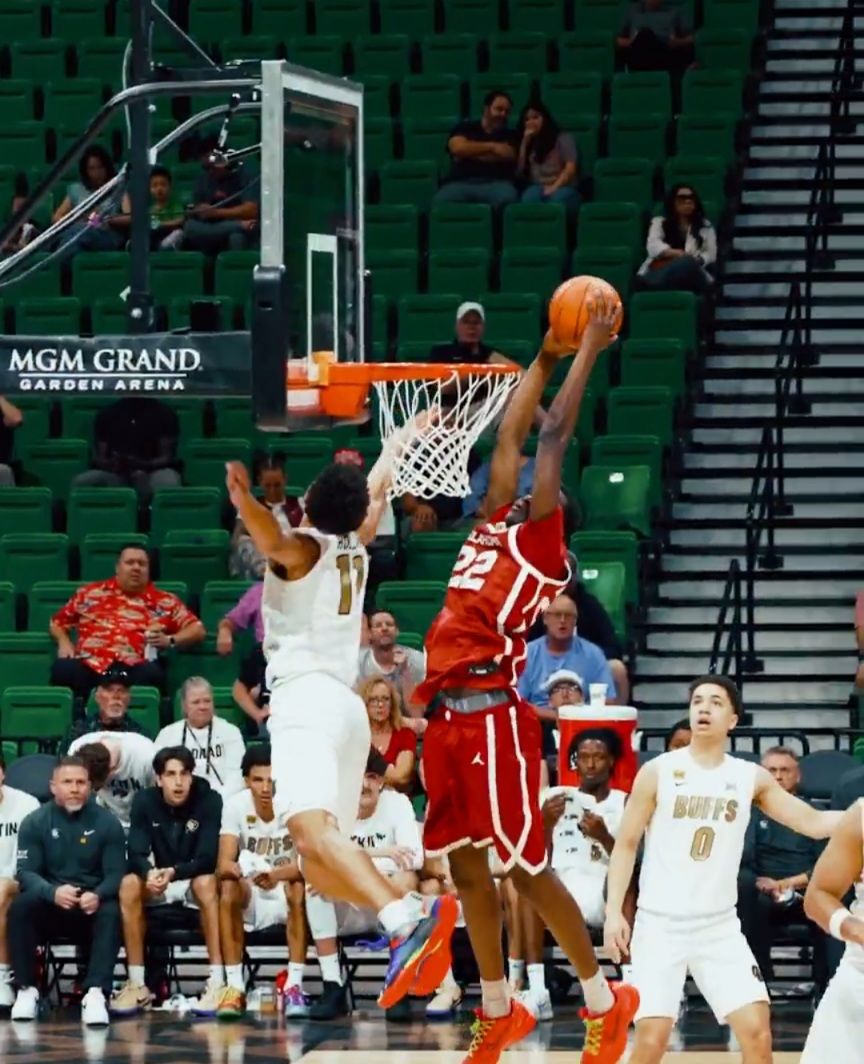
For years, Oklahoma basketball has lived in a perpetual state of “almost.”
Almost consistent.
Almost physical enough.
Almost an NCAA Tournament team.
It’s the purgatory of college basketball—too talented to tear down, too flawed to break through. And for much of Oklahoma’s era under Porter Moser, the program has been defined by one word:
Rebuilding.
That word no longer applies.
April 13, 2026, changed that.
The simultaneous announcements of Xzayvier Brown returning and Khani Rooths committing weren’t just roster updates. They were a declaration—a coordinated, calculated signal that Oklahoma is no longer trying to find itself.
It’s trying to win.
This is what retooling looks like.
The Anchor Point Every Contender Needs
Every serious team begins with clarity.
Not just talent—but structure.
And in a matter of hours, Oklahoma established both.
Brown’s return gives the Sooners something they haven’t consistently had: backcourt stability with proven production. A 15.4 points-per-game scorer and experienced floor general, Brown isn’t just a returning starter—he’s the connective tissue of everything Oklahoma wants to be offensively.
He sets tempo. He manages pressure. He carries institutional knowledge from a season that, while uneven, ended with real momentum.
Then comes Rooths.
At 6-foot-10, he doesn’t just fill a roster spot—he fills a philosophical void. Oklahoma needed length. It needed athleticism. It needed a frontcourt presence capable of surviving the SEC’s physical grind.
Rooths brings all three.
Together, they form an “inside-out” core that transforms Oklahoma from a collection of pieces into a team with a defined identity.
That’s not rebuilding.
That’s building around something real.
Proof That the Investment Is Finally Real
Let’s not ignore the timing.
These moves didn’t happen in isolation. They came on the heels of a public admission from athletic director Roger Denny that Oklahoma had been under-resourced—particularly in NIL and staffing.
For years, Oklahoma was playing catch-up in the SEC arms race. While others invested, the Sooners tried to maximize.
That model doesn’t work anymore.
So the university made a choice: invest, modernize, and compete.
And April 13 was the first tangible proof that those promises weren’t empty.
Landing a high-upside transfer like Rooths while retaining a cornerstone player like Brown is exactly what functional programs do. It’s what coordinated programs do.
It’s what serious programs do.
Even more telling? The speed.
In today’s transfer portal era, “speed to market” isn’t a business term—it’s a survival skill. The best programs don’t wait. They identify, engage, and secure talent before competitors can pivot.
That’s what Oklahoma did.
That’s new.
The Lucas McKay Effect Is Already Showing
You don’t need a press release to see the fingerprints of Lucas McKay all over this.
Hired as Oklahoma’s first-ever general manager, McKay wasn’t brought in to observe—he was brought in to operate. His role is simple in theory and complex in execution: turn Oklahoma into a modern basketball organization.
That means:
- Evaluating talent through analytics and fit
- Structuring NIL offers efficiently
- Managing the chaos of the transfer portal
- Building a roster, not just collecting players
The fact that Oklahoma secured its lead guard and a foundational frontcourt piece on the same day isn’t coincidence.
It’s coordination.
It’s strategy.
It’s the kind of front-office alignment that elite programs have embraced—and Oklahoma has lacked.
Add in the presence of Trae Young as a recruiting-facing figure, and the Sooners now have something they’ve never had before: a dual-layer system of attraction and execution.
Young opens doors.
McKay closes deals.
That’s how modern programs operate.
The Shift to “SEC-Sized” Basketball
If you watched Oklahoma last season, the issue wasn’t always effort.
It was size.
The SEC is unforgiving in the frontcourt. Length, athleticism, and physicality aren’t luxuries—they’re requirements. And too often, Oklahoma looked undersized, overmatched, or both.
Rooths changes that.
But he’s not alone.
With players like Derrion Reid and Kai Rogers, Oklahoma is quietly assembling a frontcourt that finally resembles the league it plays in—a trio of long, versatile athletes in the 6’8” to 6’10” range capable of switching defensively and protecting the rim.
This isn’t accidental.
It’s a philosophical pivot.
Call it the “Wall of Norman” if you want—but it’s clear what Oklahoma is building: a roster designed not just to compete in the SEC, but to survive it.
There’s risk, of course. Shooting could be inconsistent. Rooths himself isn’t a proven perimeter threat.
But that’s the trade-off Oklahoma is willing to make.
Because in this conference, you don’t win by being pretty.
You win by being physical, adaptable, and relentless.
From Reaction to Control
Here’s the biggest shift—and the one that matters most.
For years, Oklahoma has been reactive in the portal.
Lose players? Replace them.
Miss recruits? Pivot late.
Fall short? Try again next cycle.
That’s rebuilding.
What happened on April 13 was different.
Oklahoma dictated terms.
It retained its most important guard and added a high-impact forward in a coordinated move that sends a message to every remaining transfer in the portal:
The foundation is already here.
That matters.
Because players aren’t just choosing schools anymore—they’re choosing situations. Fit. Opportunity. Stability.
And now, when prospects look at Oklahoma, they don’t see a question mark.
They see a blueprint.
A point guard to play with. A frontcourt partner to build around. A system already taking shape.
That’s how dominoes fall.
Momentum Matters—And Oklahoma Is Using It
The timing also capitalizes on something Oklahoma hasn’t always been able to sustain: momentum.
A run to the College Basketball Crown final could have easily faded into offseason uncertainty. Instead, it’s been leveraged into retention and recruitment.
Keeping Brown ensures that the culture built during that run—resilience, composure, late-season growth—doesn’t walk out the door.
Adding Rooths ensures that culture has the talent to evolve.
This isn’t a reset.
It’s a continuation.
The Verdict
For the first time in the Porter Moser era, Oklahoma isn’t scrambling to rebuild a roster.
It’s strategically retooling one.
That distinction matters.
Rebuilding is about survival.
Retooling is about pursuit.
And everything about April 13—from the coordination, to the targets, to the underlying structure—suggests Oklahoma has finally shifted its mindset.
This is no longer a program hoping to sneak into relevance.
It’s a program positioning itself to stay there.
The pieces aren’t all in place yet. There are still roster spots to fill, questions to answer, and expectations to meet.
But the direction is undeniable.
Oklahoma isn’t starting over.
It’s loading up.
And in the SEC, that’s the difference between chasing the field—and becoming part of it.
Follow us on Instagram & Facebook