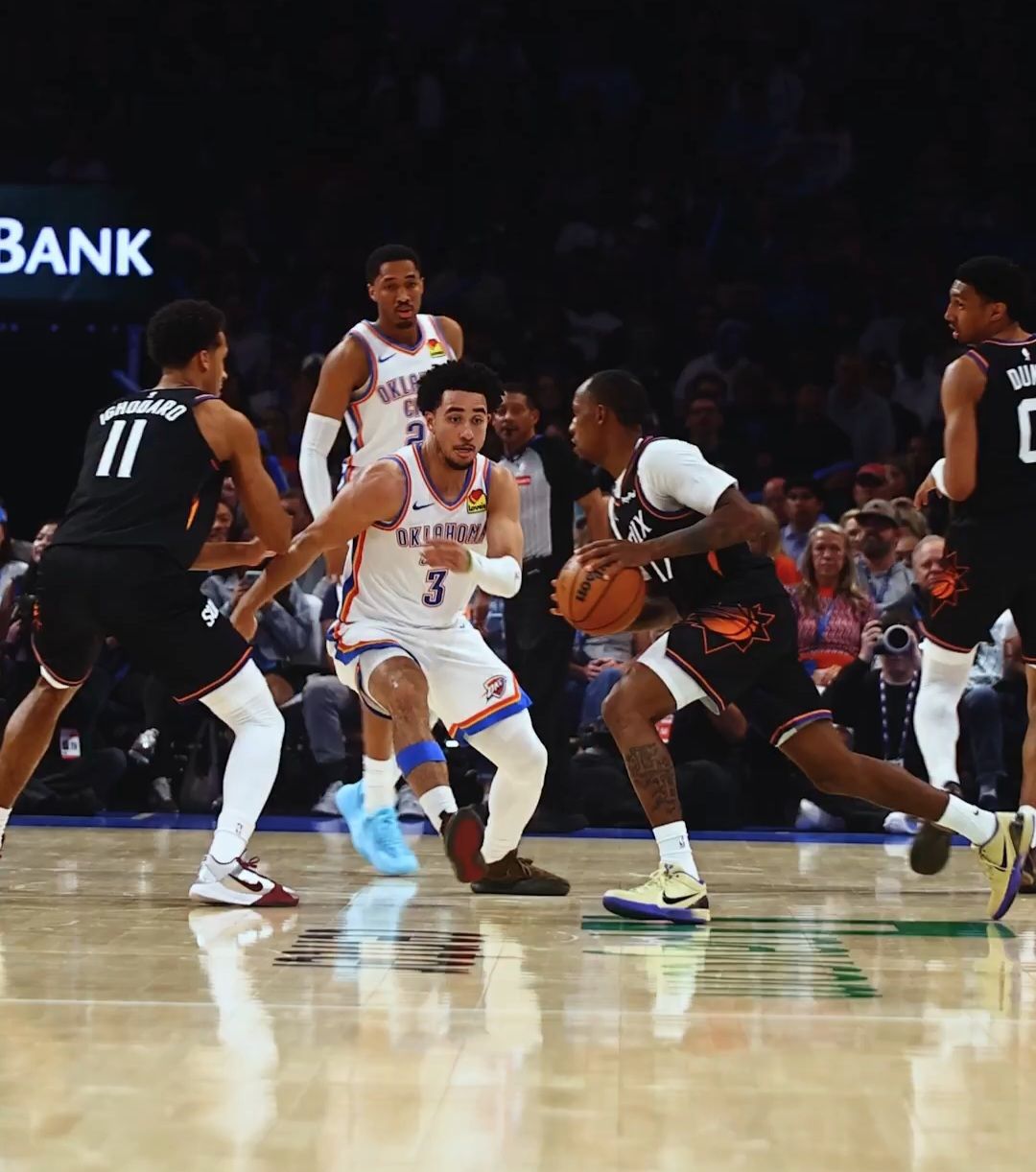
In a league that often confuses activity with progress, the Oklahoma City Thunder just delivered a quiet reminder of what real organizational clarity looks like.
Sunday’s regular-season finale—a lopsided loss that barely registered in the standings—wasn’t a failure. It wasn’t even particularly important in the traditional sense. But from a strategic lens, it was something far more telling: a masterclass in balancing championship ambition with individual player rewards.
This is what grown-up team building looks like in the NBA.
Because while fans saw a depleted roster and a 32-point defeat, the Thunder front office and coaching staff saw something entirely different: risk avoided, incentives honored, depth evaluated, and culture reinforced—all in a single night.
Championship Teams Know When Not to Compete
Start with the most obvious decision—the one casual observers often struggle with.
The Thunder rested 10 rotation players.
No Shai Gilgeous-Alexander. No Chet Holmgren. No meaningful minutes for the core group that powered Oklahoma City to a 64–18 record, the second-best mark in franchise history.
And that’s precisely the point.
When you’ve already secured the No. 1 overall seed, the final game of the regular season becomes a mathematical exercise. There is nothing left to gain—no seeding advantage, no statistical edge, no narrative boost that outweighs the inherent risk of injury.
History is littered with cautionary tales: stars tweaking ankles, suffering soft-tissue injuries, or entering the postseason less than 100% because of one unnecessary appearance in Game 82.
The Thunder refused to become the next example.
Instead, head coach Mark Daigneault treated the finale like what it truly was: a pre-playoff preservation window. Oklahoma City didn’t just earn the top seed—they maximized it. By sitting their core, they effectively extended their recovery period, ensuring their “engine” is fully operational when the games actually matter.
That’s not passivity. That’s discipline.
And it’s the kind of decision that separates contenders from champions.
The Precision of the Lu Dort Decision
If resting the stars was the macro-level strategy, the handling of Luguentz Dort was the micro-level masterpiece.
Dort played exactly 20 minutes.
Not 19. Not 21. Exactly 20.
That wasn’t coincidence—it was calculation.
Under the NBA’s current eligibility rules, players must appear in at least 65 games and log a minimum of 20 minutes in those games to qualify for end-of-season awards. Dort, widely viewed as a frontrunner for All-Defensive First Team honors, needed that threshold.
So the Thunder gave it to him.
And then they pulled him immediately.
It was a surgical decision—one that ensured Dort’s season would be recognized without exposing him to unnecessary wear and tear. In doing so, Oklahoma City accomplished two things simultaneously:
- Protected a key playoff contributor
- Validated a player’s individual achievement
That second point matters more than people realize.
Championship teams aren’t just built on talent. They’re built on trust. Players need to believe that the organization sees them—not just as interchangeable parts, but as professionals whose individual goals matter.
By prioritizing Dort’s award eligibility, the Thunder sent a clear message to the locker room: We will take care of you.
That message carries weight. It builds buy-in. It strengthens culture.
And culture, especially in the postseason, is often the difference between a good team and a great one.
A Defensive Identity Worth Rewarding
Dort’s candidacy isn’t symbolic—it’s earned.
The Thunder finished the season ranked No. 1 in defensive rating at 107.4, anchoring one of the most versatile and disruptive defenses in the league. Their +11.7 net rating also led the NBA, underscoring just how dominant they were on both ends of the floor.
Dort is central to that identity.
He guards the opposing team’s best perimeter player nightly. He absorbs physical matchups. He sets the tone. His impact doesn’t always show up in the box score, but it shows up in wins—and Oklahoma City had 64 of them.
Ensuring he qualifies for All-Defensive recognition isn’t just a nice gesture. It’s a reflection of organizational alignment. The Thunder reward what they value.
And what they value is defense, toughness, and consistency.
The Hidden Value of a 32-Point Loss
Now let’s talk about the part that will confuse people who only look at the scoreboard.
The Thunder lost big.
But in doing so, they gained something far more valuable than a regular-season win: information.
With the rotation gutted, Oklahoma City turned the finale into a live-action scouting session. And the returns were significant.
Nikola Topić logged 39 minutes and dished out 14 assists, tying a franchise rookie record. That’s not just production—that’s proof of concept. It showed that the Thunder have a secondary playmaker capable of running an offense under real NBA conditions.
Branden Carlson delivered one of the most intriguing stat lines of the night: 26 points, 10 rebounds, and 5 blocks. Even more compelling? His ability to stretch the floor, hitting 5-of-10 from deep, suggesting he can replicate elements of Holmgren’s role if needed.
Payton Sandfort added 23 points, including five made threes, reinforcing the Thunder’s “next man up” philosophy.
These aren’t just feel-good performances. They’re contingency plans.
Playoff basketball is unpredictable. Foul trouble happens. Injuries happen. Rotations tighten, but they also get tested. The teams that survive are the ones with playable depth—not just bodies, but contributors.
Sunday gave Oklahoma City confidence that their depth isn’t theoretical.
It’s ready.
The Bigger Picture: A Franchise Operating at Full Alignment
Zoom out, and the brilliance of the Thunder’s approach becomes even clearer.
They finished the regular season 64–18. They secured the No. 1 seed. They posted the league’s best net rating. They anchored the top-ranked defense. And they did it in a way that preserved their stars, empowered their role players, and strengthened their internal culture.
Even more telling? Their +11.7 net rating actually surpasses that of last year’s championship team.
That’s not just continuity. That’s evolution.
And the finale encapsulated that evolution perfectly.
It wasn’t about chasing 65 wins or polishing a résumé. It was about preparing for what comes next. It was about making decisions that prioritize April, May, and June—not April 13.
In a league obsessed with optics, the Thunder chose substance.
The Verdict
Yes, it was a boring night for fans expecting a competitive game.
Yes, the final score looked ugly.
But if you understand what championship basketball demands, you saw something else entirely.
You saw a franchise operating with clarity, precision, and purpose.
You saw a team that knows exactly who it is—and more importantly, what it wants.
And if the goal is an NBA Finals trophy, Sunday night wasn’t a throwaway.
It was a statement.
Follow us on Instagram & Facebook