In an era where college football rosters turn over almost as quickly as coaching staffs, continuity has become one of the sport’s rarest—and most valuable—commodities.
For Oklahoma, that rarity may be the foundation of something significant in 2026.
As the Sooners push through spring practice and toward the April 18 Spring Game, the biggest storyline isn’t a position battle or a schematic overhaul. It’s something far less flashy but far more impactful: Year Two of the offense under Ben Arbuckle with John Mateer at the controls.
And within the walls of the Switzer Center, there’s a growing sense that this version of the offense is built differently—not because it’s new, but because it finally isn’t.
The Continuity Advantage in a Portal Era
Across the SEC and the broader Power 4 landscape, most programs are still installing offenses each spring. Quarterbacks are learning terminology, receivers are adjusting to new route trees, and coordinators are trying to accelerate chemistry that typically takes years to develop.
Oklahoma is operating from a different starting point.
For Arbuckle and Mateer, 2026 marks their second season together in Norman—but more importantly, their fourth year working in tandem overall. That extended history has created a level of familiarity that is increasingly uncommon in modern college football.
Instead of teaching the system, Arbuckle is refining the player.
That distinction matters.
It shows up in practice tempo, where the Sooners are operating faster without sacrificing execution. It shows up in communication, where adjustments at the line of scrimmage are cleaner and more decisive. And it shows up in preparation, where conversations between quarterback and coordinator go beyond play calls and into philosophical tweaks.
Mateer recently described the relationship as one built on trust—one that allows for direct, sometimes difficult conversations about what works and what doesn’t. That kind of dialogue simply isn’t possible in first-year pairings.
The result is an offense that’s no longer trying to figure itself out. It’s trying to perfect itself.
A Spring Focused on Precision, Not Installation
Because the foundation is already in place, Oklahoma’s spring has taken on a different tone—particularly at quarterback.
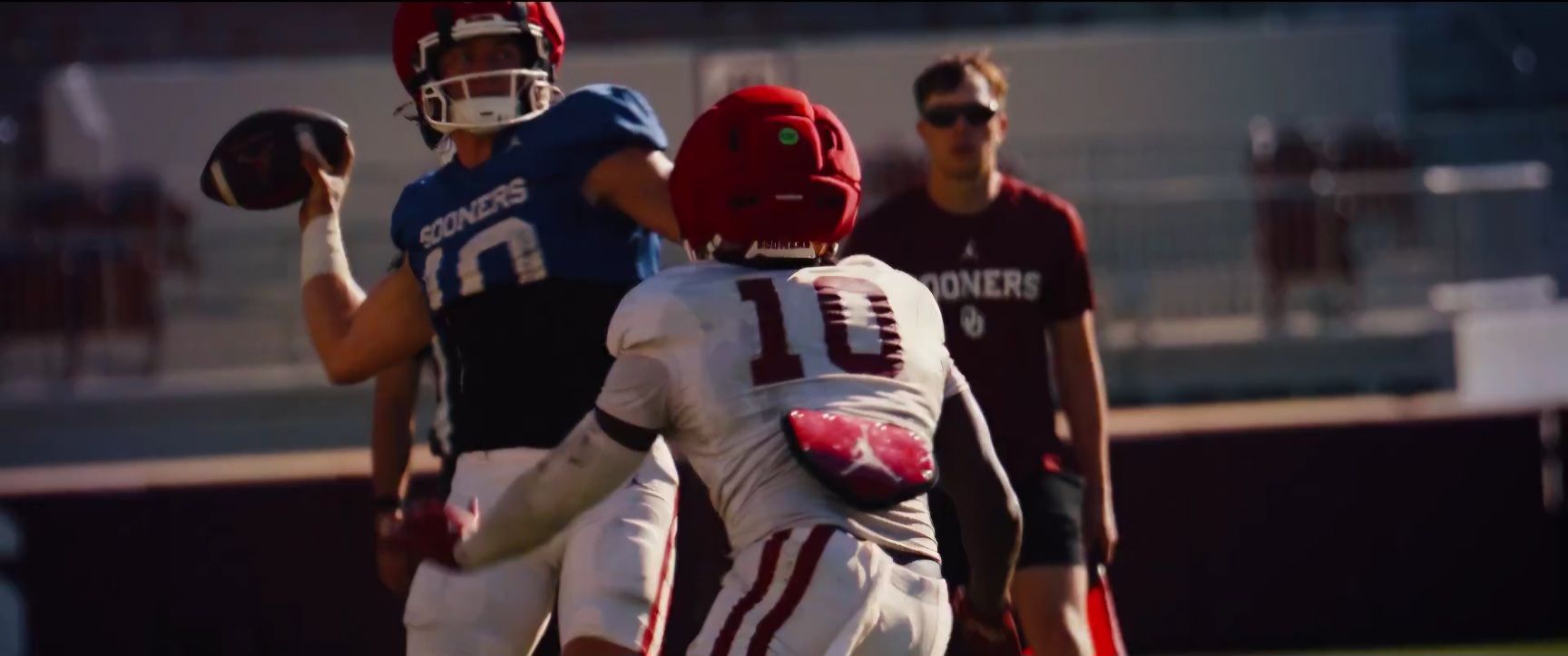
Rather than splitting time between learning new concepts and executing them, Mateer has spent the majority of the spring focused on technical refinement. The most notable area of emphasis has been his throwing mechanics.
After suffering a thumb injury during the 2025 season, Mateer adjusted his delivery to compensate. His arm angle dropped, shifting toward a more sidearm release that allowed him to manage discomfort but altered his consistency.
This spring, under quarterbacks coach John Kuceyeski, the goal has been to restore his natural motion.
The coaching staff has emphasized returning to an “over-the-top” release point—keeping the ball closer to the ear and improving trajectory and accuracy. It’s a subtle change, but one with significant implications for ball placement, especially on intermediate and vertical routes.
Beyond the release point, Mateer is also working through more advanced elements of quarterback play. Coaches have introduced variations in drop-backs and footwork, adjusting timing based on pass rush looks and coverage structures. It’s the type of detailed development typically reserved for upperclassmen preparing for the NFL, not quarterbacks still growing within a system.
But that’s the benefit of continuity. With the mental side of the game already established, the physical side can be refined.
Evolving for the SEC: A More Complete Offensive Identity
While Mateer’s development is central to Oklahoma’s progress, the evolution of the scheme itself may be just as important.
Arbuckle has been clear this spring: the Sooners cannot rely solely on a traditional Air Raid approach in the SEC.
That doesn’t mean abandoning the passing game—it means expanding the offense into something more balanced and more physical.
Last season exposed the need for that shift. Oklahoma’s run game struggled for consistency, finishing near the bottom of the FBS in several key metrics. At times, the lack of a reliable ground attack allowed defenses to key in on the passing game, limiting the offense’s overall effectiveness.
This spring, the focus has been on building a more efficient and physical rushing identity.
Running backs are being coached to finish runs with authority. Offensive linemen are emphasizing leverage and displacement. Practice drills have been restructured to prioritize physicality at the point of attack.
The goal is clear: establish a run game that complements the passing attack rather than existing as an afterthought.
If successful, it will force defenses to account for both dimensions—opening up opportunities for explosive plays downfield while providing a more consistent baseline for offensive production.
The Tight End Factor: Expanding the Playbook
One of the most noticeable changes within the offense has come at the tight end position, where new position coach Jason Witten has made an immediate impact.
Under Witten’s guidance, the tight end room has undergone a transformation—not just in personnel, but in purpose.
In previous seasons, tight ends were often supplementary pieces within the offense. This year, they are becoming integral components of the overall scheme.
Witten has introduced a more detailed, pro-style approach to the position, emphasizing blocking technique, route precision, and situational awareness. Players are being developed as complete tight ends—capable of contributing in both the run and pass game.
As a result, Oklahoma is expected to utilize more two-tight end sets, creating additional flexibility in both formation and play-calling.
This shift serves multiple purposes. It provides added support in the run game, helps counter the size and physicality of SEC defensive fronts, and creates mismatches in the passing game—particularly against linebackers and safeties.
In essence, the tight end position is becoming a bridge between Oklahoma’s spread roots and its evolving SEC identity.
Revisiting 2025: A Foundation with Untapped Potential
To fully understand the significance of these developments, it’s important to revisit the trajectory of the 2025 season.
In his first year as the starting quarterback, Mateer led Oklahoma to a 10–3 record and a College Football Playoff appearance—an impressive achievement given the circumstances.
Early in the season, the offense was among the most productive in the country. Mateer averaged over 300 passing yards per game through the first month, operating with efficiency and confidence.
The thumb injury altered that trajectory.
Following the injury, production declined. Passing yardage dropped, completion percentage dipped, and the offense lost some of its explosiveness. While still effective, it was no longer operating at its early-season peak.
And yet, even in that diminished state, Mateer delivered a strong performance in the playoff against the Alabama Crimson Tide, throwing for over 300 yards and accounting for three total touchdowns.
That performance serves as a reminder of the offense’s potential.
If that level of production was possible under less-than-ideal conditions, the expectation is that a healthy, more refined version of the unit can take another step forward in 2026.
What It Means Moving Forward
As Oklahoma approaches the Spring Game, the signs of progress are evident—but the true impact of Year Two under Arbuckle will ultimately be measured in the fall.
The combination of continuity, mechanical refinement, and schematic evolution positions the Sooners to field a more complete offense than they did a year ago.
There will still be challenges. The SEC demands consistency, physicality, and depth on a weekly basis. Improvement in the run game must translate from practice to game day. The integration of tight ends must hold up against top-tier defenses.
But for the first time in several seasons, Oklahoma enters the next phase of its development with clarity.
The system is established. The quarterback is experienced. The direction is defined.
Now, it becomes about execution.
And if the progress seen this spring carries forward, Year Two of the Arbuckle system may not just represent continuity—it may mark the beginning of Oklahoma’s next offensive evolution.
Follow us on Instagram & Facebook