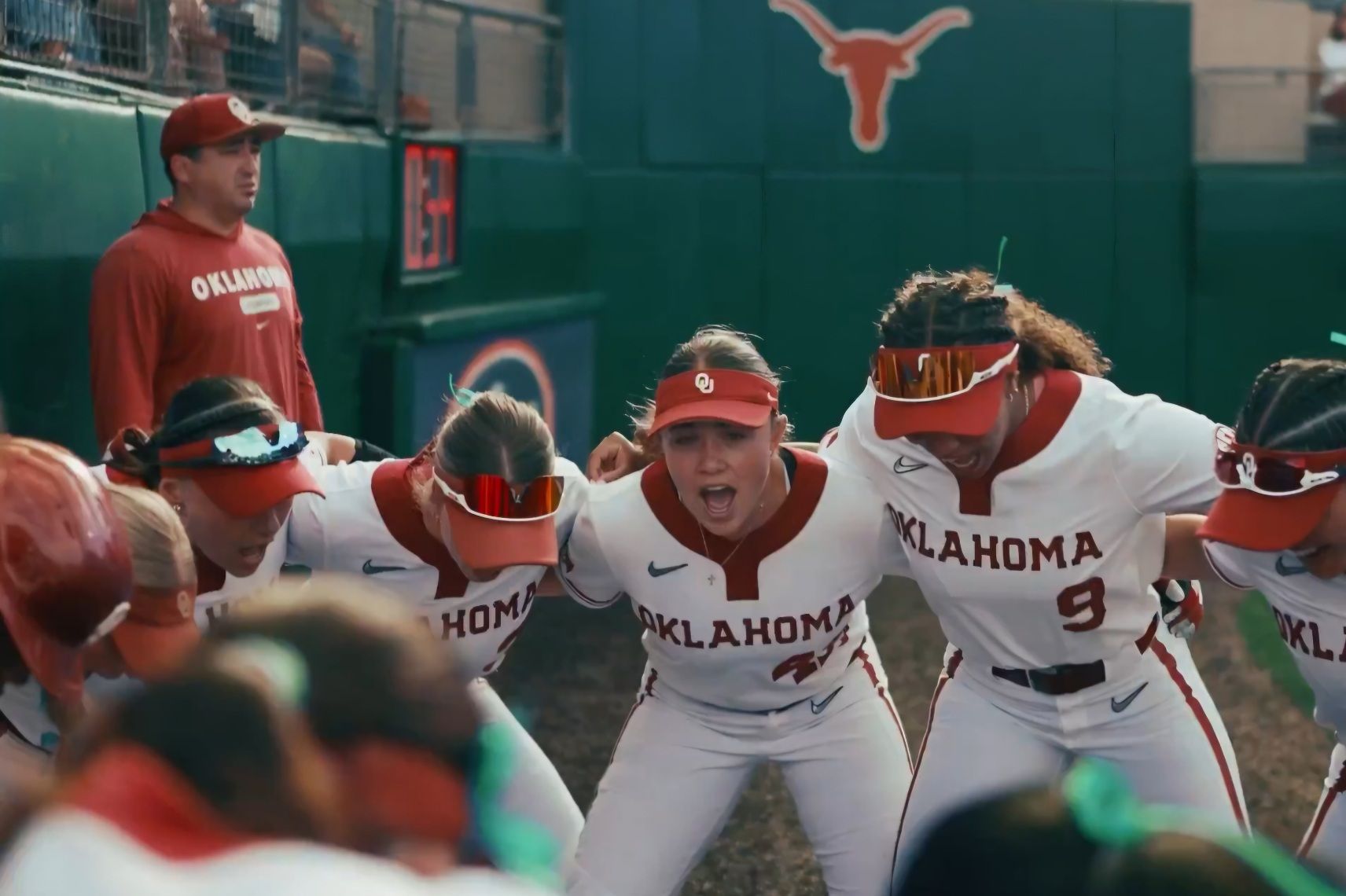
Tonight’s Bedlam clash between the No. 1 Oklahoma Sooners and No. 21 Oklahoma State Cowgirls at Devon Park isn’t just another midweek matchup—it’s a statistical collision. A game where nearly every meaningful number points to Oklahoma’s dominance, but just enough variables exist to make the outcome compelling.
This is Bedlam, filtered through the lens of production, efficiency, and historical pace.
Let’s break it down.
40–4: The Foundation of Dominance
Start with the baseline.
Oklahoma enters Wednesday night at 40–4 overall and 13–2 in SEC play, the first program in the country to reach 40 wins this season (tied with Grand Canyon). That record isn’t just impressive—it’s instructive.
It tells you this team doesn’t lose often. But more importantly, it tells you how rarely they even play close games.
The Sooners have won 29 games by run-rule, meaning nearly two-thirds of their victories have ended early. That’s not just dominance—it’s separation.
And yet, here’s the number that matters most in this context:
8–3 vs. ranked teams
Because Oklahoma State isn’t just another opponent. It’s the 12th ranked matchup of the season for OU, and those games tend to compress the margins.
506 Runs: The Engine Behind Everything
If you’re looking for the number that defines Oklahoma’s identity, this is it:
506 runs in 44 games
That’s 11.3 runs per game, a figure that doesn’t just lead the country—it challenges history.
For context, the program record for scoring came in 2021, when Oklahoma posted 638 runs in 60 games (10.6 per game). This year’s team is operating at an even higher per-game clip.
That matters because it reframes expectations.
Oklahoma doesn’t need to manufacture offense. It doesn’t need sequencing to be perfect. It overwhelms.
And that’s where this matchup becomes interesting—because Oklahoma State’s entire game plan is built around disrupting that overwhelm.
.416 / .511 / .853: A Historic Slash Line
The slash line tells the full story:
- .416 batting average
- .511 on-base percentage
- .853 slugging percentage
Each number on its own would be elite. Together, they’re unprecedented.
The .416 average would break the program record set in 2021 (.405). The .853 slugging percentage leads the nation. The .511 on-base percentage means more than half of Oklahoma’s plate appearances result in a baserunner.
This isn’t just a lineup—it’s constant pressure.
For Oklahoma State, the math is simple: you’re not stopping this offense entirely. You’re trying to survive it in segments.
148 Home Runs: The Great Equalizer
No number in this preview carries more weight than this one:
148 home runs in 44 games
Oklahoma has hit at least one home run in 41 of 44 games, including a streak of 20 straight earlier this season.
Even more staggering:
OU has more home runs than 74 Division I teams have total runs.
Read that again.
That’s not just power—that’s structural advantage. It means Oklahoma can erase deficits instantly. It means no lead is safe. It means even elite pitching can’t afford mistakes.
Which brings us to the centerpiece of this power surge.
31: The Number Defining Kendall Wells
Freshman seasons aren’t supposed to look like this.
31 home runs.
That’s the NCAA freshman single-season record. It’s also the SEC single-season record. And she did it in just 37 games.
Wells didn’t just break a record—she shattered a standard previously held by names like Jocelyn Alo and Lauren Chamberlain.
But here’s the number that matters more for Wednesday:
1 swing = 3 runs
That’s what Wells did in Game 2 against Texas. That’s what she’s capable of doing in any moment.
In a rivalry game where margins tighten, that kind of instant offense becomes decisive.
.484: The Table-Setter in Kai Minor
If Wells is the exclamation point, Kai Minor is the opening sentence.
.484 batting average
That leads not just Oklahoma—but all Division I freshmen and the entire SEC.
Add in:
- 61 hits (2nd in SEC)
- 16 stolen bases (Top 5 in SEC)
- 22 multi-hit games
And you get a player who dictates tempo before the lineup even turns over.
For Oklahoma State, this is the hidden challenge.
It’s not just stopping power—it’s preventing traffic. Because when Minor gets on, everything accelerates.
56–153–153–.422: The Freshman Core
Oklahoma’s freshman class isn’t contributing—it’s defining the season.
Combined totals:
- 56 home runs
- 153 RBIs
- 153 runs scored
- .422 batting average
That includes Wells, Minor, Allyssa Parker, and Lexi McDaniel.
This matters for one reason above all:
There is no “easy out” in this lineup.
Even the bottom third carries power. Even the bench produces.
Depth isn’t a luxury for Oklahoma—it’s a weapon.
30–2: The Sophomore Arms
For all the attention on the offense, this number might be the most important in determining Wednesday night’s outcome:
30–2 combined record
That’s what Audrey Lowry and Miali Guachino have done in the circle.
Break it down further:
- Lowry: 2.10 ERA, 90 innings pitched
- Guachino: .196 opponent batting average, 77 strikeouts
Together, they’ve given Oklahoma both volume and efficiency.
But here’s the counterpoint:
Sunday against Texas, Oklahoma allowed five home runs.
So the question isn’t whether Oklahoma’s pitching staff is elite—it is.
The question is whether Oklahoma State can replicate that formula.
8 Games, 1 State: The Stretch Begins
Wednesday marks the beginning of an unusual scheduling stretch:
Eight consecutive games in the state of Oklahoma
It’s a logistical detail—but also a rhythm factor.
No travel fatigue. Familiar environments. Consistent routine.
Historically, that’s where Oklahoma thrives.
104–74: The Bedlam Baseline
History favors the Sooners:
104–74 all-time vs. Oklahoma State
And at Devon Park specifically, Oklahoma has consistently performed well, including an 11–3 run-rule win in last year’s meeting at the same venue.
But rivalry numbers always come with a caveat.
They tell you what has happened—not what will.
The Counter Numbers: What Oklahoma State Brings
While this preview is Oklahoma-centric, a few numbers from the Cowgirls frame the challenge:
- 17–6 record for ace Ruby Meylan
- .389 average for Claire Timm
- Double-digit home run power from Amanda Hasler
But the most important number might be this:
0
As in, zero easy innings.
Oklahoma State’s veteran lineup doesn’t collapse under pressure. They extend at-bats. They force mistakes. And if Oklahoma repeats its Sunday issues with the long ball, the Cowgirls have enough power to capitalize.
The Number That Decides It
In a game like this, with this much offensive firepower, the deciding number often isn’t obvious.
It’s not home runs. Not batting average. Not even strikeouts.
It’s this:
Free baserunners
Walks. Errors. Hit-by-pitches.
Because against Oklahoma, those turn into crooked numbers. Against Oklahoma State, they turn into extended innings.
Whichever team controls that number will likely control the game.
Final Number: 1
At the end of all this data, all this production, all this history, the most important number remains simple:
1 game.
That’s all this is.
Not a series. Not a tournament. Just one night, one stage, one rivalry.
And in Bedlam, numbers may tell the story—but they don’t always write the ending.
Follow us on Instagram & Facebook