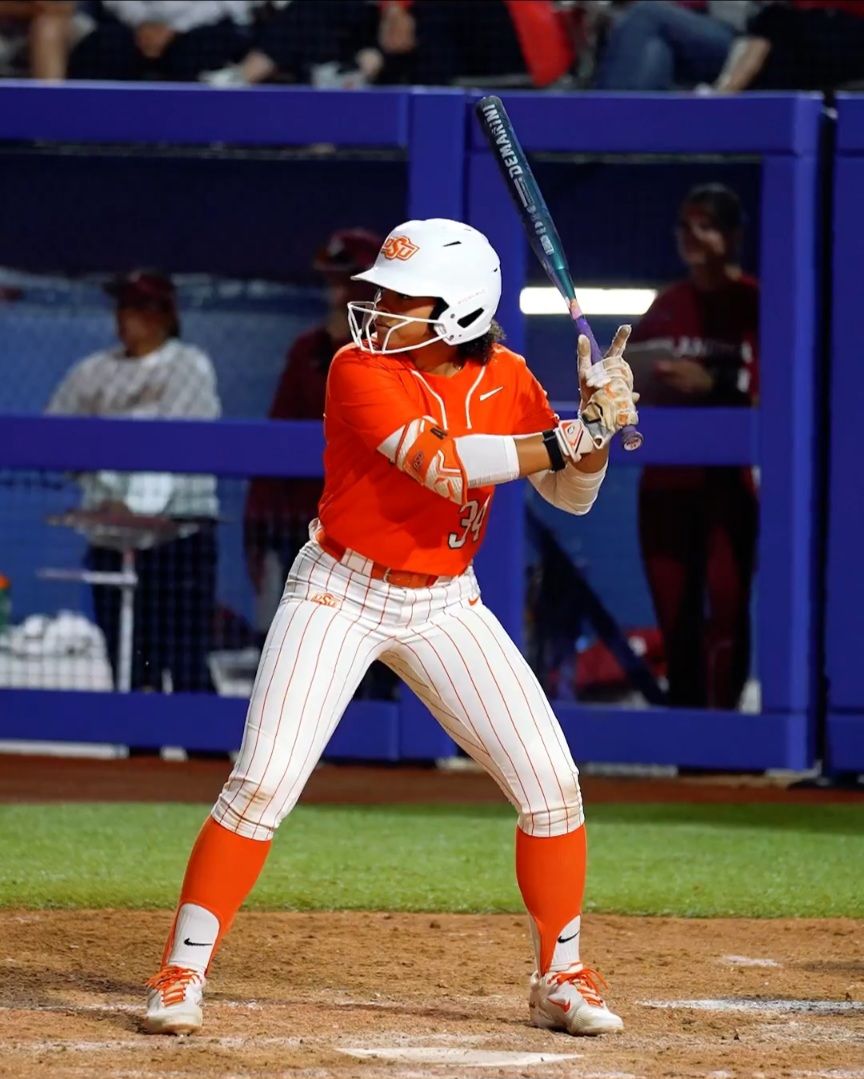
For a program that has spent most of the 2026 season overwhelming opponents with volume—runs, hits, home runs, and run-rule victories—Wednesday night at Devon Park came down to something far more precise.
Execution. Timing. Margins.
And in those areas, No. 1 Oklahoma came up just short in a 6–4 loss to No. 21 Oklahoma State in the latest edition of Bedlam.
This “Inside the Numbers” breakdown reveals exactly where the game tilted—and why, for the first time all season, Oklahoma finds itself searching for answers after consecutive losses.
0–2: A First-Time Feeling
For the first time in 2026, Oklahoma has lost back-to-back games.
That number—zero—had defined the Sooners’ consistency all season. Even when they stumbled, they responded immediately. Not this time.
After an extra-inning loss to Texas on Sunday, Oklahoma couldn’t reset in time for Bedlam. Instead, the Sooners now sit at 40–5, with two straight losses exposing something rarely seen under Patty Gasso: vulnerability.
It’s not panic-worthy. But it is notable.
5: Consecutive Scoring Innings by Oklahoma State
The defining number of the night wasn’t Oklahoma’s total—it was Oklahoma State’s consistency.
The Cowgirls scored in five consecutive innings (second through sixth), never allowing the game to settle. No explosive frame. No single knockout punch.
Just pressure.
- 2nd inning: 1 run
- 3rd inning: 1 run
- 4th inning: 2 runs
- 5th inning: 1 run
- 6th inning: 1 run
That’s five straight trips producing offense—an approach that neutralized Oklahoma’s usual ability to control tempo. Instead of chasing one big inning, OSU forced the Sooners to defend every frame.
Against most teams, Oklahoma can absorb that. On Wednesday, it slowly wore them down.
3: Two-Out Runs That Changed Everything
If you’re looking for the most telling number in this game, this is it.
Oklahoma State scored three of its six runs with two outs.
Those are momentum-killers. Inning-extenders. The difference between escaping damage and watching it pile up.
- Fourth inning: Two-out RBI single from Jayelle Austin
- Fifth inning: RBI groundout after extended at-bats
- Sixth inning: Two-out insurance run
Oklahoma had chances to end innings early, particularly in the middle frames. Instead, OSU extended counts, found barrels late, and capitalized on moments that typically swing toward elite pitching staffs.
For a Sooners team built on shutting the door, those three runs loomed large.
4: Hits Allowed by Miali Guachino… That Turned Into 4 Runs
Miali Guachino entered the game undefeated. She left it with her first loss of the season.
Her line—4 earned runs in 3.1 innings—tells part of the story. But the deeper number is efficiency.
Oklahoma State didn’t need a barrage of hits. They maximized the ones they got.
A leadoff double in the second turned into a run.
A pair of extra-base swings and singles in the fourth turned into two more.
The Cowgirls consistently turned base runners into scoring threats—and then into runs.
That’s not just hitting. That’s situational execution.
7 vs. 10: The Hit Gap
Oklahoma finished with seven hits. Oklahoma State had ten.
On paper, that’s not a massive difference. But context matters.
This was just the fourth time all season Oklahoma has been outhit—and the Sooners are now 0–4 in those games.
That number is more than coincidence. It’s a blueprint.
When opponents match or exceed Oklahoma’s offensive output, the Sooners’ margin for error shrinks dramatically. Their dominance is often built on overwhelming volume—more hits, more pressure, more scoring chances.
Take that away, and games become coin flips.
On Wednesday, Oklahoma State controlled that category—and the result followed.
32: Another Milestone for Kendall Wells
Even in a loss, Kendall Wells continues to rewrite record books.
Her third-inning two-run homer was her 32nd of the season—now the fifth-most in NCAA Division I single-season history.
The number itself is staggering. But its impact Wednesday night was fleeting.
Wells’ blast gave Oklahoma a brief 2–1 lead. Within an inning, that advantage was gone.
That’s the strange tension of this game: historic individual production, minimal lasting team impact.
5: Triples for Kai Minor
Kai Minor continues to be one of the most dynamic table-setters in the country.
Her leadoff triple in the third inning—her fifth of the season—set the stage for Wells’ home run and Oklahoma’s early lead.
It’s the kind of play that usually sparks a big inning.
But on this night, it resulted in just two runs—and no sustained momentum.
2: Big Swings, Limited Output
Oklahoma’s offense largely came down to two swings:
- Wells’ two-run homer in the third
- Abby Dayton’s two-run double in the sixth
That’s all four runs.
Against most teams, two swings can be enough. Against a pitcher like Ruby Meylan, it wasn’t.
The Sooners struggled to string together consistent at-bats. Outside of those moments, they couldn’t build innings—no rallies, no multi-hit pressure sequences.
It was power or nothing.
And Wednesday, it leaned toward nothing.
133: Pitches That Defined the Night
Meylan’s complete-game effort came on 133 pitches—a number that tells you everything about her night.
She didn’t dominate by overpowering Oklahoma early and coasting. She battled.
Deep counts. Traffic on the bases. High-leverage moments.
And she won most of them.
Nine strikeouts, seven hits allowed, and a scoreless seventh inning to close it out—her performance was the single biggest factor in the outcome.
Against the nation’s most explosive offense, she bent but didn’t break.
42 of 45: The Home Run Consistency Remains
Oklahoma has now homered in 42 of 45 games this season.
That number reinforces what this offense is built on: power.
But it also highlights a growing trend over the past week.
When the home run is limited to isolated damage—two runs here, two runs there—rather than multi-inning explosions, Oklahoma becomes more manageable.
That’s not a flaw. It’s a reality of facing elite pitching.
And it’s something teams are increasingly testing.
0: Errors, But Not Clean Execution
Oklahoma committed zero errors.
But this wasn’t a clean defensive performance.
There were near plays that weren’t made. Balls that extended innings. Opportunities to shut down rallies that slipped away.
Meanwhile, Oklahoma State turned two defensive miscues into opportunities that eventually translated into pressure and runs.
The box score says clean. The game felt different.
The Bigger Picture
This wasn’t a collapse. It wasn’t even a bad performance.
It was a tight game against a ranked rival, decided by execution in key moments.
But the numbers point to something important:
- When Oklahoma doesn’t out-hit opponents, it struggles
- When runs come in isolated bursts, not waves, the margin shrinks
- When opponents score consistently—even in small increments—it disrupts the Sooners’ rhythm
For a team built on overwhelming force, this game was about precision.
And for one night, Oklahoma State had more of it.
What Comes Next
Oklahoma now returns home to face a top-10 Arkansas team, carrying something unfamiliar into the weekend: urgency.
Not panic. Not doubt.
But urgency.
Because the numbers from Wednesday don’t define the season—but they do offer a glimpse of what it looks like when the Sooners are forced to play a different kind of game.
And the next step isn’t about changing who they are.
It’s about proving they can win when they aren’t at their most dominant.
That’s the next evolution.
And it starts now.
Follow us on Instagram & Facebook