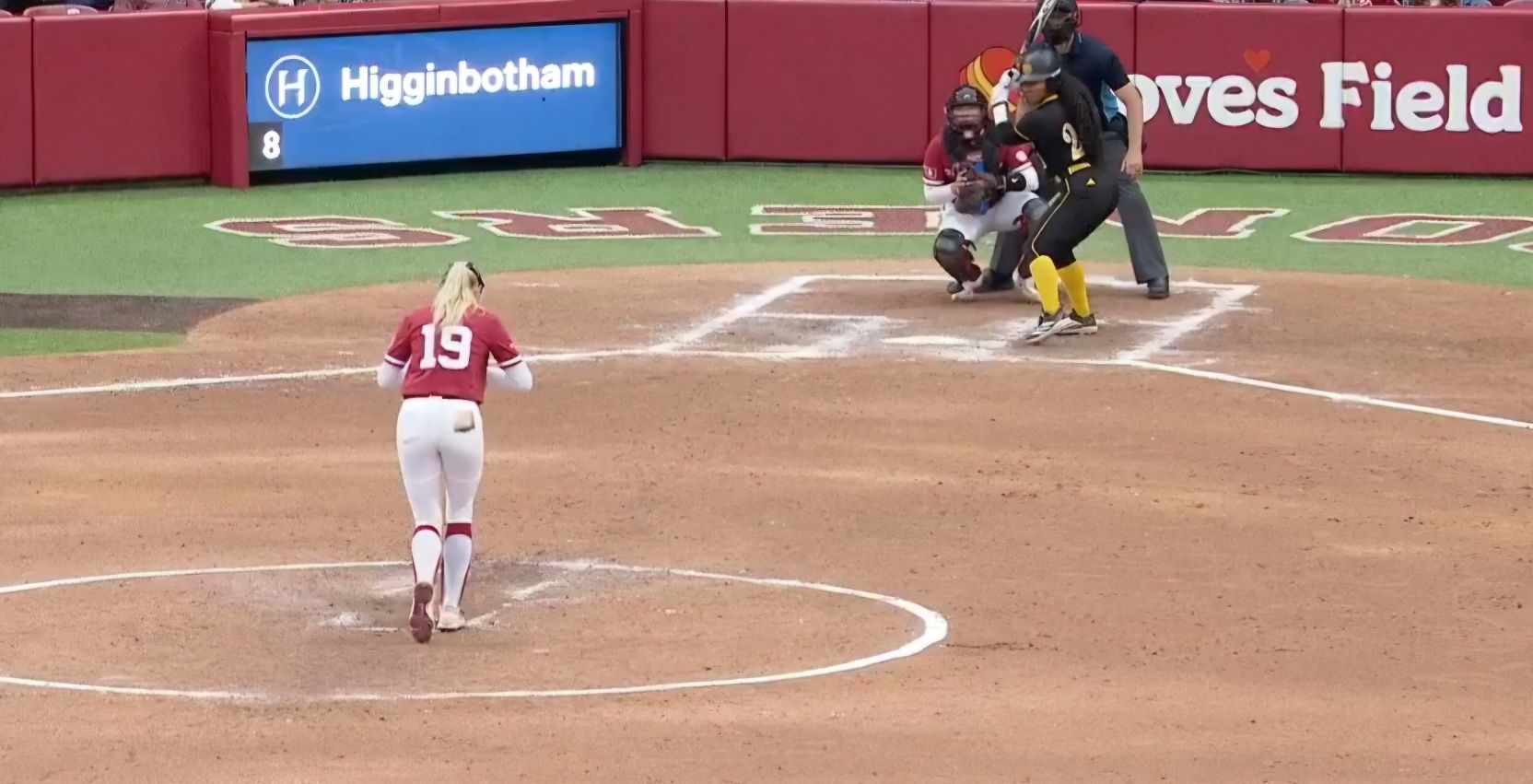
The Oklahoma Sooners didn’t just close out their non-conference schedule with a 9-0 run-rule victory over Arkansas-Pine Bluff. They delivered a performance that, when examined through the numbers, reveals why this team is not merely chasing championships—it’s redefining the statistical ceiling of the sport.
A staff no-hitter. Eleven strikeouts in five innings. Three more home runs. And, perhaps most notably, a tie with the legendary 2021 Oklahoma Sooners softball team for the most home runs in a single season in NCAA history.
This wasn’t just a win. It was a layered display of efficiency, depth, and historical trajectory.
161: A Record Tied, Not Just Reached
The headline number—161—demands context.
With three home runs on Tuesday night, Oklahoma matched the NCAA single-season team home run record, a mark previously set by its own 2021 squad. That team needed 60 games to reach the milestone. This version of the Sooners got there in just 50 games, underscoring a critical distinction: this is not just power, it’s accelerated power.
The home runs themselves told the story of roster-wide impact:
- Allyssa Parker ignited the scoring with a solo shot in the second inning.
- Lexi McDaniel followed immediately with another, giving Oklahoma back-to-back blasts that effectively cracked the game open.
- Isabela Emerling delivered the defining swing in the fourth—a two-run homer that tied the NCAA record and punctuated a five-run inning.
That swing wasn’t just historic. It was timely. Emerling’s blast pushed the Sooners firmly into run-rule territory, reinforcing a trend that has defined Oklahoma’s offensive identity: they don’t just hit for power—they weaponize it at decisive moments.
5 Innings, 11 Strikeouts, 0 Hits: The Anatomy of a No-Hitter
If the offense set the tone, the pitching staff eliminated any possibility of resistance.
Oklahoma’s trio of Miali Guachino, Kierston Deal, and Berkley Zache combined for a five-inning no-hitter that was as efficient as it was overpowering.
Break it down numerically:
- 15 outs recorded
- 11 via strikeout
- 0 hits allowed
- 2 total baserunners (walks)
That means 73% of all outs came via strikeout—a staggering figure that highlights not just dominance, but command.
Guachino set the tone early. In two innings, she retired all six batters she faced, striking out five. There was no adjustment period for Arkansas-Pine Bluff. No feeling-out process. Just immediate suppression.
Deal followed with two innings of her own, striking out four and maintaining the rhythm. Her outing was particularly important from a sequencing standpoint—she didn’t just preserve the no-hitter, she sustained the strikeout pressure, preventing any shift in momentum.
Zache closed the door with a perfect fifth, striking out two more and eliminating any lingering doubt. It was clinical. Efficient. Final.
For a team preparing to re-enter SEC play, this wasn’t just a shutout—it was a demonstration of depth. Three pitchers, three different looks, one identical outcome: outs without contact.
The Second Inning: Where the Game Broke Open
The most decisive frame, from a structural standpoint, was the second inning.
Oklahoma scored four runs, but the sequence matters more than the total:
- Back-to-back home runs (Parker, McDaniel)
- Two walks
- A run-scoring single from Chaney Helton
- Productive situational hitting, including an RBI groundout from Kai Minor
- Aggressive baserunning, including stolen bases
This wasn’t a one-dimensional rally. It was layered offense.
Power initiated the inning, but discipline sustained it. Situational awareness finished it.
That’s the formula that has allowed Oklahoma to produce double-digit scoring outputs with consistency this season. It’s not reliant on one skill—it’s the accumulation of many.
Take A Deeper Dive Into Oklahoma Softball
– No Hits, No Doubt | Oklahoma Ties NCAA Record in 9-0 Run-Rule Win Over Arkansas-Pine Bluff
– Oklahoma Closes Non-Conference Play with Arkansas-Pine Bluff
– Power Perfected | Why Oklahoma’s Offense Is Built on Efficiency, Not Just Explosion
Exclusively on our subscription page.
112-9: The Fourth Inning Advantage
If there’s a single statistic that encapsulates Oklahoma’s identity, it might be this:
The Sooners have outscored opponents 112-9 in the fourth inning this season.
Let that settle for a moment.
Tuesday’s five-run fourth inning wasn’t an anomaly—it was a continuation of a season-long pattern. Oklahoma doesn’t just maintain pressure late in games; it amplifies it.
In this one, the fourth inning included:
- Two sacrifice flies (Minor and Tia Milloy)
- A pinch-hit RBI single from Ella Parker
- Emerling’s record-tying home run
What stands out is the diversity of contributions. Starters, reserves, situational hitters—everyone played a role.
For opponents, this creates a strategic dilemma. Survive the early innings, and you still haven’t escaped. Oklahoma’s most dangerous stretch often comes after adjustments should have been made.
31: Run-Rule Wins as a Metric of Dominance
The victory marked Oklahoma’s 31st run-rule win of the season.
That number is more than a footnote—it’s a measure of sustained superiority.
Run-rule games eliminate variability. They reduce the sample size. They minimize the chance for opponents to recover. And Oklahoma has made them routine.
In practical terms, it also preserves pitching arms, shortens game loads, and allows for strategic rotation management—all critical factors as the postseason approaches.
Emerling’s Surge: Clutch Meets Consistency
Emerling’s night—1-for-3, 2 RBIs, one home run—fits neatly into a larger trend.
She has now homered in four consecutive games, and Oklahoma is 25-1 when she goes deep in her career.
That’s not coincidence. That’s correlation bordering on causation.
Her home run Tuesday wasn’t just historic—it was emblematic of her role. She is the lineup stabilizer. The momentum shifter. The player who turns rallies into avalanches.
The Freshman Factor
While Emerling provided the headline moment, the freshmen once again shaped the foundation.
- Allyssa Parker: home run, two runs scored, two walks
- Lexi McDaniel: home run, continued production in extended at-bats
- Combined impact: early scoring, pressure, depth
This matters because it reinforces a broader reality: Oklahoma’s production is not senior-dependent. It’s systemic.
Seven players now have double-digit home runs, including three freshmen. That level of distribution is rare—and dangerous.
Final Non-Conference Statement
Tuesday’s win closed the book on Oklahoma’s non-conference schedule, finishing at 28-3.
It also served as a transitional moment.
The Sooners now pivot back into SEC play, with a series looming against Georgia. But this game offered something more valuable than just another tally in the win column—it provided clarity.
- The offense is historically powerful.
- The pitching staff is deep and adaptable.
- The roster can absorb lineup changes without losing production.
And perhaps most importantly:
This team is not chasing the standard set by 2021.
It’s matching it—faster, deeper, and with a different kind of balance.
That’s what makes performances like Tuesday night worth dissecting. Not because of the opponent. Not because of the scoreline.
But because, inside the numbers, you can see exactly what this team is becoming.
Follow us on Instagram & Facebook