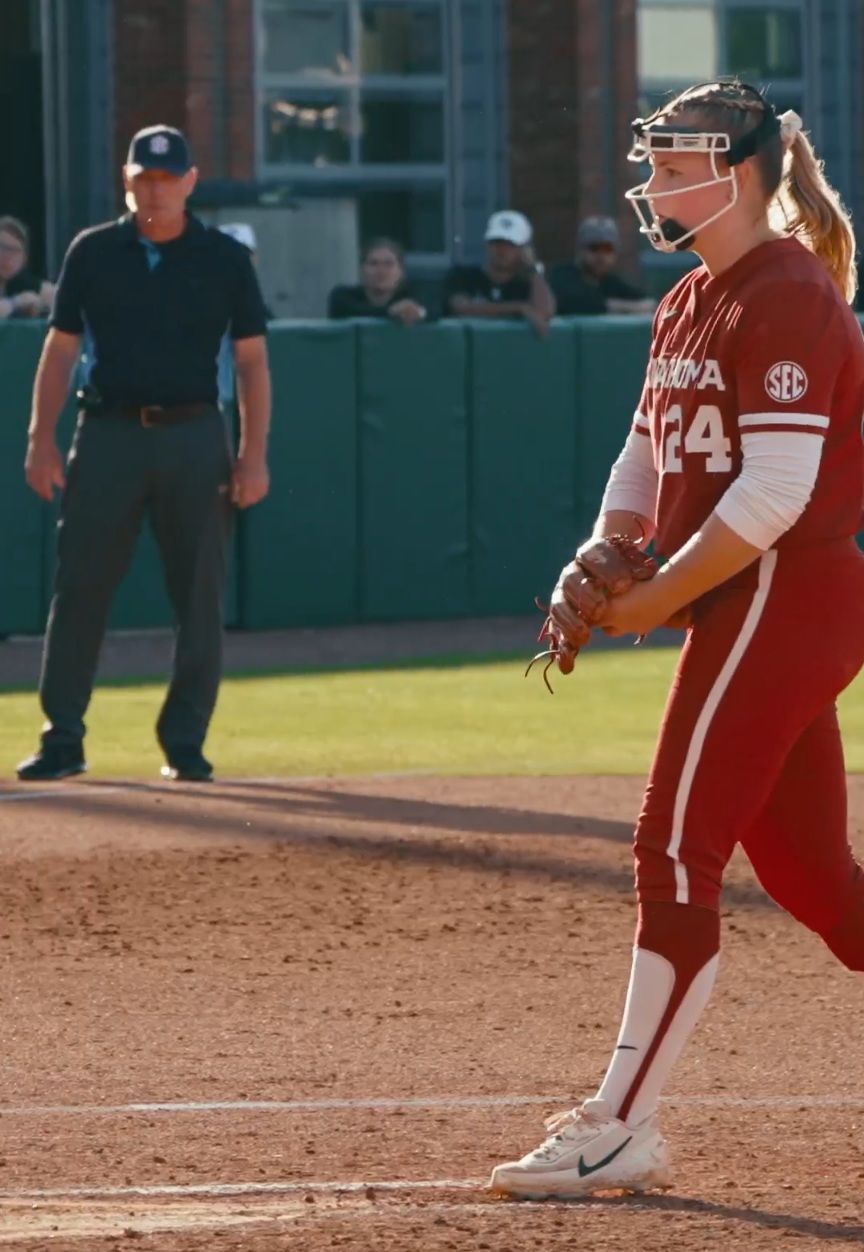
Championships are often remembered for defining moments—the clutch hit, the final out, the celebration. But if you want to understand how No. 1 Oklahoma turned a pressure-packed Saturday into a statement of dominance, you have to dig deeper.
You have to go inside the numbers.
Because in a doubleheader sweep over No. 12 Texas A&M—4-3 and 6-4—the numbers don’t just tell the story.
They define it.
2 Wins, 1 Title
Start with the simplest number of all:
2.
That’s how many wins Oklahoma needed entering Saturday to secure the SEC regular-season championship outright. Nothing complicated. No tiebreakers. No scoreboard watching.
Just win twice.
And against a top-15 opponent on the road, in a hostile environment, coming off a deflating loss earlier in the series, that’s easier said than done.
But Oklahoma didn’t just get it done—they did it in two completely different ways.
9-2 in One-Run Games
Game 1 wasn’t comfortable. It wasn’t clean. It was survival.
The Sooners edged Texas A&M 4-3, improving to 9-2 in one-run games this season—a number that says more about their championship DNA than any offensive stat ever could.
Great teams win big.
Elite teams win tight.
In a game that featured lead changes, replay reviews, defensive miscues, and late-inning tension, Oklahoma never blinked. Even when Texas A&M tied the game with back-to-back home runs in the fifth, the Sooners responded.
That response came in the form of a single swing.
1 Swing That Changed Game 1
With two outs in the sixth inning of Game 1, the margin for error was gone.
Enter Kai Minor.
Her go-ahead RBI triple down the right-field line wasn’t just a clutch hit—it was the defining moment of the opener. It turned a tied game into a lead Oklahoma would not relinquish.
1 triple. 1 run. 1 championship step closer.
Minor’s impact didn’t stop there, but in that moment, she delivered exactly what elite teams need: execution under pressure.
0 Home Runs (And Why It Matters)
Here’s a number that feels almost impossible for this Oklahoma team:
0 home runs in Saturday’s Game 1.
In a season defined by record-breaking power, Game 1 marked just the fourth time all year the Sooners failed to leave the yard.
And they still won.
That matters.
Because it proves something critical about this lineup: it’s not dependent on the long ball. Oklahoma manufactured runs with situational hitting, a squeeze bunt from Abby Dayton, and timely execution from players like Kasidi Pickering and Lexi McDaniel.
When the home runs weren’t there, the offense adapted.
Championship teams always do.
2.2 Innings of Shutdown Relief
If Game 1 was about execution at the plate, it was also about trust in the circle.
Audrey Lowry delivered 2.2 innings of scoreless relief, allowing just two hits while striking out two to close the door.
But the numbers don’t fully capture her impact.
Lowry entered with traffic on the bases, with momentum leaning toward Texas A&M, and with the game hanging in the balance. She navigated it all, including a high-pressure sixth inning where she struck out Kennedy Powell to escape a major threat.
Then came the chaos of the seventh—reviews, errors, runners on base—and still, Lowry found a way.
That’s not just production.
That’s presence.
4 Runs in the First Inning (Game 2)
If Game 1 was a grind, Game 2 was a statement.
And it started immediately.
4 runs in the first inning.
That’s how Oklahoma flipped the script in the nightcap, jumping on Texas A&M before the Aggies could even settle in.
Kai Minor set the tone with a leadoff home run—Oklahoma’s first leadoff homer of the season. Moments later, Kasidi Pickering delivered the knockout punch, launching a three-run blast that turned a quick start into complete control.
Just like that, 4-0.
No drama. No delay. Just dominance.
3 Home Runs, 1 Offensive Explosion
After going homer-less in Game 1, Oklahoma responded with 3 home runs in Game 2.
That’s the duality of this offense.
They can win without power.
And they can overwhelm you with it.
Minor’s leadoff shot, Pickering’s three-run homer, and Ella Parker’s solo blast in the sixth accounted for the bulk of the scoring and gave Oklahoma the cushion it would ultimately need.
Because even with that cushion, nothing came easy.
5.0 Innings of Control
Sydney Berzon’s stat line might not jump off the page at first glance:
5.0 innings, 2 hits, 0 runs, 5 strikeouts, 0 walks.
But within the context of this game—and this moment—it was everything.
Berzon didn’t just pitch well.
She controlled the game.
While Oklahoma’s offense built the lead, Berzon ensured Texas A&M never found a rhythm. She limited baserunners, avoided free passes, and kept the Aggies from generating any early momentum.
By the time she exited, the tone had been set.
4 Runs Allowed (And Why It Didn’t Matter)
Texas A&M’s four-run seventh inning could have undone everything.
A three-run home run from Paislie Allen cut the lead to 6-4 and brought the tying run to the plate. The crowd roared. Momentum shifted.
But here’s the number that matters:
2 outs.
That’s all Oklahoma needed.
And once again, they turned to Lowry.
She recorded the final two outs—one groundout, one flyout—to secure her third save of the season and close out the championship.
14 Straight Seasons of Hardware
Zoom out, and one number towers over the rest:
14.
That’s how many consecutive seasons Oklahoma has won either a conference regular-season or tournament title.
Let that sink in.
Different rosters. Different opponents. Different eras. Different conferences.
Same result.
Sustained excellence isn’t accidental. It’s built, reinforced, and expected.
And this team added another chapter.
8 SEC Series, 8 Wins
Another number that defines this season:
8.
That’s how many SEC series Oklahoma played.
And how many they won.
A perfect 8-for-8 in conference series play is the clearest indicator of dominance you’ll find. It means consistency. It means adaptability. It means showing up every weekend, regardless of opponent or environment.
In the SEC, that’s as impressive as it gets.
The Final Equation
Add it all together:
- 2 wins when they needed both
- 9-2 record in one-run games
- 0 home runs (Game 1) → still a win
- 3 home runs (Game 2) → statement response
- 5 scoreless innings from Berzon
- 2.2 clutch innings from Lowry (plus a save)
- 8-for-8 SEC series wins
- 14 straight seasons with a title
That’s not just a résumé.
That’s a blueprint for a champion.
What It Means Moving Forward
With the doubleheader sweep on Saturday, Oklahoma finishes the regular season at 48-7 and 20-4 in SEC play, earning the No. 1 seed in the SEC Tournament.
But more importantly, they proved something about themselves.
They proved they can respond to adversity.
They proved they can win in different ways.
They proved they can handle pressure on the road, with everything on the line.
And when the moment demanded perfection—or something close to it—they delivered.
That’s what the numbers say.
And in this case, the numbers don’t lie.
Follow us on Instagram & Facebook