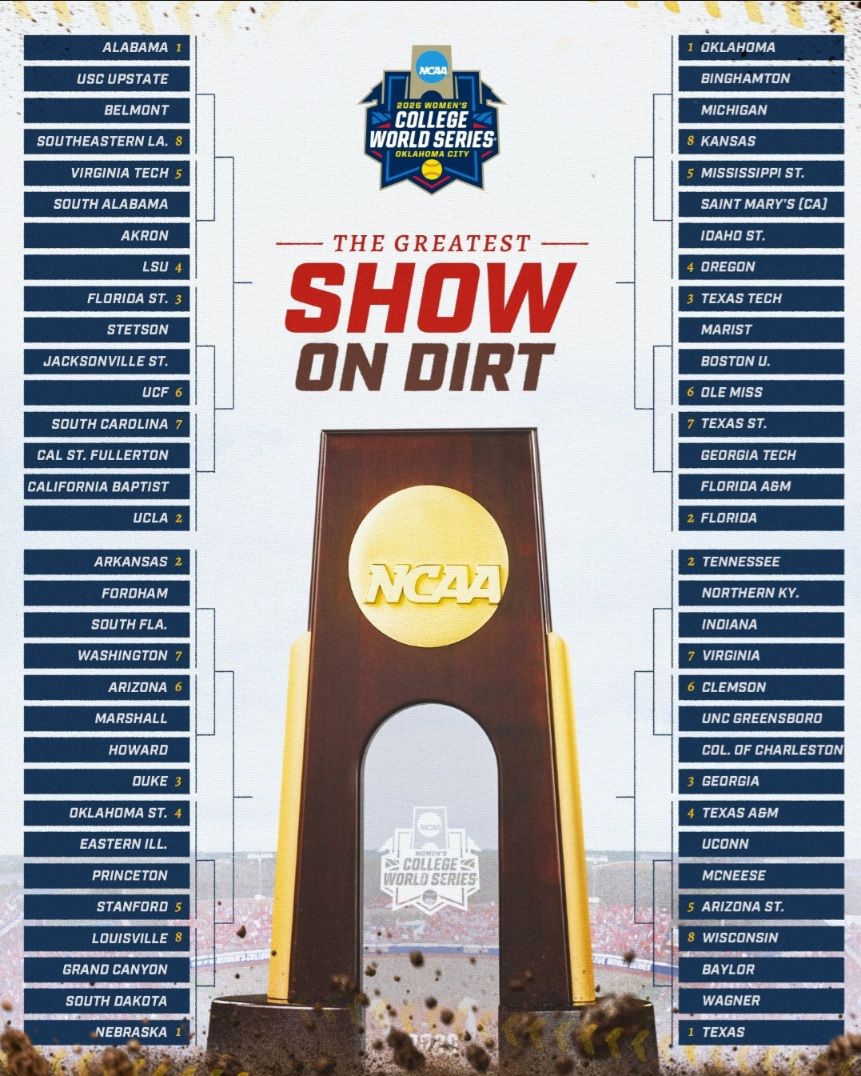
The NCAA Softball Tournament is supposed to reward order. National seeds. Home fields. Established powers. Packed stadiums. The format, historically, has been designed to protect the sport’s elite from early disaster.
But this year feels different.
The 2026 NCAA Tournament bracket looks less like a carefully tiered championship path and more like a pressure cooker loaded with volatility. The SEC claimed six of the top eight national seeds. Oklahoma enters with the nation’s best batting average. Alabama grabbed the No. 1 overall seed. Texas arrives as the defending national champion. UCLA is threatening to rewrite the offensive record book. Nebraska suddenly looks like the hottest team in America.
And yet, for all the star power at the top, this bracket feels unusually fragile.
Why? Because the sport itself has changed. Offenses are more explosive. Pitchers are being forced into heavier workloads. The transfer portal has flattened the gap between power conferences and dangerous mid-majors. And perhaps most importantly, the expansion to 32 seeded teams has created more balanced, dangerous regional pods from top to bottom.
This isn’t the old tournament model where elite hosts could cruise through two mercy-rule games before playing a nervous Sunday final. This field is littered with dangerous second seeds, battle-tested fourth seeds, and enough elite pitching to turn an entire weekend upside down.
So with the Regionals beginning Friday, here are 10 bold predictions that could define the opening weekend of the 2026 NCAA Softball Tournament.
1. LSU Will Become the First National Seed Eliminated
The most vulnerable host in the field is not some mid-tier program trying to survive the moment. It’s No. 16 seed LSU.
That sounds absurd on paper until you look at the bracket.
Virginia Tech arrives in Baton Rouge carrying one of the nation’s most dangerous offenses, blasting 104 home runs this season while ranking among the national leaders in slugging percentage. LSU has the home crowd, but Virginia Tech has the more explosive offensive ceiling.
And in regional play, explosive offenses travel.
The Tigers have spent much of the year surviving games rather than controlling them. That becomes dangerous in a double-elimination setting where one crooked inning can suddenly place a host in survival mode.
Virginia Tech won’t fear LSU’s environment. They’ve seen elite ACC pitching all season, and they possess the kind of uppercut lineup capable of flipping a regional in two innings.
By Sunday night, Baton Rouge may become the site of the tournament’s first true earthquake.
2. Oklahoma Will Not Allow a Run in Norman
This is bold because perfection in postseason softball almost never happens.
But Oklahoma is uniquely positioned to pull it off.
The Sooners enter the tournament furious after the SEC Tournament collapse against Georgia. Patty Gasso spent the past week openly challenging her team’s toughness, discipline, and emotional focus. That matters because Oklahoma historically responds to embarrassment better than any dynasty in college softball history.
The Norman Regional also sets up perfectly for them stylistically.
Michigan lacks the overwhelming power necessary to punish Oklahoma’s occasional pitching mistakes. Kansas is dangerous offensively but inconsistent in the circle. The Sooners, meanwhile, combine elite strikeout pitching with the nation’s best batting average at .389.
This won’t look like survival softball. It will look like retaliation.
Three games. Three shutouts. Statement delivered.
3. NiJaree Canady Will Throw the Most Dominant Regional Since Cat Osterman
There are star pitchers.
Then there are postseason gravity wells.
NiJaree Canady belongs in the second category.
The Texas Tech ace enters the tournament with the pressure of carrying an entire program’s championship hopes, and honestly, that may work in Texas Tech’s favor.
Because unlike teams trying to preserve pitching depth, the Red Raiders know exactly what their formula is: give Canady the ball and let her suffocate the regional.
She may throw nearly every meaningful inning in Lubbock.
And she may strike out 30-plus batters doing it.
What makes Canady terrifying isn’t just velocity. It’s emotional control. She doesn’t speed up when innings unravel. She slows the game down. That trait becomes devastating in regional formats where opponents often tighten up offensively under pressure.
Texas Tech’s path to Oklahoma City may ultimately depend on whether Canady can become superhuman for three weekends.
This weekend, she will.
4. Washington Will Knock Arkansas Into the Elimination Bracket
The Fayetteville Regional feels unfair.
Arkansas earned a top-five seed and was rewarded with one of the nastiest opening draws in the country: the Washington Huskies.
Washington’s postseason DNA remains elite even during transitional years. They defend well, they play clean softball, and they rarely panic in high-leverage innings.
Arkansas, meanwhile, remains emotionally streaky. When the Razorbacks are rolling offensively, they look capable of beating anyone. But when games tighten late, tension sometimes creeps into their defensive execution.
Washington is precisely the type of opponent that exposes tension.
This regional feels destined for chaos, and Arkansas may spend the weekend fighting uphill after an early stumble.
5. UCLA Will Hit More Home Runs Than Some Regionals Combined
The UCLA Bruins’ offense is bordering on cartoonish.
Megan Grant and Jordan Woolery are operating like arcade-mode hitters right now, and UCLA’s lineup depth forces opposing pitchers into impossible choices by the third inning.
This is not simply a power team.
This is a pressure team.
Once UCLA forces pitchers into the zone, innings spiral quickly. One walk becomes a two-run homer. One error becomes a five-run avalanche.
Playing at Easton Stadium only amplifies that momentum.
The Bruins could realistically hit double-digit home runs during regional play alone, and if that happens, they immediately become a legitimate national-title threat.
6. Nebraska Will Get Pushed to a Winner-Take-All Game
The hottest team in America is Nebraska.
That’s exactly why this regional becomes dangerous.
The Cornhuskers enter riding a 21-game winning streak, which creates enormous emotional pressure inside a home regional. Everyone expects smooth domination. But Grand Canyon has the offensive firepower to disrupt rhythm immediately.
Grand Canyon does not play cautiously. They attack counts early, swing aggressively, and create uncomfortable pace changes.
Nebraska likely survives.
But not comfortably.
This regional feels built for Sunday-night stress.
7. Clemson Will Eliminate Georgia in Athens
Here’s the uncomfortable truth about Georgia softball: emotionally draining upsets often create emotional hangovers.
Georgia’s SEC Tournament win over Oklahoma was historic. It was cathartic. It was exhausting.
Now comes the harder part: sustaining that emotional edge.
Clemson may quietly be one of the most dangerous two-seeds in the entire bracket because they possess veteran pitching and genuine postseason composure.
Georgia feeds off momentum.
Clemson specializes in disrupting momentum.
That combination makes Athens one of the weekend’s most dangerous upset sites.
8. Alabama Will Look Vulnerable Despite Advancing
Alabama deserved the No. 1 overall seed.
But being the best team entering the tournament and looking like the most dangerous team are not always the same thing.
The Crimson Tide rely heavily on elite pitching structure and defensive consistency. That formula wins championships — until offensive droughts appear.
And regional weekends have a way of exposing offensive stagnation.
Alabama probably survives. But there will be a game — likely late Saturday or Sunday — where the offense suddenly tightens, the crowd gets nervous, and the tournament pressure becomes very real.
For the first time all season, the Tide may look human.
9. At Least One Mid-Major Will Reach Super Regionals
It happens almost every year.
But this year, it feels inevitable.
The parity across college softball has exploded because experienced transfer talent now spreads deeper into the national landscape. Mid-major rosters are older, more physical, and more experienced than ever before.
Programs like McNeese, Marshall, Southeastern Louisiana, and Grand Canyon no longer enter these tournaments hoping to compete.
They enter expecting to win.
One of them will break through.
And when it happens, nobody should pretend to be shocked.
10. Only 11 National Seeds Will Survive Opening Weekend
This is the year the new 32-seed structure creates maximum instability.
The committee wanted more balance.
Congratulations. They got it.
Several top-16 seeds drew nightmare matchups. Others carry obvious emotional pressure. Some are over-reliant on one pitcher. Others have offensive volatility that becomes dangerous in elimination games.
The result?
The clean chalk bracket is dead.
By Sunday night, at least five national seeds will be gone, and the road to Oklahoma City will suddenly feel wide open.
That’s what makes this tournament so fascinating.
For the first time in years, this postseason doesn’t feel predetermined. It feels combustible.
Follow us on Instagram & Facebook
One Reply to “Chaos Theory: 10 Bold Predictions for the 2026 NCAA Softball Regionals”