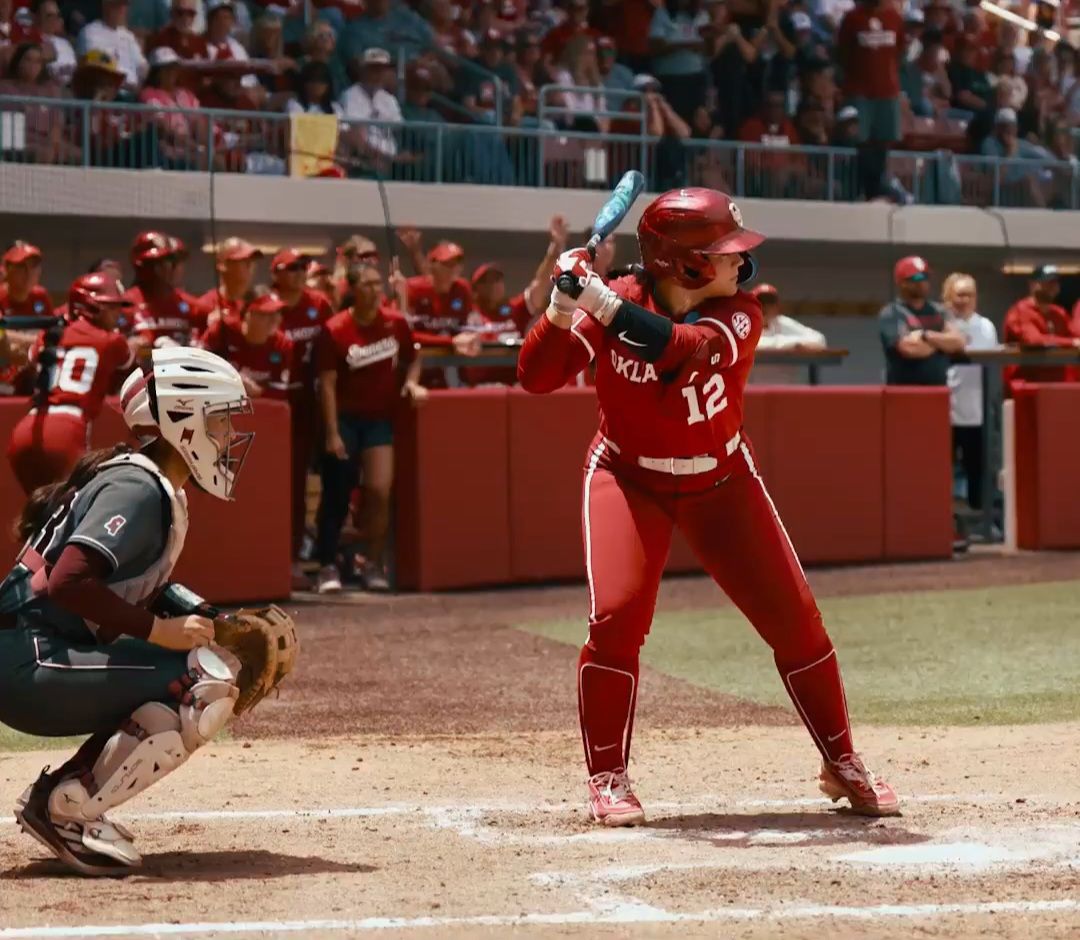
There are games that reveal talent, and then there are games that reveal identity.
On Saturday afternoon at Love’s Field, Oklahoma revealed exactly who it still believes it is.
One day after suffering one of the most stunning collapses in program history — an 11-9 loss that snapped an 18-game Super Regional winning streak and put Oklahoma on the brink of elimination — the Sooners answered with the kind of poised, ruthless response that has defined the sport’s modern dynasty. Oklahoma overwhelmed Mississippi State 7-1 in Game 2 of the Norman Super Regional, forcing a decisive winner-take-all Game 3 on Sunday.
And the numbers behind the victory tell the story of a championship-caliber bounce back.
The Sooners did not merely survive Saturday. They re-established control.
7 Runs in One Inning Changed Everything
For two innings, Saturday looked eerily similar to Friday.
Mississippi State’s pitching was mixing speeds effectively. Oklahoma’s offense was creating traffic but not yet detonating. The tension around Love’s Field lingered after the Bulldogs had stolen Game 1.
Then came the bottom of the third inning.
In a devastating 24-minute stretch, Oklahoma sent 10 batters to the plate and scored all seven of its runs in what instantly became one of the defining innings of its season.
The avalanche started quietly enough.
Kai Minor quickly moved into scoring position. Then the Sooners’ stars began stacking pressure pitch after pitch.
Kendall Wells ripped an RBI single to open the scoring. Gabbie Garcia followed by drawing a bases-loaded walk. Isabela Emerling produced another run on a groundout. A passed ball added another score.
Then came the swing that completely broke Mississippi State’s momentum.
Freshman Lexi McDaniel — inserted as a pinch-hitter by Patty Gasso specifically for the matchup — launched a towering three-run home run 266 feet into the upper deck in left field.
In one swing, the entire atmosphere changed.
“It was important to get her the opportunity to do what she does,” Gasso said afterward. “That changed the game dramatically.”
That statement was not coach-speak. It was fact.
At 7-0, Oklahoma suddenly looked like Oklahoma again.
87 Pitches That Saved Oklahoma’s Season
The most important number of Saturday might not have been seven.
It might have been 87.
That is all sophomore left-hander Audrey Lowry needed to throw a complete-game masterpiece in possibly the biggest start of her young career.
One day after struggling in relief during Oklahoma’s Game 1 collapse, Lowry responded with absolute composure. She scattered five hits across seven innings, allowed just one run, walked two, struck out two, and completely controlled the tempo of the game.
More importantly, she stabilized a pitching staff that had looked rattled 24 hours earlier.
Friday’s opener forced Oklahoma to use multiple arms while surrendering 15 hits and committing four errors. Saturday was the exact opposite. Lowry worked efficiently, trusted her defense, attacked the zone, and never allowed Mississippi State to build sustained pressure.
The efficiency numbers are staggering.
- 47 pitches through five shutout innings
- Just 87 pitches total in a complete game
- Only her fourth complete game of the season
- Oklahoma’s bullpen remained entirely rested for Game 3
That final point matters enormously.
Instead of scrambling to patch together innings in an elimination game, Oklahoma now enters Sunday with virtually its entire pitching arsenal available.
That is a massive strategic advantage in a winner-take-all setting.
The Kai Minor Effect Continues
Every great Oklahoma lineup has a player who quietly controls games without necessarily dominating headlines.
This year, that player might be Kai Minor.
While Wells’ home-run chase and McDaniel’s dramatic blast grabbed attention Saturday, Minor once again functioned as the engine of Oklahoma’s offense.
The freshman centerfielder finished 2-for-4 with a double, triple, and run scored while extending her hitting streak to 11 games. She now owns a team-leading 29 multi-hit games this season.
The deeper numbers are even more revealing.
Minor has now recorded:
- Six extra-base hits during NCAA Tournament play
- Seven triples this season
- A .446 batting average that ties for the SEC lead
Her seventh triple also tied her for fourth-most in a single season in Oklahoma history.
Minor changes games because she pressures defenses constantly. Her speed turns singles into doubles, doubles into triples, and routine defensive plays into rushed decisions.
After Mississippi State capitalized on Oklahoma’s defensive mistakes Friday, Minor’s aggressiveness helped flip the pressure entirely back onto the Bulldogs Saturday.
Lexi McDaniel’s Role Is Bigger Than a Bench Bat
Oklahoma’s freshman class has deservedly received national attention all season, but Saturday reinforced just how dangerous the Sooners become when their depth enters the equation.
McDaniel’s home run was not merely dramatic. It highlighted one of the most underrated aspects of Oklahoma’s roster construction.
No team in college softball has more dangerous complementary pieces.
McDaniel now has:
- 11 home runs this season
- Four pinch-hit home runs
- 11 pinch-hit RBIs
- A staggering .531 batting average at home
Think about those numbers for a moment.
Most programs use pinch-hitters to survive matchups.
Oklahoma uses them to bury opponents.
Gasso’s decision to deploy McDaniel in that exact moment was tactical brilliance. Mississippi State pitchers had begun losing command, Oklahoma had traffic on the bases, and Gasso trusted one swing could permanently alter the game.
She was right.
The Defense Looked Like Oklahoma Again
Friday’s Game 1 disaster was shocking largely because it looked so unfamiliar.
The Sooners committed four errors, allowed 15 hits, and repeatedly failed to execute routine defensive plays. It was arguably Oklahoma’s sloppiest postseason defensive performance in over a decade.
Saturday looked nothing like that.
Oklahoma played clean, controlled softball behind Lowry and immediately restored order to the field.
The contrast was impossible to ignore.
Game 1:
- 4 errors
- 15 hits allowed
- 11 runs allowed
Game 2:
- 0 errors
- 5 hits allowed
- 1 run allowed
That turnaround speaks directly to Oklahoma’s maturity.
Championship teams are not defined by avoiding bad performances. They are defined by how quickly they correct them.
The Home Numbers Still Matter
For all the panic that surrounded Friday, Saturday served as a reminder that Love’s Field remains one of the sport’s most intimidating environments.
With the victory, Oklahoma improved to:
- 28-2 at home this season
- 13-1 in NCAA postseason games at Love’s Field
- 47-1 when outhitting opponents
- 8-1 following losses
Perhaps the most revealing number of all?
The Sooners still have not lost consecutive games against an SEC foe this season.
That consistency is not accidental. It is the product of a veteran culture that refuses to allow emotional carryover from one performance to the next.
Oklahoma Found Its Blueprint Again
Saturday also revealed something critical entering Game 3.
Oklahoma finally found its offensive blueprint against Mississippi State’s elite pitching staff.
The Sooners stopped chasing early. They forced stressful counts. They used situational hitting instead of relying exclusively on the home run. They created pressure with baserunners before landing the knockout punch.
And importantly, they forced Mississippi State to burn pitching depth.
After Friday’s emotional comeback victory, the Bulldogs suddenly looked exhausted trying to contain Oklahoma’s relentless third-inning attack.
Now the pressure shifts dramatically.
Instead of Oklahoma facing elimination, both teams enter Sunday with everything at stake.
And after what unfolded Saturday, the Sooners suddenly appear to have regained the emotional edge.
The Biggest Number Heading Into Sunday: 1
One game.
That is all that remains between Oklahoma and its 10th consecutive trip to the Women’s College World Series.
Saturday proved something important about this Oklahoma team. The Sooners are not invincible. Friday exposed that clearly.
But they are resilient.
And that may matter even more.
Because championship programs are rarely remembered for avoiding adversity. They are remembered for how they answer it.
On Saturday, Oklahoma answered emphatically.
Follow us on Instagram & Facebook