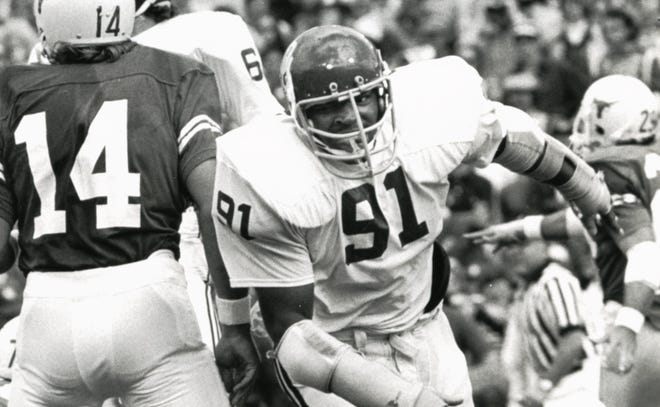
When Oklahoma fans talk about the Selmon brothers, the conversation usually begins with Lee Roy.
And understandably so.
Lee Roy Selmon won the Outland Trophy, the Lombardi Award, two national championships, became the No. 1 overall pick in the NFL Draft, and eventually earned a place in both the College Football Hall of Fame and the Pro Football Hall of Fame.
But here’s the reality many younger Sooner fans don’t realize:
There was another Selmon brother who was every bit as important to Oklahoma’s championship success.
As the countdown to the 2026 season reaches 91 days, we’re celebrating No. 91, Dewey Selmon — an All-American defensive tackle, two-time national champion, Academic All-American, NFL star, and one of the most accomplished student-athletes in Oklahoma football history.
If Lee Roy became the face of the Selmon dynasty, Dewey was the engine that helped drive it.
The Middle Brother Who Carved His Own Legacy
The story begins in Eufaula, Oklahoma.
The Selmon brothers—Lucious, Dewey, and Lee Roy—would eventually become the most famous family in Oklahoma football history.
For five seasons, from 1971 through 1975, at least one Selmon brother occupied a spot on the Sooners’ defensive front.
The results were staggering.
During that span, Oklahoma posted a remarkable 54-3-1 record, won four Big Eight championships, and captured back-to-back national titles in 1974 and 1975.
The trio combined for hundreds of tackles and countless disruptive plays.
Their impact was so overwhelming that bumper stickers began appearing all over Norman with a simple message:
“God blesd, Mrs. Selmon.”
Even Barry Switzer loved repeating the phrase.
But while Lee Roy often received the national headlines, Dewey quietly built one of the greatest defensive careers in school history.
The Tackle Machine Nobody Could Block
Modern football statistics don’t always do justice to players from previous eras.
But Dewey Selmon’s numbers still jump off the page.
He finished his Oklahoma career with 325 total tackles.
For a defensive tackle, that’s almost impossible to comprehend.
Then there’s what happened during Oklahoma’s back-to-back championship seasons.
In 1974, Dewey recorded 104 tackles.
That alone would have been an incredible accomplishment for an interior defensive lineman.
Instead of slowing down, he somehow became even more productive the following year.
In 1975, he piled up an astonishing 122 tackles.
Think about that for a moment.
Many modern linebackers don’t reach those numbers.
Dewey accomplished it as a defensive lineman while battling offensive linemen on every snap.
His combination of strength, effort, intelligence, and instincts made him nearly impossible to neutralize.
Opposing offenses quickly learned that assigning one blocker to Dewey Selmon was a losing proposition.
The Foundation of a Championship Defense
The 1974 and 1975 Oklahoma teams are remembered among the greatest squads in school history.
Both won national championships.
Both featured elite defenses.
And both relied heavily on Dewey Selmon.
The Sooners played a physical brand of football that overwhelmed opponents.
While the wishbone offense often generated headlines, Oklahoma’s defense consistently controlled games by dominating the line of scrimmage.
Dewey was at the center of that success.
His relentless pursuit of the football allowed Oklahoma’s defense to dictate games rather than react to them.
Every championship team needs stars.
Every championship team also needs players willing to do the difficult work that doesn’t always make the highlight reels.
Dewey provided both.
Saving a National Championship
Great players elevate their games on the biggest stages.
Dewey Selmon certainly did.
The defining moment came in the 1976 Orange Bowl against Michigan.
The game served as the final hurdle in Oklahoma’s quest for a second consecutive national championship.
Michigan entered with one of the nation’s most powerful offenses.
They quickly discovered they were facing one of the nation’s toughest defenses.
Dewey delivered one of the finest performances of his career.
He recorded 13 tackles and spearheaded a legendary goal-line stand that helped preserve Oklahoma’s lead.
Time and again, the Sooners denied Michigan scoring opportunities.
When the final whistle sounded, Oklahoma had secured a 14-6 victory and another national championship.
Championships are won through countless plays across an entire season.
But on that night in Miami, Dewey Selmon helped finish the job.
More Than a Football Player
What truly separates Dewey Selmon from many football legends is what happened after his playing career.
While many athletes are remembered solely for their accomplishments on the field, Dewey built a second legacy through education.
During his playing days, he was already excelling in the classroom.
He earned Academic All-American honors and developed a reputation as one of the smartest players in the Oklahoma locker room.
That commitment to learning never faded.
After football, he continued his education and eventually earned a Ph.D. in philosophy from the University of Oklahoma.
It’s an achievement so rare that many former teammates and coaches simply refer to him as “Dr. Dewey Selmon.”
The nickname carries enormous respect.
Because while plenty of athletes become champions, very few become doctors.
Dewey accomplished both.
Taking Oklahoma’s Legacy to the NFL
The NFL quickly recognized Dewey’s talent.
In the 1976 NFL Draft, the Tampa Bay Buccaneers selected him in the second round.
The selection reunited him with Lee Roy as members of the expansion franchise.
Together, the brothers helped establish the identity of a young organization searching for credibility.
Dewey proved he could thrive at the professional level just as he had in college.
During his seven NFL seasons, he played both defensive line and linebacker.
His versatility became one of his greatest strengths.
In 1979, he earned First-Team All-Pro honors while helping lead Tampa Bay to its first NFC Championship Game appearance.
Just as he had done in Norman, Dewey became a foundational piece of a winning team.
Carrying the Selmon Legacy Forward
Today, Dewey remains one of Oklahoma football’s most respected ambassadors.
His work in business, construction, consulting, housing initiatives, and youth education has extended his impact far beyond football.
Fans regularly see him participating in university events and celebrations honoring Oklahoma’s rich history.
Perhaps the most visible reminder of that legacy stands outside Gaylord Family-Oklahoma Memorial Stadium.
In 2022, Oklahoma unveiled a bronze statue honoring the Selmon brothers.
The monument recognizes not only their football accomplishments but also the values they represented.
Hard work.
Humility.
Excellence.
Service.
Those qualities continue to define the Selmon name decades after the brothers last took the field.
Why No. 91 Still Matters
Every great football program has players who become legends.
A select few become symbols.
Dewey Selmon belongs in that category.
His career was about more than statistics.
More than awards.
More than championships.
He represented everything Oklahoma football strives to be.
Tough.
Intelligent.
Dependable.
Selfless.
As the Sooners prepare for another season in the SEC, the program continues to search for players who embody those same characteristics.
Players who put team success above personal recognition.
Players who quietly become the foundation of championship teams.
Players like Dewey Selmon.
His brother may have become the most famous member of Oklahoma’s greatest football family.
But make no mistake:
The dynasty doesn’t happen without No. 91.
Days Until Kickoff: 91