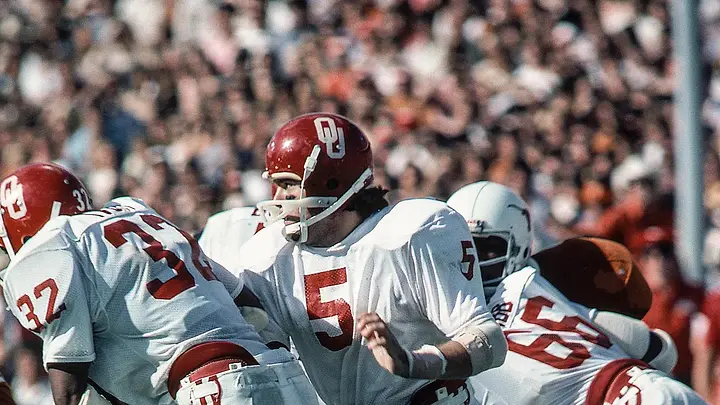
Championship teams are usually remembered for their dominance.
The 1975 Oklahoma Sooners are remembered for something even more impressive.
Their resilience.
With 75 days remaining until Oklahoma football returns to Norman, our countdown turns back to one of the most remarkable seasons in school history — a journey that featured heartbreak, redemption, and ultimately a second straight national championship.
Barry Switzer’s Sooners entered the year as defending national champions and one of the most talented teams in America. Oklahoma carried a remarkable 28-game winning streak into November and looked poised to cruise toward another title.
Then came one of the biggest shocks in program history.
On Nov. 8, 1975, an unranked Kansas team stunned No. 2 Oklahoma 23-3 in Norman. Suddenly, the Sooners’ dreams of repeating as national champions appeared to be over.
Oklahoma dropped to No. 3 in the rankings, and many around the country assumed the title race had moved on without them.
The Sooners never believed that.
A Team Loaded With Stars
The 1975 squad was overflowing with future NFL talent. Sixteen players from the roster eventually heard their names called on draft day, including some of the greatest players to ever wear the Crimson and Cream.
On offense, senior halfback Joe Washington remained the centerpiece of Switzer’s wishbone attack. The electrifying “Little Joe,” famous for his silver shoes and blazing speed, rushed for 916 yards and finished fifth in the Heisman Trophy voting.
Quarterback Steve Davis served as the steady hand behind the option offense. Though Oklahoma rarely threw the football, Davis’ leadership proved invaluable. He rushed for 362 yards while directing an offense that averaged over 30 points per game.
Wide receiver Tinker Owens made the most of limited opportunities, averaging an incredible 26.8 yards per reception.
Meanwhile, a young freshman named Billy Sims was beginning his own legendary journey. Few could have known the future Heisman Trophy winner was taking his first steps toward Sooners immortality.
But the strength of the team was undoubtedly its defense.
Lee Roy Selmon put together one of the greatest seasons by a defensive lineman in college football history. The future No. 1 overall NFL Draft pick captured both the Outland Trophy and the Lombardi Award while terrorizing opposing offenses.
Alongside him stood his brother, Dewey Selmon, another consensus All-American who formed one of the most feared defensive fronts in America.
Linebacker Jimbo Elrod brought relentless energy and physicality to a defense that surrendered just 13.5 points per game.
Opponents averaged only 113.5 rushing yards against Oklahoma’s iron wall.
One Last Test Against Nebraska
Despite the loss to Kansas, Oklahoma still controlled its destiny in the Big Eight race.
Standing in the way was No. 2 Nebraska.
The annual rivalry showdown became a winner-take-all battle for the conference championship and a trip to the Orange Bowl.
The Sooners delivered one of their most dominant performances of the season.
The defense forced six turnovers, and Oklahoma converted five of those takeaways into touchdowns. By the time the dust settled, the Sooners had rolled to a convincing 35-10 victory over the Cornhuskers.
The conference title belonged to Oklahoma.
But national championship hopes still required help.
Chaos Opens the Door
Entering New Year’s Day, Oklahoma sat third in the country and prepared to face No. 5 Michigan in the Orange Bowl.
A stunning loss by Texas A&M, to Arkansas, really left Ohio State in the driver’s seat for a title.
Then the unimaginable happened.
UCLA stunned the top-ranked Buckeyes 23-10 in the Rose Bowl.
Suddenly, Oklahoma’s showdown with Michigan transformed into a de facto national championship game.
The opportunity that seemed lost in November was alive once again.
Finishing the Job
The Orange Bowl became exactly what everyone expected: an old-fashioned slugfest.
Michigan’s defense was stout.
Oklahoma’s defense was better.
Steve Davis scored on a 9-yard keeper, and Billy Brooks broke loose for a thrilling 39-yard touchdown on an end-around. That proved to be enough.
The Sooners held Michigan to just six points and secured a 14-6 victory.
When the final polls were released, Oklahoma stood atop college football once again.
Back-to-back national champions.
More Than a Championship
The 1975 Sooners finished 11-1 and claimed the sixth national championship in program history.
But their story was bigger than trophies.
It was about perseverance.
A season that appeared lost after the stunning defeat to Kansas ended with confetti falling in Miami.
Switzer’s team never panicked.
They simply kept playing.
Seventy-five days before another season begins, the 1975 Sooners serve as a reminder that championship teams aren’t always defined by perfection.
Sometimes, they’re defined by how they respond when perfection slips away.
And few teams in Oklahoma history responded better than the champions of 1975.
75 days.
1975 Oklahoma Sooners Quick Hits
- Record: 11-1
- Final AP Ranking: No. 1
- Head Coach: Barry Switzer
- Points Per Game: 30.0
- Points Allowed Per Game: 13.5
- Signature Wins: Pitt (46-10), Texas (24-17), Nebraska (35-10), Michigan (14-6)
- National Championship: Defeated Michigan 14-6 in the Orange Bowl
- Future Legends: Lee Roy Selmon, Dewey Selmon, Joe Washington, Billy Sims, Steve Davis, Tinker Owens, Jimbo Elrod