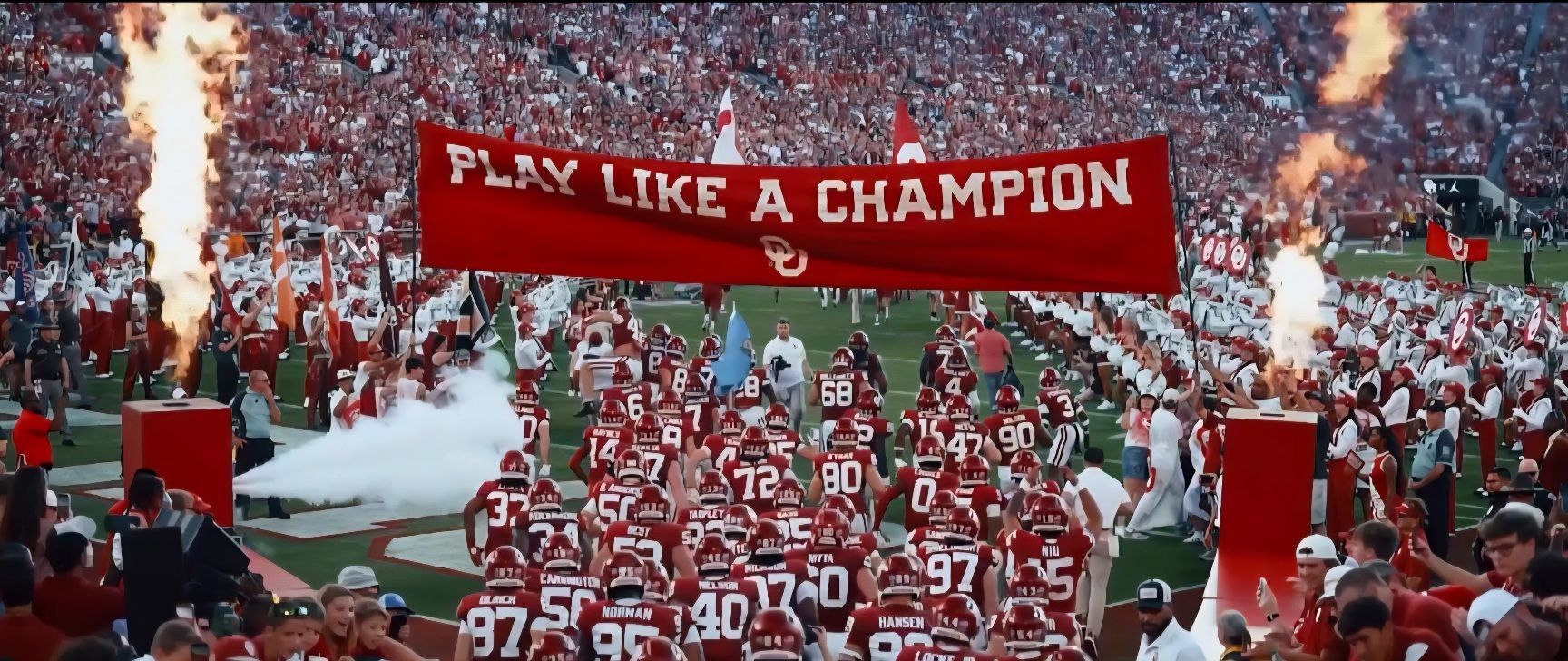
Oklahoma’s season opener told the Sooners almost everything they wanted to hear.
The offense was efficient. The defense was disruptive. John Mateer was sharp. Isaiah Sategna III was electric. Oklahoma scored 51 points, posted a shutout and did exactly what a top-15 team should do against an overmatched UTEP opponent.
But now comes the part that matters.
There will be no emptying the bench early this Saturday. There will be no comfortable second half spent evaluating young players. There will be no margin for sloppy execution.
Instead, No. 11 Oklahoma will walk into Ann Arbor for one of college football’s most intimidating environments and face a Michigan program with plenty to prove after escaping Western Michigan by the narrowest of margins.
The Big House changes the equation.
Michigan Stadium changes communication. It changes momentum. It changes how quickly a young offensive lineman has to process a defensive adjustment. And perhaps most importantly, it changes what happens when one team makes an early mistake.
For Brent Venables and the Sooners, Saturday is the first real measuring stick of 2026.
Oklahoma looked the part in Week 1.
Now it has to prove it can travel.
Here are the three biggest questions facing the Sooners in Ann Arbor.
1. How Much Can Oklahoma Lean on Lloyd Avant?
The first question might also be the most important.
How much of the offense can Oklahoma put on the shoulders of Lloyd Avant?
Against UTEP, the junior transfer showed why Oklahoma brought him to Norman. Avant carried the ball 15 times for 79 yards and a touchdown, providing the kind of physical, north-south presence the Sooners wanted to establish in the running game.
But Saturday presents an entirely different challenge.
Michigan is not UTEP.
The Wolverines have built their identity around physical football for generations, and regardless of what happened during their Week 1 scare, Oklahoma should expect a defensive front capable of making every rushing yard difficult.
That puts Avant at the center of Saturday’s offensive equation.
Oklahoma doesn’t necessarily need him to rush for 150 yards. In fact, focusing exclusively on the final rushing total could miss the point entirely.
The more important question is whether Avant can keep Oklahoma on schedule.
Can he turn first-and-10 into second-and-six?
Can he turn a potentially negative play into a two-yard gain?
Can he fall forward when Michigan’s defensive line wins the initial collision?
Can Oklahoma hand him the football enough times to prevent Michigan from teeing off on Mateer?
Those are the questions.
If Avant consistently gives the Sooners manageable down-and-distance situations, Ben Arbuckle’s offense becomes significantly more difficult to defend.
The entire playbook remains open.
The RPO game becomes more dangerous. Play-action becomes more believable. Michigan’s linebackers have to respect the run. And Mateer is not constantly operating in third-and-long against an aggressive defense.
That last part matters.
Michigan wants to create predictable situations. Elite defensive fronts don’t simply dominate because they are physically talented. They dominate when they know what is coming.
If Oklahoma faces third-and-eight repeatedly, Michigan can unleash its pass rush.
If Oklahoma is facing second-and-five and third-and-two, the Wolverines have a problem.
Avant doesn’t have to be spectacular on every carry.
He has to be reliable.
And with Tory Blaylock continuing to work his way back from a hamstring injury, Avant’s importance becomes even more obvious. Oklahoma may have multiple backs available, but Avant represents the most established physical option heading into the weekend.
The Sooners need him to set the tone.
They need him to absorb contact.
And they may need him to carry the ball 20 times.
Because in Ann Arbor, the running game isn’t just about producing yards.
It’s about protecting your quarterback, controlling the tempo and keeping the crowd from becoming a factor.
2. Can Oklahoma’s Offensive Line Handle the Noise?
Every road game presents challenges.
Few present this one.
Michigan Stadium holds more than 100,000 people, and Oklahoma’s offensive line will be asked to operate inside an environment where verbal communication can disappear almost immediately.
That makes Saturday’s game particularly interesting because the Sooners enter the week with an offensive line that appears to be getting healthier—but still has questions.
The encouraging news is the potential return of important pieces.
Jake Maikkula’s return at center would provide Oklahoma with a more experienced option in the middle of the offensive line after true freshman Noah Best admirably stepped into a difficult situation against UTEP.
Ryan Fodje also appears to be progressing toward a return, giving Oklahoma additional experience and flexibility along the interior.
Those developments are significant.
Against Michigan, experience matters.
Communication matters.
And perhaps nothing matters more than knowing exactly what you’re doing before the football is snapped.
The challenge is that Michigan’s crowd can eliminate traditional communication.
Oklahoma will have to rely heavily on silent counts, visual signals and pre-established communication procedures.
The center has to identify the front.
The guards have to understand the protection.
The tackles have to recognize movement.
And everyone has to operate together.
One missed signal can become a free runner.
One delayed snap can destroy the timing of a play.
One false start can turn second-and-four into second-and-nine.
That is the danger of playing in the Big House.
The physical matchup receives most of the attention, but the mental matchup could be equally important.
Michigan’s defensive line doesn’t have to record five sacks to affect the game. If the Wolverines can force procedural penalties, create confusion and put Oklahoma behind schedule, the pass rush becomes exponentially more dangerous.
And there is another layer to the situation.
Michael Fasusi’s shoulder remains a storyline.
If Fasusi is limited, Oklahoma’s depth and versatility could be tested. That could force additional movement along the offensive line and create communication challenges in the biggest environment the unit has faced.
The good news for Oklahoma is that the UTEP game provided something valuable: adversity.
Best was forced into meaningful action. Other linemen were asked to handle responsibilities they may not have expected entering the week.
That experience doesn’t replicate Michigan Stadium.
Nothing does.
But it could help.
Saturday will provide the ultimate test.
Can Oklahoma get lined up?
Can the Sooners avoid pre-snap penalties?
Can they identify Michigan’s pressures?
And can they execute when 100,000 people are trying to make communication impossible?
If the answer is yes, Oklahoma has a chance to control the game.
If the offensive line struggles with the environment early, Michigan will feed off it.
Take A Deeper Dive Into Our Oklahoma Football Coverage On Our Facebook Subscription Hub
Unlock Exclusive, data-driven film room breakdowns, recruiting Update, high-leverage personnel matrix updates you won’t find anywhere else, and More by subscribing to our premium Oklahoma Sooners football coverage today.
The Michigan Blueprint | What UTEP Film Tells Us About The Wolverines Matchup
The Big House Depth Chart & Personnel Matrix | What Oklahoma’s Evolving Roster Could Look Like At Michigan
Oklahoma’s Portal Plan Was Never About One Season, It Was About Building A Program That Doesn’t Have To Start Over
3. Can Oklahoma Set the “Nasty” Defensive Standard Immediately?
Brent Venables has made it clear what he wants from his defense.
Aggressive.
Physical.
Disciplined.
And, in his words and philosophy, Oklahoma needs to play with a certain level of nastiness.
Against UTEP, the Sooners certainly played fast.
They recorded four sacks, forced two fumbles and limited the Miners to 198 total yards.
The final score was dominant.
But Venables also saw things he didn’t like.
He described moments of the defense as overly anxious and acknowledged that players were occasionally trying too hard to make a play.
His description was revealing.
The players’ “hair was on fire,” Venables explained.
The problem wasn’t a lack of effort.
It was too much aggression without enough discipline.
Against Michigan, that cannot happen.
The Wolverines have a young and immensely talented quarterback in Bryce Underwood. Venables has been complimentary of Underwood’s ability, calling him one of the most talented players in college football.
But young quarterbacks can be affected by pressure.
They can be affected by disguised coverages.
They can be affected by a defense that wins early downs and forces them into uncomfortable situations.
That’s where Oklahoma’s opportunity begins.
The Sooners need to establish their defensive identity on the first possession.
Not the third quarter.
Not after Michigan has established momentum.
Immediately.
Can David Stone and Oklahoma’s defensive front make Michigan work for every rushing yard?
Can Taylor Wein and the edge defenders create pressure without losing containment?
Can Oklahoma’s linebackers remain disciplined against play-action and misdirection?
Can the secondary disguise coverages and force Underwood to hesitate?
Those are the questions that could determine Saturday’s game.
Oklahoma doesn’t necessarily need to produce a turnover on Michigan’s first possession.
But the Sooners need to send a message.
Michigan should feel the physicality.
Michigan should understand that the running game isn’t going to come easily.
And Underwood should know that every snap will require a decision.
That is the “nasty” standard.
It isn’t reckless football.
It isn’t players flying out of their gaps in an attempt to create a highlight.
It is controlled aggression.
It is physicality with discipline.
It is knowing your responsibility and then trying to dominate the player standing across from you.
Against UTEP, Oklahoma had enough talent to overcome occasional mistakes.
Against Michigan, those mistakes could be the difference between winning and losing.
Venables knows that.
And his defense should know it, too.
(Bonus) The Fourth-Quarter Factor: Who Handles the Moment?
There are plenty of reasons to believe Saturday will be decided by more than talent.
Oklahoma has talent.
Michigan has talent.
Both programs have coaches who understand the magnitude of the game.
The difference could come down to which team handles the moment better.
Michigan is coming off a Week 1 performance that created more questions than answers. The Wolverines survived Western Michigan, 13-12, thanks to a dramatic finish.
Oklahoma, meanwhile, enters the game with confidence after a 51-0 victory.
But confidence and composure are not the same thing.
The Sooners are walking into Michigan’s home stadium.
They will be playing in front of a hostile crowd.
They will be facing a desperate opponent.
And they will be carrying the expectations that come with being a ranked team and an early road favorite.
That is why the first quarter matters.
If Oklahoma can establish the run, handle the crowd noise and make Michigan uncomfortable defensively, the pressure begins shifting toward the home team.
If Michigan starts fast and the Big House becomes a factor, the Sooners will have to prove they can respond.
This is where John Mateer becomes particularly important.
Saturday will test more than his arm talent.
It will test his command.
Can he settle the offense after a penalty?
Can he manage the silent count?
Can he make the correct decisions against pressure?
Can he keep Oklahoma from chasing a big play when a simple completion will move the chains?
Those moments often determine road games.
Not the spectacular plays.
The routine ones.
Three Questions. One Massive Opportunity.
Oklahoma’s opener was impressive.
The Sooners did what they were supposed to do.
They beat UTEP.
They dominated UTEP.
And they gave themselves a week of confidence heading into one of the biggest games of the early college football season.
But Week 1 is over.
The scoreboard from Norman won’t help Oklahoma on Saturday at The Big House.
The 51 points won’t make the crowd quieter.
The shutout won’t block Michigan’s defensive line.
And the national ranking won’t gain the Sooners a single yard.
Oklahoma has to earn everything again.
So when the Sooners take the field in Ann Arbor, three questions will follow them.
Can Lloyd Avant give the offense enough consistency to stay ahead of the chains?
Can a healthier—but still evolving—offensive line handle the noise and communication challenges of the Big House?
And can Brent Venables’ defense establish the nasty, disciplined identity its head coach expects?
Answer those questions, and Oklahoma could leave Ann Arbor with one of the most important early-season victories in college football.
Fail to answer them, and the Sooners will discover just how quickly a comfortable 51-0 opening win can become irrelevant.
UTEP was the introduction.
Michigan is the examination.