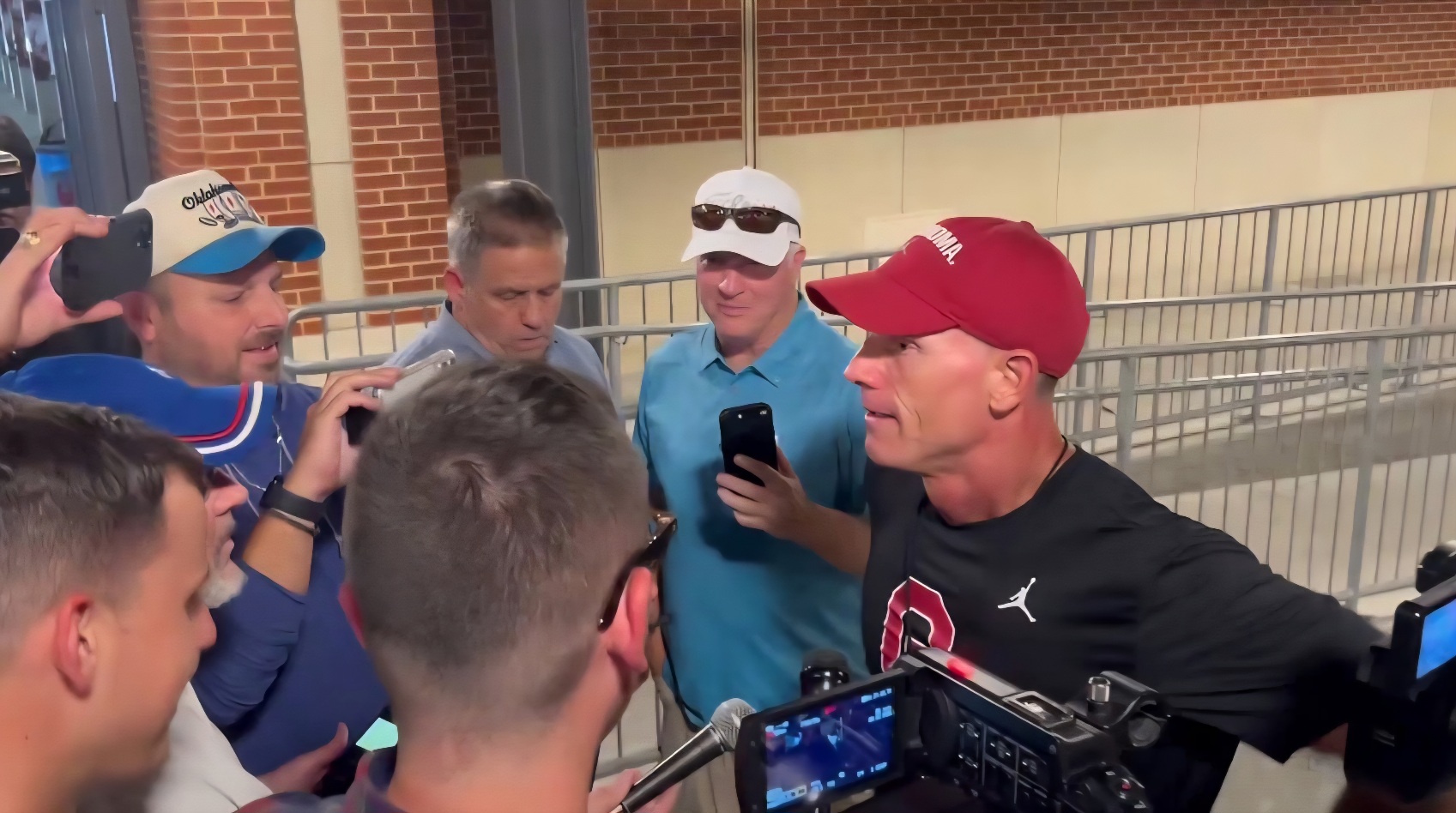
Brent Venables made one thing perfectly clear this week.
John Mateer is still Oklahoma’s quarterback.
“John’s our starting quarterback,” Venables said during a Wednesday media session, ending any speculation that they might use the bye week to install a new signal caller.
There will be no quarterback change heading into the Cotton Bowl. No panic move. No handing the offense to Whitt Newbauer because Mateer had three turnovers in one disastrous quarter against Georgia.
That’s probably the right decision.
But it also creates a much bigger responsibility for Oklahoma’s coaching staff.
If John Mateer is going to remain the quarterback, then Oklahoma has to build an offense that gives him a legitimate chance to succeed.
Because simply putting Mateer back on the field and telling him to stop turning the ball over isn’t a plan.
It’s a hope.
And Oklahoma doesn’t have time for hope.
The Sooners are 2-2, they’ve lost the two biggest games and they’re walking into the Cotton Bowl to face a Texas team that is 4-0 and ranked No. 1 in the country. Meanwhile, Oklahoma’s offense sits at the bottom of the SEC in total offense at 321.3 yards per game and has committed 10 turnovers through four games.
That’s not a John Mateer problem.
That’s an Oklahoma problem.
Defending Mateer Doesn’t Mean Excusing Him
Let’s get something straight before going any further.
Mateer has to play better.
He cannot lose the football at the goal line.
He cannot put the ball in harm’s way repeatedly.
He cannot turn one bad play into three bad plays because he is trying to manufacture something that isn’t there.
Against Georgia, his mistakes were devastating.
The Sooners were driving toward the end zone when Mateer lost a fumble near the Georgia goal line. Chris Cole scooped it up and took it 85 yards for a touchdown.
Later, Mateer threw an interception.
Then he lost another fumble.
Three turnovers on three consecutive second-quarter drives.
Ultimately, Georgia turned Oklahoma’s four turnovers into 17 points in a game the Sooners eventually lost 41-13.
That’s not something you can shrug away.
But here’s where the conversation has become too simplistic.
The answer isn’t automatically, “Put the backup in.”
Venables has explained why.
Newbauer doesn’t have the same level of experience. Bowe Bentley is a true freshman. Neither has been asked to quarterback Oklahoma against an opponent like Texas.
That doesn’t make Mateer immune from accountability.
It makes the decision more complicated.
And Venables has apparently decided that the best chance of winning right now is to help Mateer get back to being the player Oklahoma believed it was getting.
That is coaching.
The harder question is what happens next.
“That’s the Art of Coaching”
One of Venables’ most revealing comments wasn’t actually about whether Mateer would start.
It was about how you rebuild him.
Everybody responds differently, Venables explained. Coaches have to figure out what a player needs and what he doesn’t need.
“That’s the art of coaching.”
That sounds like standard coach-speak until you consider what came next.
Venables pointed out that sometimes the structure around a player can help him find rhythm and confidence.
That’s an important admission.
Because Oklahoma cannot simply ask Mateer to regain his confidence while continuing to put him in an offense that demands he create everything himself.
The quarterback needs help.
He needs manageable throws.
He needs a run game the defense respects.
He needs protection.
He needs early completions.
He needs situations in which the offense can build momentum instead of asking him to rescue it.
And most importantly, he needs to know that one mistake isn’t going to force him into hero-ball on the next snap.
That is where the bye week becomes so important.
Oklahoma’s Biggest Problem Is Still Up Front
Venables was also refreshingly blunt about the running game.
He called the execution disappointing.
That word doesn’t adequately describe how badly Oklahoma has struggled to establish itself physically.
The Sooners rushed for just 65 yards on 35 attempts against Georgia.
That’s 1.9 yards per carry.
That isn’t enough to win in the SEC.
It isn’t enough to protect a quarterback.
And it certainly isn’t enough to force Texas to respect the running game.
Venables has spent much of the offseason talking about the need to fix Oklahoma’s rushing attack after calling last year’s production “pathetic.”
We’re now four games into the season.
The problem isn’t fixed.
And that’s where the offensive line has to become the centerpiece of this bye-week reset.
Venables talked about becoming more aggressive and confident and about players needing to stop “seeing too much.”
That’s a fascinating phrase.
Because offensive linemen who are thinking instead of attacking are usually already in trouble.
They’re reacting.
They’re hesitating.
They’re waiting to see what the defense does instead of imposing their will on it.
That has to change.
And Oklahoma is apparently willing to make personnel changes to find the answer.
Sophomore Peyton Joseph is getting more opportunities at right guard. Michael Fasusi is working his way back from injury. The coaching staff is still trying to figure out which combination can give the offense some stability.
That’s not insignificant.
The offensive line doesn’t need another speech.
It needs five guys who know exactly what they’re doing and are willing to play violently and confidently.
This Is Where Ben Arbuckle Has to Earn His Money
There is another uncomfortable part of this conversation.
At some point, the offense has to become easier.
Not necessarily simpler.
Easier.
There’s a difference.
Oklahoma doesn’t need to throw away Ben Arbuckle’s offense.
It needs to find the portions of it that give Mateer the greatest chance to play fast and confidently.
If the quarterback is pressing, give him throws he can complete.
If the run game isn’t creating anything, find ways to manufacture positive yardage.
If defenses are sitting on certain concepts, change the tendency.
If protection is unreliable, don’t consistently put the quarterback in situations where he has to hold the ball forever waiting for something to develop.
This isn’t about protecting Mateer from criticism.
It’s about maximizing the quarterback Oklahoma has decided to play.
Venables said the staff is studying its own formations, motions and tendencies during the bye week.
Good.
Because self-scouting has to mean something.
If Oklahoma can identify what opponents already know about its offense, then it can stop giving away information for free.
That’s especially important against Texas.
Steve Sarkisian isn’t going to need much help figuring out where Oklahoma is vulnerable.
The Longhorns will have the Georgia film.
They’ll have Michigan.
They’ll have New Mexico.
They’ll have four total games of tendencies.
Oklahoma has to give them something different to prepare for.
“People Are Pissed”
Then there was the comment that may ultimately tell us the most about where this team is mentally.
“People are pissed.”
Good.
They should be.
Venables said he would be disappointed if his players weren’t angry after what happened in Athens. He also emphasized that players can disagree, speak their minds and still remain connected as a team.
That’s not necessarily a sign of a fractured locker room.
In fact, it can be the opposite.
A team that gets embarrassed and responds with indifference has a much bigger problem.
Anger isn’t the issue.
What the players do with it is the issue.
If “pissed” means Oklahoma comes back from the bye week more physical, more focused and more willing to confront its weaknesses, then good.
If it means players point fingers at the quarterback, offensive line, coaches or anybody else, then nothing has been accomplished.
The answer isn’t finding someone to blame.
The answer is finding something to fix.
And That’s What This Bye Week Has to Be
Venables also pushed back on the idea of making staff changes in the middle of the season.
Again, that’s understandable.
Oklahoma isn’t going to reinvent the coaching staff in October.
But there is a difference between changing the staff and changing what the staff is asking the players to do.
That’s where the pressure belongs.
The coaches have to evaluate everything.
The formations.
The motions.
The protections.
The run concepts.
The quarterback reads.
The personnel groupings.
The early-down calls.
The third-down calls.
The red-zone offense.
Everything.
Because Oklahoma doesn’t need a cosmetic adjustment.
It needs an offensive reset.
Not a new offense.
A reset.
Venables Is Putting His Reputation Behind Mateer
By publicly declaring Mateer his quarterback, Venables has made a bet.
He’s betting that the player Oklahoma saw before the Georgia meltdown is still in there.
He’s betting that experience matters.
He’s betting that Mateer can regain his confidence.
He’s betting that the coaching staff can put him in better positions.
Most importantly, he’s betting that Oklahoma can fix enough around him to make the quarterback position manageable again.
That’s a reasonable bet.
But it cannot be a blind one.
Mateer has to stop giving the ball away.
The offensive line has to become more physical.
The running game has to become functional.
The play-calling has to create rhythm.
The receivers and tight ends have to consistently win their opportunities.
And the entire offense has to stop treating every possession like Mateer has to perform a magic trick to produce a first down.
Because that’s the real problem.
Oklahoma has made quarterback play disproportionately important because it hasn’t established enough around the quarterback.
Against Georgia, that became painfully obvious.
The defense wasn’t perfect, but it did enough to keep the game from becoming the statistical demolition the 41-13 score suggests. Georgia had only a modest advantage in total yardage, while Oklahoma’s turnovers repeatedly handed the Bulldogs short fields and points.
The offense couldn’t stay out of its own way.
And now it gets Texas.
The Countdown Is Already Underway
There is no guarantee that Mateer fixes everything.
There is no guarantee the offensive line suddenly becomes dominant.
There is no guarantee Oklahoma’s rushing attack turns into a strength in one week.
But that’s not what this bye week is about.
It’s about finding out whether this coaching staff can identify the problems and actually solve some of them.
Venables has chosen his quarterback.
Now he has to protect that decision with results.
Because if Mateer struggles against Texas, the quarterback debate will become deafening.
If the offensive line gets pushed around, the questions will get louder.
If the Sooners can’t run the football, the defense will once again be asked to carry an unreasonable burden.
And if Oklahoma continues to look exactly like the team that showed up in Athens, then eventually the argument will shift from who is playing quarterback to why the offense hasn’t improved.
That’s the conversation Venables needs to avoid.
Not by changing quarterbacks.
By changing the way his team plays football.
John Mateer is QB1.
Venables has made that abundantly clear.
Now the entire Oklahoma program has to prove that keeping him there was more than a decision to stay the course.
It has to become the beginning of a correction.
Because Texas isn’t coming to the Cotton Bowl to see whether Oklahoma has learned its lessons.
The Longhorns are coming to expose whether it actually has.