Oklahoma can beat the No. 1 team in the country with 238 yards of offense. It just probably can’t make a habit of it.
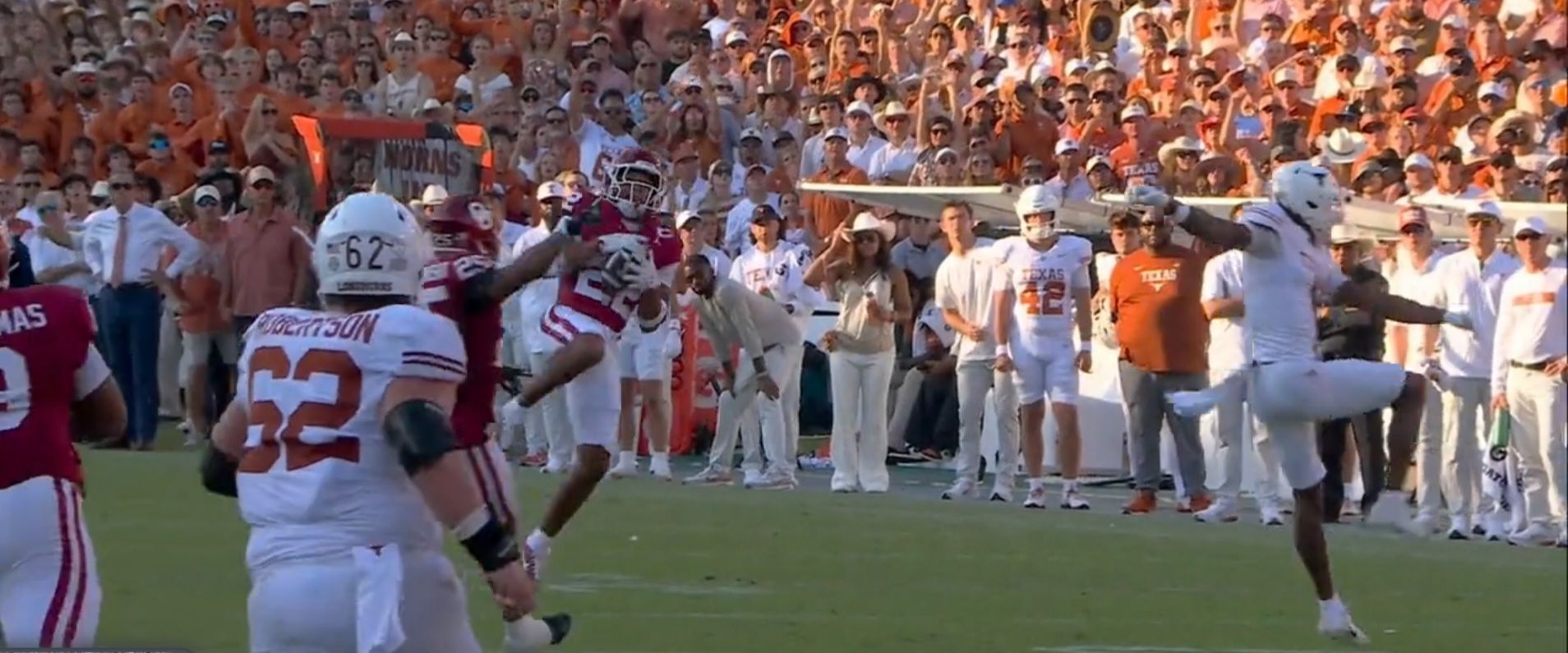
The Sooners proved that Saturday in Dallas, knocking off Texas 27-24 behind a defensive touchdown from Peyton Bowen, a blocked-punt score and Tate Sandell’s walk-off field goal. It was the kind of win that can reset a season, restore confidence and remind everyone what Brent Venables’ team is capable of when its defense takes control.
But the box score tells a less comfortable story. Oklahoma averaged just 2.7 yards per rushing attempt, struggled to sustain drives and leaned heavily on its defense and special teams to finish the job. John Mateer protected the football and delivered when the Sooners needed him late, but the offense still has too many unanswered questions.
Beating Texas changed what Oklahoma can believe about this season. What happens next depends on whether the offense can give that belief something more substantial to stand on.
Tate Sandell drilled a 47-yard field goal as time expired. Peyton Bowen turned an interception into a 42-yard touchdown. Danny Okoye blocked a punt that Dakoda Fields recovered in the end zone. Brent Venables’ defense delivered when the Sooners needed it most, and Oklahoma walked away with one of the biggest victories of the coach’s tenure.
For a team that entered the Red River Rivalry at 2-2, the importance of that afternoon cannot be overstated.
But here comes the pivot.
Oklahoma is 3-2. The Sooners have beaten the No. 1 team in the country. Their confidence should be different, their locker room should feel different, and their belief in what this season can become should be different.
Their offensive problems, however, did not disappear when Sandell’s kick split the uprights.
Oklahoma finished with just 238 total yards against Texas. The Sooners struggled to sustain drives and needed touchdowns from the defense and special teams to help compensate for an offense that remains a work in progress.
John Mateer played a much cleaner game than he had during Oklahoma’s recent struggles. He completed 18 of 26 passes for 155 yards without throwing an interception, then delivered two crucial completions to Isaiah Sategna III on the final drive.
That was enough to win.
It will not always be enough against the teams remaining on Oklahoma’s schedule.
The defense has shown that this team can compete with elite competition. Now offensive coordinator Ben Arbuckle and offensive line coach Bill Bedenbaugh must find a way to make the offense more dependable.
Because if Oklahoma wants to turn a signature victory into a successful SEC season, the offense has to evolve.
1. The Win Changed the Ceiling. The Schedule Will Determine the Floor.
The most important thing Oklahoma accomplished in Dallas was giving itself a chance to write a different story.
At 2-2, with offensive inconsistency and questions surrounding Mateer, the Sooners were approaching a point where every remaining game threatened to become a referendum on the direction of the season.
Now they have beaten the No. 1 team in the country.
That does not make Oklahoma a championship contender overnight. It does mean the Sooners have a compelling piece of evidence that their ceiling is higher than their early-season performance suggested.
The distinction matters.
Oklahoma’s defense has played well enough at times to keep the team in games against quality opponents. The special teams have provided a game-changing spark. Against Texas, the Sooners scored touchdowns on offense, defense and special teams.
That is a formula capable of producing big wins.
The challenge is whether Oklahoma can make that formula sustainable.
Defensive touchdowns are difficult to predict. Blocked punts are uncommon. A game-winning field goal is a wonderful way to finish a rivalry game, but it is not a weekly offensive strategy.
The Sooners need more ordinary possessions that end with points.
They need to turn first downs into sustained drives, find a reliable rushing identity and give Mateer enough protection and structure to operate without feeling as though every possession requires him to rescue the offense.
The next opportunity arrives Saturday against No. 15 Kentucky, a 5-1 team coming off an overtime victory over LSU.
The Wildcats will bring their own confidence to Norman. Oklahoma will bring the emotional lift of beating Texas, but it must avoid confusing momentum with a solution to its offensive shortcomings.
The stakes: Beat Kentucky, and Oklahoma can begin building a credible postseason résumé. Lose, and the Texas victory remains a memorable high point without necessarily changing the trajectory of the season.
The Sooners have earned the opportunity. Now they must capitalize on it.
2. The Path Ahead: Oklahoma Has Room to Move
Oklahoma’s remaining schedule presents opportunities, but it also leaves little room for complacency.
The Sooners have seven SEC games remaining, beginning with Kentucky at home. After that comes a road trip to Mississippi State, followed by a home game against South Carolina and a difficult stretch that includes Florida, Ole Miss, Texas A&M and Missouri.
There are no guarantees in that group.
Kentucky: The Immediate Test
Kentucky is the first measuring stick for whether Oklahoma can carry the confidence from Dallas into a different kind of game.
The Red River Rivalry demanded emotional resilience, defensive execution and timely plays. The Kentucky matchup will require those same qualities, but Oklahoma also needs to show that its offense can generate more consistent production.
The Sooners cannot assume their defense will score a touchdown every week. They cannot count on the opponent handing them a short field at the perfect moment. And they cannot make every fourth-quarter possession a high-wire act.
This is an opportunity to establish a more dependable offensive rhythm.
Mississippi State: A Road Test of Maturity
The following week takes Oklahoma away from Norman.
Road games in conference play tend to expose the details that home victories can sometimes conceal. Communication, ball security, offensive-line execution and the ability to respond when a drive stalls all become critical.
If Oklahoma is still relying on extraordinary defensive plays to survive, the margin for error will remain narrow.
The Rest of the SEC: Every Improvement Matters
The remaining schedule includes opponents capable of testing Oklahoma in different ways. That makes offensive development more than a weekly talking point. It is a requirement.
A stronger ground game could help the Sooners control tempo. Better protection could give Mateer more time to attack downfield. More consistent early-down production could reduce the number of obvious passing situations and make the offense harder to defend.
None of those improvements requires Oklahoma to become one of the nation’s most explosive offenses overnight.
It needs to become more efficient.
The projection: Oklahoma has put itself back in the postseason conversation. Its ultimate ceiling will depend on whether the offense can turn the Texas win into a foundation rather than an exception.
Take A Deeper Dive Into Our Oklahoma Football Coverage On Our Facebook Subscription Hub
Help support Heartland Sports by Unlocking Exclusive, data-driven film room breakdowns, recruiting Update, high-leverage personnel matrix updates you won’t find anywhere else, and More by subscribing to our premium Oklahoma Sooners football coverage today.
The Column: Deconstructing The Game Film And Brent Venables’ High-Stakes Decisions
Notes & Quotes: What The Sooners Said After Stunning No. 1 Texas
The Red River Overreaction Index: Sorting Fact From Fiction After Oklahoma’s Epic Cotton Bowl Upset
3. Unlocking the Rushing Game: The Next Big Assignment
The rushing attack is the most obvious place to start.
Oklahoma has not consistently created enough room for its running backs, and the numbers against Texas underscored the problem. The Sooners finished with 83 rushing yards on 31 attempts, a total heavily influenced by the difficulty of finding productive runs throughout the game.
Lloyd Avant provided the exception.
Avant carried the ball 10 times for 72 yards, averaging 7.2 yards per attempt. His 42-yard run demonstrated the explosive potential that has been missing from too many of Oklahoma’s possessions.
That performance should be encouraging. It should also raise an important question: How can the Sooners create more opportunities for that version of Avant to appear?
Find a Reliable Blocking Combination
Oklahoma’s offensive line has dealt with personnel challenges, and its performance has been inconsistent. Simply changing the starting five is not necessarily the answer.
The coaching staff needs to identify the combinations that give the line its best chance to communicate, maintain leverage and reach the second level.
That may involve adjustments at guard, different tight-end alignments or a greater emphasis on concepts that allow the offensive line to work together rather than leaving individual blockers isolated against difficult matchups.
The objective is straightforward: give the running back a clear decision and a realistic chance to get through the line of scrimmage without immediately confronting an unblocked defender.
Avant and Jonathan Hatton Jr. offer different possibilities in the backfield, but neither can consistently manufacture yards when the defense wins before the play has a chance to develop.
The line must create a foundation. The backs must turn that foundation into production.
Make Mateer’s Legs Part of the Plan
Mateer’s running ability is another part of the equation.
He entered the season with a résumé that included substantial rushing production, but his first five games of 2026 produced only about 70 net rushing yards. That figure reflects a quarterback whose mobility has not yet become a consistent weapon in the Sooners’ offense.
There are reasons for that. Protection problems can force a quarterback to scramble before a play develops. Defensive pressure can eliminate designed running opportunities. And after a stretch of costly turnovers, ball security and decision-making deserve particular attention.
Still, Oklahoma should consider whether Mateer’s athleticism can be incorporated more deliberately into the game plan.
Designed quarterback runs, zone-read concepts and selective movement passes could force defenses to account for another threat. If a defender crashes down on Avant, Mateer may have an opportunity to keep the ball. If a defense commits extra resources to containing the quarterback, that decision could create space elsewhere.
The key word is selective.
Oklahoma does not need Mateer taking unnecessary hits or becoming a running back. It needs to use his mobility to influence the defense, create uncertainty and make the existing run game more difficult to anticipate.
Rollouts can also give him a different throwing platform and create opportunities to move away from pressure. But they must be part of a varied offense, not a predictable response to every protection problem.
The goal is to make the defense defend the whole field.
Don’t Abandon the Run After One Negative Play
Perhaps the most important adjustment is philosophical.
A struggling rushing attack can become self-defeating. A run goes for no gain, the offense moves immediately to a passing situation, and the defense starts anticipating the next call. Before long, the ground game becomes a changeup rather than a meaningful part of the offense.
Oklahoma needs to find the right balance between persistence and adaptability.
That does not mean repeatedly calling runs into a defensive front that is winning every matchup. It means evaluating why a play failed, adjusting the blocking or formation when necessary, and giving the run game enough opportunities to develop.
Avant’s performance against Texas showed that explosive gains remain possible.
The coaching staff’s task is to make them less rare.
4. Lloyd Avant: Can the Breakout Become a Trend?
Avant may be the most intriguing Oklahoma running back to watch this week.
His performance against Texas was efficient, explosive and timely. Ten carries for 72 yards gave the Sooners a glimpse of what the ground game can look like when a back finds space and accelerates through it.
But one productive afternoon does not automatically establish a new workload.
Avant’s value against Kentucky will depend on how Oklahoma chooses to distribute its carries, how well the offensive line performs and whether the Sooners can stay in situations that allow them to run the ball without telegraphing their intentions.
A heavier workload would make sense if Avant continues to demonstrate that he can turn good blocking into meaningful gains. It would be equally important to keep the rotation flexible enough to respond to the matchup.
His production against Texas gives him a stronger case for consideration, but workload, matchup and the availability of other backs still matter.
The more important question for Oklahoma is what his performance means for the offense.
If Avant can become a reliable source of positive yardage, the Sooners can reduce some of the pressure on Mateer, create more manageable third downs and keep opposing defenses from focusing entirely on the passing game.
That would be a meaningful step forward, regardless of what it means for fantasy lineups.
5. The Defense Has Provided the Blueprint. The Offense Must Follow It.
Oklahoma’s victory over Texas was a reminder of what Brent Venables’ program can look like when its defining strengths show up together.
The defense created takeaways. The special teams changed the scoreboard. Sandell delivered when the game was on the line. Mateer avoided turnovers and helped the Sooners move into field-goal range when they needed it most.
That is winning football.
But the offense still has to carry a greater share of the burden.
Oklahoma cannot build its season around the assumption that Bowen will return another interception for a touchdown or that a blocked punt will provide a short field. Those plays are bonuses. They are not substitutes for first downs, productive rushing attempts and sustained scoring drives.
The encouraging part is that the Sooners do not need to overhaul everything.
Mateer showed better ball security against Texas. Avant produced an explosive run. The offense moved the ball when it mattered on the final possession. Those are building blocks, even if they do not yet amount to a complete offensive identity.
Now Arbuckle must put those pieces together more consistently.
Can Oklahoma use Mateer’s mobility without exposing him to unnecessary punishment? Can the offensive line produce cleaner combinations? Can the running backs turn occasional explosive plays into a dependable part of the game plan? Can the Sooners become more efficient on early downs and avoid putting themselves in predictable passing situations?
Those are the questions that will define the next phase of the season.
The Bottom Line: Celebrate Dallas. Get to Work on Kentucky.
Oklahoma has every reason to enjoy what happened in Dallas.
Beating No. 1 Texas in the final seconds is the kind of victory that stays with a program. It restored belief, changed the tone around the team and gave the Sooners a result they can build on.
But the schedule does not care how good the celebration felt.
Kentucky arrives in Norman with a 5-1 record and momentum of its own. Oklahoma needs to bring the same defensive intensity and special-teams execution it showed against Texas, while asking more of an offense that has too often struggled to stay on schedule.
The Sooners do not need 500 yards to become dangerous. They do not need Mateer to throw for 300 yards every Saturday. They do need an offense capable of consistently helping the defense instead of asking it to rescue the game.
The Texas win proved Oklahoma can beat an elite opponent.
The next step is proving the Sooners can keep winning when the defense and special teams don’t deliver a touchdown.
The Pivot: The season’s ceiling has risen. Now the offense must rise with it.