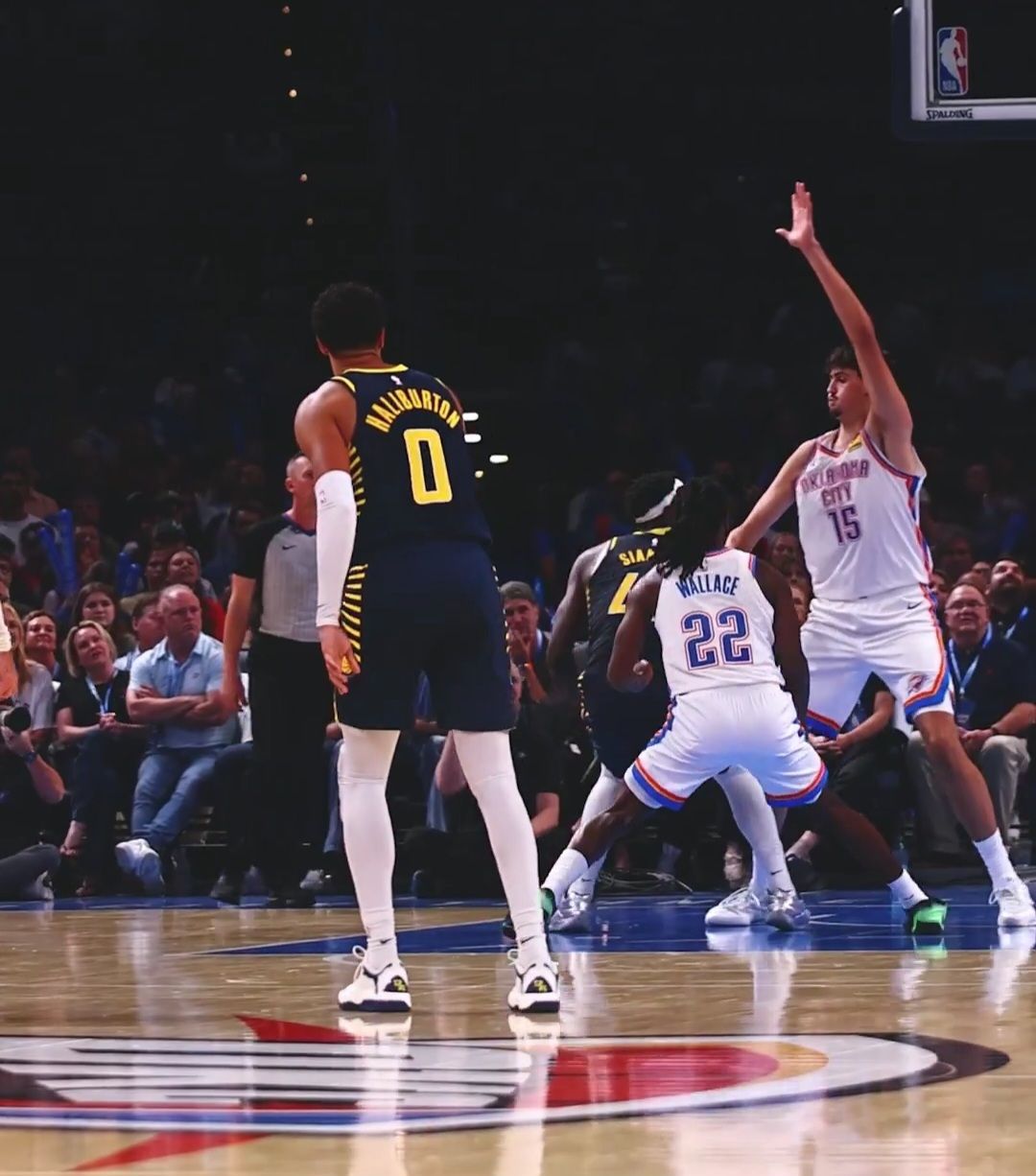
The Oklahoma City Thunder entered Tuesday night looking for their first victory of the preseason. They left Paycom Center with something more valuable than a number in the win column: a reminder of how quickly defensive pressure can change a basketball game.
Down by as many as 20 points against the Indiana Pacers, the Thunder fought their way back, weathered a difficult fourth quarter, and eventually prevailed 114-112 in overtime. It was an imperfect performance, particularly on the glass, but Oklahoma City found ways to compensate for its biggest weakness by attacking Indiana’s ball security and making the most of its opportunities.
Jared McCain led the Thunder with 20 points, including six three-pointers. Shai Gilgeous-Alexander added 15 points and six assists in an efficient outing, while Jalen Williams contributed 16 points. Rookie center Aday Mara supplied another encouraging performance off the bench, finishing with 10 points, four rebounds, and three blocks.
The result improved Oklahoma City to 1-3 in preseason play. More importantly, it offered a useful look at how the Thunder can win when the game doesn’t unfold according to plan.
A Rough Start Put Oklahoma City in a Hole
Indiana wasted little time establishing control.
The Pacers scored 33 points in the opening quarter, attacking a Thunder team that struggled to find its defensive footing early. Oklahoma City managed 25 points in response, and the visitors continued to build their advantage during the second quarter.
At one point, Indiana’s lead reached 20.
For a Thunder team built around defensive intensity, forcing mistakes, and turning stops into transition opportunities, the opening stretch presented an obvious problem. Oklahoma City was giving up too many productive possessions while struggling to dictate the terms of the game.
The response, however, began before halftime.
The Thunder scored 34 points in the second quarter, cutting into the deficit and heading into the break down just 61-59. That offensive surge changed the outlook of the contest. Indiana had controlled much of the first half, but Oklahoma City had turned what threatened to become a comfortable Pacers victory into a competitive game.
The third quarter remained tight, with the Thunder edging Indiana 26-23 to take an 85-84 lead into the final period.
The comeback was underway, but the game was far from settled.
The Defensive Pressure Made the Difference
The most revealing number from Tuesday night wasn’t Oklahoma City’s scoring total. It was Indiana’s turnover count.
The Pacers committed 28 turnovers, compared with 16 for the Thunder. Oklahoma City also finished with 14 steals, creating opportunities to generate offense without having to rely exclusively on half-court execution.
Those numbers help explain how the Thunder overcame Indiana’s significant advantage on the boards.
The Pacers collected 63 rebounds, including 19 offensive rebounds. Oklahoma City finished with 39 total rebounds and only three offensive boards. Indiana repeatedly gave itself additional chances, an advantage that would ordinarily make a comeback considerably more difficult.
But the Pacers also repeatedly gave the ball away.
That is where Oklahoma City’s defensive identity becomes important. The Thunder don’t need every possession to end with a blocked shot or a spectacular steal to create pressure. Active hands, disciplined positioning, and the willingness to crowd passing lanes can force opponents into uncomfortable decisions. Once those decisions become mistakes, the defense can turn them into scoring opportunities.
Tuesday’s 14 steals and Indiana’s 28 turnovers illustrate the impact of that pressure. They don’t, by themselves, establish how many deflections Oklahoma City recorded or prove that a particular defensive coverage caused the turnaround. But they do show that the Thunder found a way to disrupt Indiana’s offense often enough to offset the Pacers’ dominance on the glass.
That is an encouraging takeaway from a preseason game in which the defensive execution was far from perfect.
The next step is consistency. Against an opponent that secures so many offensive rebounds, Oklahoma City cannot depend on forcing turnovers to rescue every possession. The best version of this defense will combine ball pressure with the discipline to finish possessions by securing the rebound.
Jared McCain Gives the Offense a Needed Spark
McCain delivered one of the night’s most impressive individual performances.
The guard scored 20 points in fewer than 19 minutes, making six of his 12 attempts from three-point range. His perimeter shooting gave Oklahoma City an important offensive weapon as the team worked its way back into the game.
The significance goes beyond the final point total.
A team with championship aspirations needs players who can punish defensive attention directed toward its primary creators. Gilgeous-Alexander’s ability to generate efficient offense commands respect, while Jalen Williams provides another player capable of attacking defenses in multiple ways. When McCain is making shots from the perimeter, opponents must account for another dangerous scoring option.
His six three-pointers also offered a useful reminder of how quickly the Thunder can change a game’s offensive rhythm.
Oklahoma City shot 43-of-90 from the field overall and made 14 three-pointers. The team didn’t dominate the possession battle, but it shot more efficiently than Indiana and made enough shots to remain within striking distance when the game tightened.
McCain’s performance was one of the clearest individual positives from a night that required contributions from several different parts of the roster.
Aday Mara Continues to Make His Case
Mara’s development remains another storyline worth watching.
The rookie center finished with 10 points on four-of-five shooting, four rebounds, and three blocks in 18 minutes and 48 seconds. He also converted both of his free throws.
The three blocks are particularly encouraging for a young big man learning to operate within an NBA defense. Rim protection requires more than height and length. It demands timing, positioning, and the ability to recognize when to challenge a shot without opening up an easier scoring opportunity elsewhere.
Mara’s performance suggests that he can provide a meaningful defensive presence in limited minutes, while his efficient finishing gives Oklahoma City another option around the basket.
It is still preseason, and one strong outing should not be mistaken for proof that a rookie is ready for a major rotation role. But Mara has continued to offer reasons for the coaching staff to take a closer look at his development.
His role will become more interesting as Oklahoma City evaluates its frontcourt combinations and determines which players can best complement its established rotation.
For now, the combination of efficient scoring and three blocks was a positive step.
The Stars Provided Stability, but the Finish Required More
Gilgeous-Alexander needed only six field-goal attempts to score 15 points, converting five of them while adding six assists. His efficiency helped keep Oklahoma City’s offense organized despite the difficult opening stretch.
Williams added 16 points on seven-of-14 shooting, along with four rebounds and three assists. Cason Wallace contributed seven points, three rebounds, two steals, and a block.
Isaiah Hartenstein, meanwhile, had a quieter offensive night, finishing without a point in just under 13 minutes. He recorded one rebound and two assists.
Those numbers underline an important distinction: this was a team victory, but not a flawless performance from every member of the rotation.
Oklahoma City still struggled to control the glass. It committed 16 turnovers of its own and shot 14-of-21 at the free-throw line. The Thunder made enough plays to win, but the game also exposed areas that will need attention before the regular season begins.
The final quarter was especially tight. Oklahoma City scored 15 points, while Indiana managed 16, leaving the teams tied at 100 after regulation.
Overtime would decide it.
Zhaire Smith Delivers in Overtime
With the game hanging in the balance, Oklahoma City needed someone outside its most established names to make a difference.
Zhaire Smith supplied a timely contribution.
Smith finished with seven points in just five minutes, shooting a perfect three-for-three from the field and making his lone three-point attempt. His brief appearance proved consequential in a game that required the Thunder to find points wherever they could.
Oklahoma City scored 14 points in overtime, compared with 12 for Indiana, finally securing a victory after four quarters had failed to separate the teams.
Smith’s production was a reminder of why preseason minutes matter. Players competing for opportunities must show that they can make an impact when their number is called, even if the window is short.
It would be premature to draw sweeping conclusions about his long-term role from five minutes of action. But in a two-point overtime win, a perfect shooting performance and seven points were meaningful contributions.
The Thunder needed someone to step forward, and Smith did.
The Final Verdict: A Useful Win, With Work Still to Do
The Thunder’s first preseason victory was not a defensive masterpiece from beginning to end. Indiana scored 61 points in the first half, collected 19 offensive rebounds, and forced Oklahoma City to fight through an uncomfortable game.
But the Thunder responded.
They rallied from a 20-point deficit, turned Indiana’s ball-security problems into a major advantage, received 20 points from McCain, and saw Mara continue to develop as a potential defensive contributor. Gilgeous-Alexander and Williams provided efficient scoring, while Smith delivered a timely spark in overtime.
Those are legitimate positives.
The most important lesson, however, may be the balance Oklahoma City still needs to find. Forcing turnovers and generating steals can fuel a comeback, but a team cannot allow an opponent to collect that many rebounds and expect to win consistently. Defensive disruption must be paired with sound rebounding and reliable execution.
That is the next challenge for the Thunder.
Preseason results ultimately matter far less than the habits a team establishes before the games count. Tuesday night gave Oklahoma City a win, but it also offered a clear list of areas to improve.
The Thunder now have a successful comeback to build on—and a reminder that their defensive identity will be most effective when pressure, positioning, and rebounding work together.