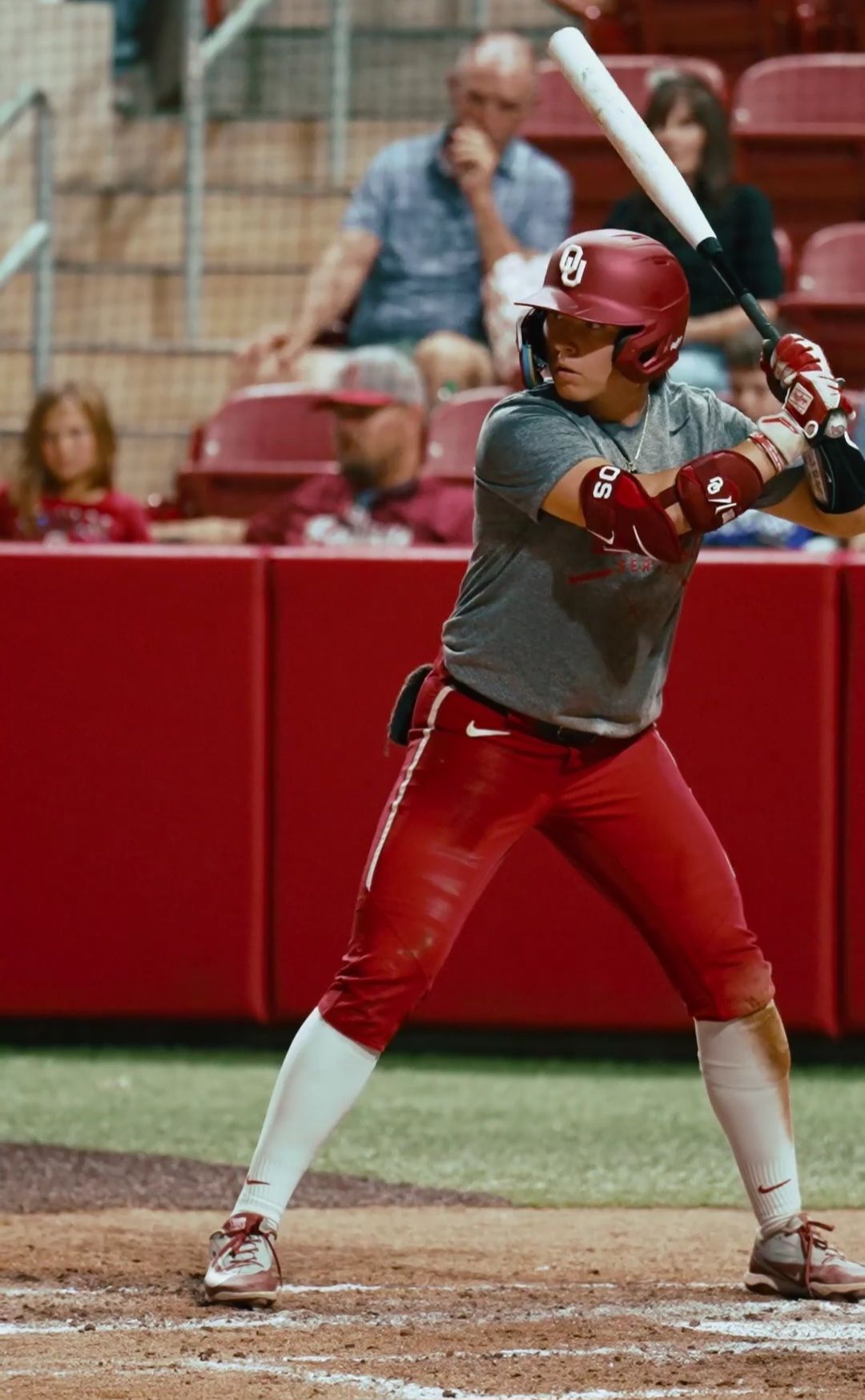
Oklahoma softball’s fall Battle Series is doing exactly what Patty Gasso needs it to do: expose questions, test solutions, and give a roster full of established contributors and new faces an opportunity to compete for roles before the games start counting.
Tuesday night’s Battle Series Game 3 at Love’s Field offered a little bit of everything. There was the continued emergence of sophomore Kai Minor, another power display from Juliana “Goose” Hutchens, a three-run home run from two-way freshman Ella Kate “EK” Smith, a pair of encouraging scoreless pitching performances, and a reminder that Ella Parker’s defensive ability deserves just as much attention as her bat.
The game was moved up a day because of the incoming weather forecast, and the schedule change meant there was no official 1Oklahoma livestream. But the on-field developments still offered plenty to evaluate as the Sooners continue preparing for the 2027 season.
Here are my biggest observations from Oklahoma’s third Battle Series game.
1. Kai Minor Is Making an Early Statement
Minor entered the night coming off a remarkable Game 2 performance in which she went 6-for-6 with seven RBIs, two stolen bases, and a three-run home run.
She followed that up with a 2-for-2 performance Tuesday, extending her Battle Series hitting streak to eight hits in eight at-bats.
That is an eye-catching start for a player who already proved she belongs among the program’s most dangerous offensive weapons during her freshman season.
The significance goes beyond the batting average. Minor is showing the ability to carry momentum from one outing into the next, even as the pitching and defensive matchups change from one intrasquad game to another. She is forcing the coaching staff to consider just how much pressure she can create at the top of the lineup.
Minor’s speed adds another dimension. A hitter who can consistently reach base and immediately threaten to steal second changes how a defense positions itself, how a pitcher works from the stretch, and how much attention the catcher must devote to the running game.
Her run of perfection will not last forever. The sample remains small, and facing Oklahoma’s own pitching staff in fall competition is different from seeing elite SEC arms during the spring. Still, the quality of the start is impossible to ignore.
2. Goose Hutchens Continues to Show Why Her Bat Matters
Hutchens supplied another home run Tuesday, adding to the excitement surrounding her arrival in Norman.
Her performance against Tarleton State earlier in the fall established the power potential in unmistakable fashion. She went 4-for-4 with two home runs and six RBIs in Oklahoma’s 14-0 exhibition victory. Tuesday’s home run provided another reminder that her offensive ceiling could make her an important part of the 2027 lineup.
The appeal is not simply the home-run total. Oklahoma needs hitters who can change a game with one swing, particularly as the program works through the process of rebuilding its lineup and determining how to distribute at-bats among its returning players and newcomers.
Hutchens gives the coaching staff another option with the potential to do exactly that.
There is still a distinction between showing power in October and consistently producing against the pitching Oklahoma will encounter during the regular season. Pitch recognition, plate discipline, defensive responsibilities, and the ability to make adjustments after opponents begin scouting her will all matter.
But power is a difficult tool to teach. When a player repeatedly demonstrates that she can drive the ball out of the park, the coaching staff has every reason to keep finding opportunities to see what else she can do.
For Hutchens, the next step is turning those flashes into a complete offensive approach.
3. EK Smith’s Three-Run Homer Adds Another Layer to Her Value
Smith also went deep Tuesday, delivering a three-run home run that highlighted the offensive potential of one of Oklahoma’s intriguing two-way newcomers.
Her ability to contribute in the circle and at the plate creates an interesting roster question for Gasso and her staff. Oklahoma has several players competing for offensive opportunities, and every player who can provide value in more than one area gives the coaching staff additional flexibility.
Smith’s home run is encouraging, especially following her earlier fall power display. It reinforces the idea that she should be evaluated as more than just a pitcher when the staff considers how to construct its lineup and manage the available roster.
Of course, a handful of fall at-bats cannot determine how large her offensive role will become. The challenge for a two-way player is sustaining development in both disciplines while managing the workload that comes with pitching at the college level.
Smith still has to demonstrate how her bat translates against different pitching styles and how consistently she can produce over a longer stretch. Her development in the circle will be equally important.
But a three-run homer is the kind of moment that gets a coaching staff thinking about possibilities.
If Smith can become a dependable contributor in both areas, Oklahoma could have another valuable piece in a roster that is still taking shape.
4. Ella Parker’s Defense Deserves More Attention
Parker has well established herself as one of Oklahoma’s most dangerous hitters, but her sliding catch in right field Tuesday was a reminder that her impact does not stop when she leaves the batter’s box.
It is easy to focus on Parker’s offensive production. She has the kind of bat that naturally draws attention, and her presence in the lineup can change an opponent’s pitching strategy.
But her defensive growth is an important part of Oklahoma’s roster outlook.
Parker earned SEC All-Defensive Team recognition after her work in right field during the 2026 season. That distinction reflects a player who has developed into more than a powerful offensive presence. Her range, ability to track the ball, and willingness to make difficult plays give Oklahoma another source of defensive reliability.
Tuesday’s sliding catch was a particularly useful reminder because those plays do not show up in a batting average or home-run total. A well-timed defensive play can take away an extra-base hit, prevent a rally from developing, or save a pitcher from having to navigate a more difficult situation.
That matters for a pitching staff that will be working to establish its identity this fall.
The Sooners are sorting through several lineup and defensive combinations, and Parker’s ability to contribute in right field gives Gasso more options. It also allows the coaching staff to think about the lineup in terms of the complete player rather than treating defensive positioning as an afterthought.
Parker’s bat will remain a major part of Oklahoma’s identity. Her defense could be just as important to how complete this team becomes.
5. Audrey Lowry and Miali Guachino Provide an Encouraging Pitching Response
One of the most encouraging developments from Tuesday was the combined effort of Lowry and Guachino, who worked five scoreless innings.
Oklahoma needs its pitching staff to take meaningful steps forward during the fall. The Sooners have experienced arms returning to the circle, but the staff must continue developing consistency, command, and the ability to navigate difficult stretches against elite offenses.
Lowry and Guachino offer different options, and the coaching staff will benefit if both can deliver reliable innings.
For Lowry, the focus is on building on her experience and finding consistency that can carry through an entire season. Her 23-4 record in 2026 demonstrated how valuable she can be, but the next stage of her development involves sustaining that effectiveness as opposing hitters see her repeatedly and make adjustments.
That means sequencing pitches effectively, limiting mistakes in hitter-friendly counts, and continuing to make quality pitches when the lineup turns over.
Guachino, meanwhile, gives Oklahoma another experienced arm with the potential to provide important innings. Her development will depend on consistently getting ahead in counts, commanding her pitches, and avoiding the stretches that allow opposing offenses to gain momentum.
Five scoreless innings do not settle the pitching questions Oklahoma must answer before 2027. Fall competition offers a limited sample, and the staff will face a different level of challenge against the SEC schedule.
Still, the value of a night like this is clear. Scoreless innings allow pitchers to build confidence, test their approaches, and give the coaching staff encouraging evidence of progress.
Oklahoma does not necessarily need one pitcher to handle every major moment. It needs enough dependable options to navigate a long season and give the staff confidence in different matchups.
If Lowry and Guachino can become more consistent, that would go a long way toward making the entire staff more difficult to prepare for.
6. Oklahoma’s Fall Evaluation Is About More Than Finding Nine Starters
The broader takeaway from Game 3 is that Oklahoma has plenty of individual talent to evaluate, but talent alone does not determine how a lineup fits together.
The Sooners entered the fall with 12 returning players and nine newcomers. That creates opportunities, but it also means the coaching staff must evaluate combinations rather than simply assign positions based on reputation or previous production.
Who gives Oklahoma the best combination of on-base ability and speed near the top of the order? How can the staff maximize the power available in the middle? Which defensive alignments provide the most confidence? And how should the coaching staff account for players who can contribute in multiple roles?
Those questions cannot be answered by one intrasquad game.
Minor’s hot streak, Hutchens’ power, Smith’s two-way potential, Parker’s defense, and the scoreless work from Lowry and Guachino all provide useful pieces of the evaluation. None, by itself, determines the final lineup or pitching rotation.
That is precisely why the Battle Series matters.
The coaching staff can test combinations, expose players to different situations, and evaluate how they respond without the pressure of a regular-season result. Players can make their cases for larger roles, while established contributors can continue refining the parts of their games that will matter most when the schedule becomes more demanding.
For a program with Oklahoma’s expectations, fall ball is not simply about getting ready to play. It is about identifying what the team can become.
The Bottom Line
Oklahoma’s third Battle Series game offered several encouraging signs, from Minor’s continued offensive production to the home runs by Hutchens and Smith. Parker’s sliding catch highlighted the importance of defensive versatility, while Lowry and Guachino combined for five scoreless innings that could provide a foundation for further progress in the circle.
The biggest caution is the same one that applies throughout October: fall performances are useful indicators, not guarantees.
The Sooners still have work to do before the 2027 season, and the real test will come when opposing teams begin preparing specifically for them. But the Battle Series is helping Gasso and her staff identify the pieces they can trust, the combinations worth exploring, and the areas that need more development.
That is what makes these games valuable.
Oklahoma is not trying to win October. It is trying to build a team capable of competing for championships in May and June.
And after three Battle Series games, there are plenty of intriguing possibilities to keep watching.