There are moments in college football when everything changes in the blink of an eye.
For Oklahoma, this was a game that seemed destined to become another frustrating chapter in an increasingly complicated season. The offense had struggled to sustain drives. John Mateer had faced questions about his decision-making and consistency. The Sooners had spent much of the afternoon searching for answers against a Texas team that entered the rivalry with championship aspirations.
Then came the interception.
Then came 19 seconds.
And then came Tate Sandell.
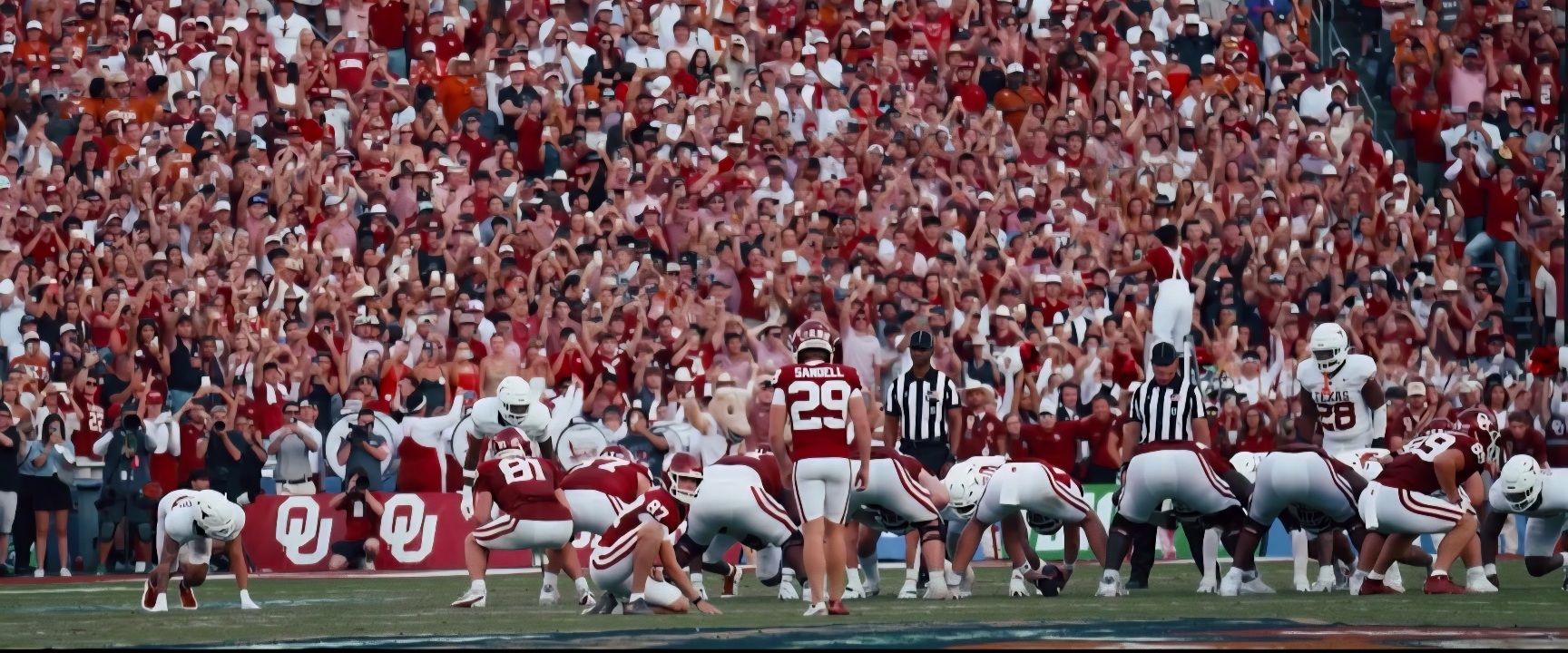
When Sandell’s 47-yard field goal sailed through the uprights to give Oklahoma a dramatic victory over No. 1 Texas, the significance extended far beyond a single result in the win-loss column.
The Sooners had found a way to defeat their bitter rival when the circumstances appeared to offer almost no margin for error. They had done it with a quarterback who had endured weeks of scrutiny, a receiver who delivered when the stakes were highest, and a kicker who converted an opportunity that would have become an enduring nightmare had the ball gone the other way.
The final sequence was extraordinary.
But to understand why those 19 seconds became legendary, it is necessary to understand everything that came before them.
The Setup: An Afternoon of Frustration
The Red River Rivalry rarely needs additional motivation. The history, the hatred, the recruiting battles, and the annual collision of two passionate fan bases guarantee that every meeting carries enormous emotional weight.
This one carried even more.
Oklahoma entered the game needing a signature victory. After an encouraging season-opening performance, the offense had struggled to establish a consistent identity. Losses and uneven performances had intensified the scrutiny surrounding Mateer and offensive coordinator Ben Arbuckle.
The quarterback who had demonstrated the ability to threaten defenses as both a passer and a runner had spent too much time searching for rhythm.
Against Texas, the inconsistency continued.
Oklahoma struggled to sustain drives, and the offense repeatedly put itself in difficult situations. The Sooners needed their defense to keep the game within reach while the offense searched for enough production to take advantage of the opportunity.
That dynamic created a familiar problem.
Every unsuccessful possession increased the pressure on the defense. Every defensive stop became more valuable. Every mistake threatened to become decisive.
The Sooners were not playing the kind of offensive football that inspires confidence in a comeback.
But they were still in the game.
And as long as Oklahoma remained within striking distance, the possibility of one defining sequence remained alive.
The Defense Refuses to Surrender
One of the most important elements of Oklahoma’s victory was its ability to remain competitive despite the offense’s difficulties.
Brent Venables has built his program around defensive discipline, physicality, and creating opportunities for the entire team to contribute. Those principles become especially important when an offense cannot consistently move the football.
The defense must tackle. It must limit explosive plays. It must force opponents to execute over the length of a possession rather than surrendering easy points.
And when the opportunity arrives, it must make a game-changing play.
Oklahoma eventually received that opportunity through Courtland Guillory.
With Texas in position to possibly steal the game in the closing seconds, Guillory intercepted Arch Manning at the Oklahoma 39-yard line with 19 seconds remaining.
Suddenly, the momentum changed.
Texas had been in position to dictate the finish. Oklahoma had been running out of time. The Sooners needed a remarkable sequence of execution merely to create a realistic opportunity to win.
Now they had the football.
Nineteen seconds.
No room for hesitation.
No time to waste.
And no guarantee that another opportunity would come.
Play No. 1: The Boundary Bleeder
19 seconds remaining | Oklahoma 39-yard line
The first decision following an interception is often as important as the interception itself.
A defense has just created an opportunity, but the offense must immediately recognize the circumstances. Oklahoma needed to move the ball into field-goal range without allowing the clock to become its biggest opponent.
The Sooners did not have time to spend an entire possession working through a conventional sequence of plays.
They needed a completion that accomplished two things: gaining meaningful yardage and stopping the clock.
That is where the sideline became an important part of the strategy.
The Tactical Objective
In a late-game situation, the sideline effectively becomes an additional offensive resource.
A completion in the middle of the field can produce valuable yardage, but the receiver must get down or the officials must spot the ball before the offense can comfortably organize its next play. The clock continues to matter.
A completion near the boundary offers a different possibility.
If the receiver secures the catch and gets out of bounds, the offense can preserve precious seconds while moving closer to its objective.
The challenge is balancing the need for yardage with the need for clock management.
Throw too short, and the offense may gain little meaningful ground. Throw too deep, and the receiver may struggle to complete the catch or get out of bounds. Force the ball into coverage, and the opportunity created by the interception can disappear immediately.
Mateer and his receivers needed to find the balance.
The Execution
Isaiah Sategna III became the central figure in the first step of Oklahoma’s final possession.
The objective was straightforward: gain enough yardage to improve Sandell’s potential kicking distance while preserving the clock.
Sategna’s ability to secure the football near the sideline made the play especially valuable. Oklahoma needed more than a completion. It needed a completion that allowed the offense to move quickly into its next decision.
The first play accomplished precisely that purpose.
Oklahoma had moved the ball across midfield, and the Sooners had another opportunity to attack.
There was still plenty of work to do.
But the field was getting shorter.
And the clock was still running in Oklahoma’s favor.
Play No. 2: The Back-Shoulder Dagger
13 seconds remaining | Texas 48-yard line
The next completion transformed a promising opportunity into a legitimate chance to win.
Oklahoma needed additional yardage to improve the probability of making the field goal. Texas, meanwhile, had to account for the possibility that another sideline completion would allow the Sooners to stop the clock and attempt the kick.
That creates a difficult defensive dilemma.
A defender must respect the receiver’s ability to threaten vertically while remaining alert to a route that breaks back toward the quarterback.
Play too aggressively toward the boundary, and the receiver may exploit the space behind the defender. Protect too much depth, and a shorter throw may produce the yardage Oklahoma needs.
The offense is trying to create uncertainty.
The defense is trying to eliminate it.
In those circumstances, quarterback-receiver timing becomes critical.
Mateer Finds Sategna Again
Mateer and Sategna delivered another important connection.
The second completion pushed Oklahoma farther into Texas territory, giving the Sooners a much more manageable kicking situation.
The importance of the play extended beyond its yardage.
It demonstrated that Oklahoma could execute under extraordinary pressure.
Mateer had spent much of the season facing questions about his consistency. Sategna had to win his matchup, secure the football, and ensure the completion did not create another clock-management problem.
Both players had to execute immediately.
There was no opportunity to recover from a mistake.
There was no time to wait for another possession.
One well-timed throw and one clean reception moved Oklahoma closer to a moment that had seemed almost impossible only seconds earlier.
Why the Back-Shoulder Concept Matters
A back-shoulder throw is one of the more difficult plays for a defensive back to defend when the quarterback and receiver are synchronized.
Rather than asking the receiver to continue toward the end zone, the quarterback places the ball where the receiver can stop or adjust his momentum and make the catch while the defender is still moving downfield.
The concept relies on several factors:
- The receiver must recognize the quarterback’s intention.
- The quarterback must place the ball away from the defender.
- The receiver must maintain body control through the catch.
- Both players must understand how the defender’s leverage affects the available throwing window.
When executed correctly, the throw can turn tight coverage into a manageable opportunity.
The broader point is unmistakable: Oklahoma needed a precise, high-pressure completion, and Mateer and Sategna delivered one.
The Sooners were now close enough to make the final decision.
The next move would determine whether the game ended with a kick or another opportunity for Texas.
Take A Deeper Dive Into Our Oklahoma Football Coverage On Our Facebook Subscription Hub
Help support Heartland Sports by Unlocking Exclusive, data-driven film room breakdowns, recruiting Update, high-leverage personnel matrix updates you won’t find anywhere else, and More by subscribing to our premium Oklahoma Sooners football coverage today.
The Strategic Blueprint: The 3 Critical Corrections Ben Arbuckle Must Make Immediately
The Trench Report: Oklahoma’s Offensive Line Survived Texas. Now It Must Get Better
The Column: Deconstructing The Game Film And Brent Venables’ High-Stakes Decisions
The Setup: Managing the Left Hash
Nine seconds remaining
Getting into field-goal range is only part of the process.
The offense must also consider the kicker’s preferred approach, the location of the football, the available timeouts, and the possibility that one additional play could either improve the kick or create an unnecessary risk.
That is where clock management becomes an essential part of offensive strategy.
With only seconds remaining, Oklahoma had to determine whether another pass was worth the potential reward.
A completion could improve the kicking distance. An incompletion might stop the clock without gaining anything. A sack or turnover could destroy the opportunity entirely.
The decision required an understanding of the difference between maximizing yardage and maximizing the chance of winning.
Those are not always the same thing.
The Value of Field Position
Kickers develop preferences regarding their approach and the angles from which they are most comfortable attempting field goals.
Hash-mark management is therefore a legitimate consideration late in a game.
The location of the football can influence the angle of the kick, the available approach, and the kicker’s view of the uprights. Coaches must weigh those factors against the risk of using another play and the time required to execute it.
Oklahoma’s final sequence included a quarterback run designed to help manage the situation, according to the account provided.
The Sooners then used their timeout with three seconds remaining.
That left the game resting on the leg of Sandell.
No additional offensive possession was necessary.
No more decisions had to be made.
Oklahoma had created the opportunity.
Now it had to finish it.
The Climax: Tate Sandell’s Ice-Water Moment
Three seconds remaining | 47-yard field-goal attempt
A 47-yard field goal is never automatic.
The snap must be clean. The holder must secure the football and position it correctly. The kicker must approach the ball with the right timing and strike it cleanly. The offensive line must provide enough protection to prevent the kick from being disrupted.
Every part of the operation matters.
But when a field goal decides a rivalry game against the nation’s top-ranked team, the physical execution is only one component of the challenge.
The kicker must also manage the moment.
There is no opportunity to ease into the pressure. There is no next possession to make up for a miss. There is no guarantee that another chance will arrive.
The result of the entire sequence can be reduced to one swing of the leg.
For Tate Sandell, that was the moment.
From Opportunity to Legend
Sandell’s journey to Oklahoma gave the moment an additional layer of significance.
His path included time as a walk-on at UTSA before he established himself at Oklahoma. His subsequent recognition as the winner of the Lou Groza Award placed him among the nation’s most accomplished kickers.
That background makes the kick an especially compelling story of persistence and preparation.
Walk-ons do not always receive the same attention as highly recruited players. Kickers can spend entire games waiting for the opportunity to make one decisive contribution.
But their role can become the most important position on the field in a single moment.
The team can spend hours preparing its offensive and defensive game plans. It can make dozens of important plays. It can survive mistakes and recover from adversity.
And then the outcome can depend on whether the kicker delivers.
Sandell did.
The 47-yard field goal gave Oklahoma a dramatic victory over Texas, completing a sequence that began with Guillory’s interception and continued through the rapid-fire connections between Mateer and Sategna.
It was an extraordinary finish to a game that had offered Oklahoma very little offensive comfort for much of the afternoon.
The Sooners had found a way to win.
And they had done it against their biggest rival.
The Anatomy of the Upset: Three Things That Made It Possible
The final kick will dominate the highlights, but Oklahoma’s victory was built on three distinct elements.
1. The Defense Created the Opportunity
Guillory’s interception changed the circumstances of the game.
Without that takeaway, Oklahoma would not have had the same opportunity to move into field-goal range with 19 seconds remaining.
The play demonstrated why turnovers can be so valuable in rivalry games. A defense does not need to dominate every possession to influence the outcome. Sometimes, one decisive play can create an opportunity that the offense must be prepared to seize.
Oklahoma’s defense gave its teammates that opportunity.
2. Mateer and Sategna Executed Under Pressure
The two late completions were essential to the final result.
Oklahoma needed yardage, but it also needed to manage the clock. Those competing demands made every decision more important.
Mateer had to deliver the football accurately. Sategna had to secure it and help preserve the remaining time.
The sequence required immediate execution from both players.
It also offered an important reminder about quarterback evaluation.
A difficult season can create understandable questions about a player’s consistency, but the ability to respond in a high-pressure moment remains significant.
Mateer delivered when Oklahoma needed him.
3. Sandell Finished the Job
The final kick transformed an improbable opportunity into a victory.
The offense had done enough to give its kicker a chance. The defense had done enough to create the possession. Sandell supplied the decisive execution.
That is complimentary football in its most dramatic form.
One unit creates an opportunity. Another advances it. A third finishes it.
Oklahoma did not need every part of the team to dominate every phase of the game.
It needed the right players to make the right plays at the right time.
In the final seconds, they did exactly that.
What the Victory Means for Brent Venables and Oklahoma
The emotional significance of beating Texas is obvious.
Rivalry victories can energize a fan base, strengthen a team’s confidence, and create memories that last long after the players leave campus.
But the larger implications deserve consideration as well.
Oklahoma still has offensive questions to answer.
The Sooners cannot expect every game to be decided by a last-second field goal. They cannot assume that a defensive takeaway will always arrive when the offense needs it most. And they cannot allow one extraordinary finish to obscure the importance of consistent execution.
Those realities make the victory both encouraging and instructive.
It showed that Oklahoma can remain competitive when its offense struggles. It demonstrated the value of a defense capable of producing a decisive takeaway. And it provided a reminder that Mateer, Sategna, and Sandell possess the ability to deliver under pressure.
For Venables, the next step is turning that resilience into a more complete football team.
The Sooners must improve their offensive efficiency, protect the football, and become more consistent on third down. They must build on the confidence gained from the victory without assuming the problems that preceded it have disappeared.
The win over Texas does not eliminate those responsibilities.
It makes them more important.
Oklahoma now has a signature victory to build upon. The challenge is ensuring that the result becomes a turning point rather than an isolated moment of brilliance.
The Legend of 19 Seconds
Long after the final score fades from the headlines, Oklahoma fans will remember the sequence.
Guillory’s interception.
Mateer looking downfield.
Sategna finding space near the sideline.
Another completion.
The clock winding down.
Sandell preparing for the kick.
And then the football rising through the air before the Cotton Bowl erupted.
That is how rivalry legends are made.
Not always through four quarters of dominance. Not always through an overwhelming statistical advantage. Sometimes, they emerge from a game in which almost nothing works until the moment when everything suddenly does.
Oklahoma had 19 seconds to turn a defensive takeaway into a victory.
The Sooners used every second.
They found the yardage they needed. They managed the clock. They trusted their kicker.
And when the opportunity arrived, Sandell delivered.
The final kick will live in highlight packages. Guillory’s interception will be replayed as the moment that made the comeback possible. Mateer and Sategna will be remembered for the connections that moved Oklahoma into position.
But the defining feature of the finish was the way those plays fit together.
Defense created the opportunity. The offense took advantage of it. Special teams completed the job.
Nineteen seconds.
Three phases of football.
One unforgettable ending.
Oklahoma didn’t just beat Texas. It created another chapter in the legend of the Red River Rivalry.