When Oklahoma beat No. 1 Texas a little more than a week ago, the possibilities suddenly seemed endless again.
The Sooners had the signature win. They had the defensive playmakers. They had John Mateer delivering in the biggest moments. For a few days, the conversation shifted from what Oklahoma needed to fix to how high this team could climb.
Then Kentucky came to Norman and reminded everyone how fragile that optimism can be.
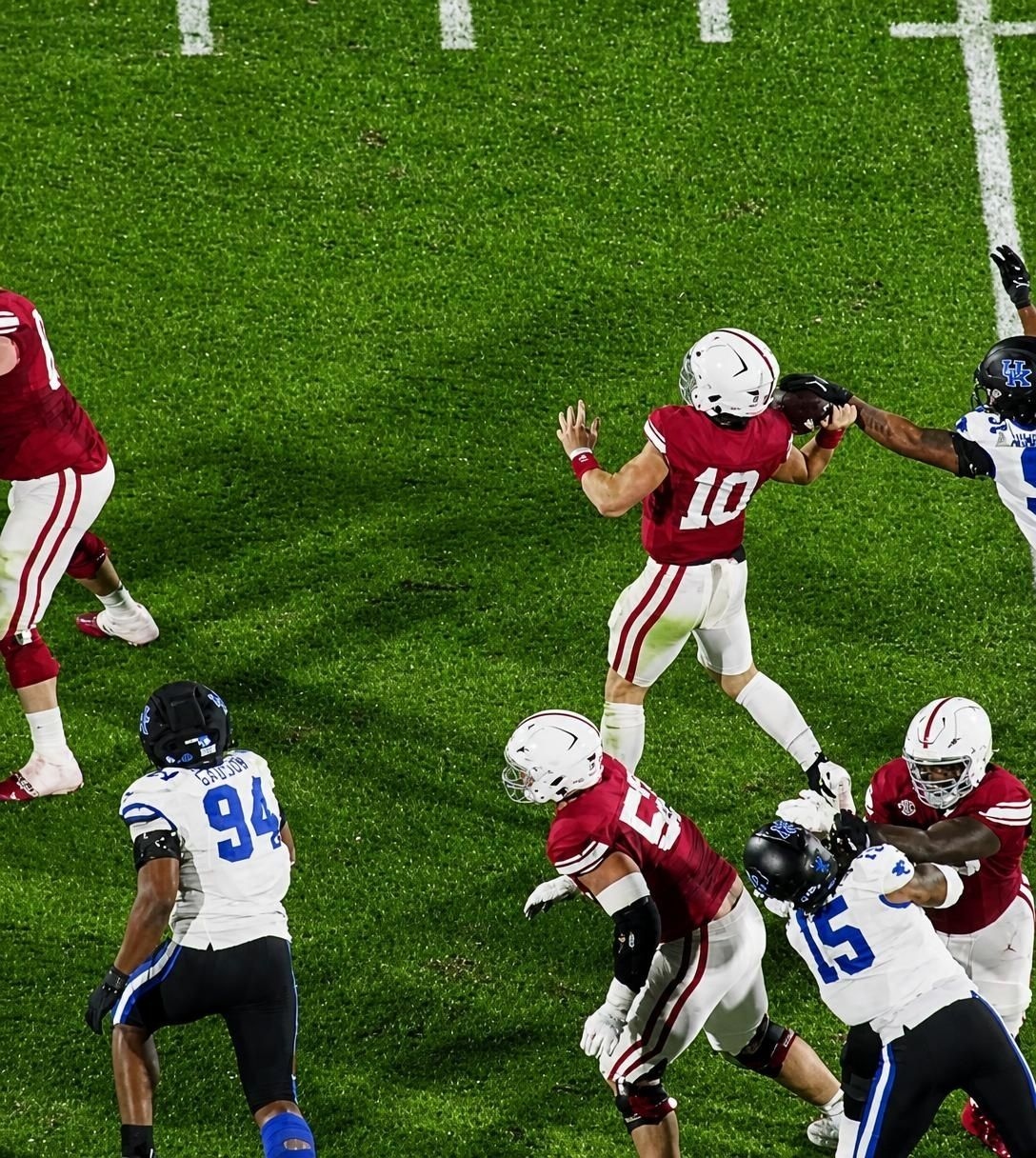
The Wildcats left with a 21-13 victory, scoring 14 fourth-quarter points to erase Oklahoma’s 13-7 lead. The Sooners outgained Kentucky in yards 346-230, threw for 270 yards and finished with more first downs. They still lost by eight because Kentucky intercepted four Oklahoma passes, including a fake-field-goal attempt, and turned the mistakes into points.
Now the reaction has been predictable. Social media has turned toward demands for firings, benchings and wholesale changes. Some of that frustration is justified. Oklahoma is 3-3, the offense remains inconsistent, and a defense capable of keeping the Sooners competitive is being asked to survive too many self-inflicted wounds.
But there is a difference between recognizing a serious problem and assuming every possible solution is obvious.
Welcome to the Overreaction Index, where we sort the legitimate concerns from the message-board panic.
The pulse check: How did Oklahoma lose this game?
| Category | Oklahoma | Kentucky |
|---|---|---|
| Final score | 13 | 21 |
| Total yards | 346 | 230 |
| Passing yards | 270 | 158 |
| First downs | 19 | 14 |
| Turnovers | 4 | 0 |
| Fourth-quarter points | 0 | 14 |
The numbers tell an uncomfortable story. Oklahoma moved the ball better than Kentucky, but the Wildcats protected possessions and made the decisive plays when the game tightened.
John Mateer completed 24 of 40 passes for 270 yards and a touchdown. He also threw three interceptions. The other interception came when the Sooners attempted a fake field goal and holder Jacob Ulrich’s pass was intercepted.
That is the starting point for this discussion. Oklahoma did not lose because it was incapable of moving the football. It lost because its mistakes repeatedly erased the value of that production.
Let’s break down what deserves concern—and what deserves a little perspective.
Index No. 1: The calls to bench John Mateer and fire the offensive staff
OVERREACTION METER: 6/10
The frustration is understandable. The conclusion that Oklahoma should immediately abandon its quarterback or overhaul the coaching staff is premature.
Mateer’s three interceptions were a major reason Oklahoma lost. There is no need to soften that reality. One interception gave Kentucky a short field, another became a 41-yard pick-six for Jordan Castell, and a final interception ended Oklahoma’s comeback opportunity.
A quarterback cannot give away that many possessions and expect his team to win consistently, especially in the SEC.
But the broader evaluation cannot stop at the turnover column.
Mateer threw for 270 yards, connected with Manny Choice for 98 receiving yards and helped Oklahoma move the ball between the 20-yard lines. The Sooners produced 346 total yards and 19 first downs. This was not an offense that did absolutely nothing for four quarters.
It was an offense that repeatedly failed to turn production into a winning result.
That distinction matters.
Oklahoma needs Mateer to make better decisions when a play breaks down, recognize when a throw is not worth the risk and understand when taking a sack or throwing the ball away is preferable to giving the opponent another possession. The final interception was particularly damaging because it came at a moment when Oklahoma still had a chance to make the game interesting.
At the same time, the coaching staff has to help him. Better protection, more dependable early-down execution and clearer answers against pressure would make his job easier.
The answer cannot be to excuse every interception because the offensive line is banged up. Nor should one disastrous night automatically erase everything Mateer has shown when he is operating effectively.
The same goes for offensive coordinator Ben Arbuckle. He deserves scrutiny for how the offense performed, particularly in the fourth quarter. But a coaching evaluation should focus on whether the staff can identify the problems and produce tangible improvement—not simply whether fans are angry enough to demand a change.
The verdict: Mateer has to play better, and Arbuckle has to find better answers. Both statements can be true without requiring an immediate quarterback change or a coaching purge.
Index No. 2: The offensive line is in serious trouble
OVERREACTION METER: 2/10
This is where the criticism becomes much harder to dismiss.
Oklahoma’s offensive line entered the Kentucky game dealing with significant injuries. Michael Fasusi and Heath Ozaeta were among the key players unavailable, while Eddy Pierre-Louis was also out. The injury situation worsened during the game, with multiple offensive linemen dealing with injuries.
That context matters because offensive football depends on five players functioning as a unit up front. When the lineup changes, communication and chemistry can suffer. When players are asked to work at unfamiliar positions or play through injuries, even a sound play design can become difficult to execute.
The consequences show up everywhere.
The running game becomes less reliable. The quarterback has less time to work through his progressions. Play-action loses some of its value when the defense no longer has to respect the run. Third-and-long situations become more frequent, allowing the defense to attack with pressure and disguise coverage.
Oklahoma rushed for just 76 yards against Kentucky. Mateer was sacked five times, losing 25 yards. Those numbers are not solely an offensive-line statistic—quarterback decisions, defensive execution and play design all matter—but they reinforce how difficult it was for the Sooners to establish a dependable offensive foundation.
And this is where some of the loudest criticism misses the point.
You cannot simply demand that Oklahoma run the ball more without considering whether the line can create consistent movement. You cannot ask Mateer to stand in the pocket longer without considering whether the protection will hold. You cannot assume a different play call will fix every problem if the offense cannot consistently win its assignments.
That does not mean the offensive line gets a free pass. Oklahoma must find its best available combination, improve communication and determine whether certain concepts need to be simplified while the personnel situation remains unsettled.
It also means the staff needs to be honest about what this group can execute right now.
A championship-caliber defense can cover up offensive shortcomings. It cannot indefinitely compensate for a line that struggles to protect the quarterback, create rushing lanes and keep the offense on schedule.
The verdict: The offensive-line concern is not message-board panic. It is one of the most urgent problems on the roster. The injuries help explain the struggle, but they do not remove the need for solutions.
Take A Deeper Dive Into Our Oklahoma Football Coverage On Our Facebook Subscription Hub
Oklahoma Makes The Cut For Elite 2028 DB Phoenix Evans, But A Major Recruiting Battle Awaits
Complacency, Costly Gambles, And Brent Venables’ Harsh Truths
Oklahoma Is Surging For DJ Tubbs, And The Numbers Show
Help support Heartland Sports by Unlocking Exclusive, data-driven film room breakdowns, recruiting Update, high-leverage personnel matrix updates you won’t find anywhere else, and More by subscribing to our premium Oklahoma Sooners football coverage today.
Index No. 3: Ben Arbuckle’s fourth-quarter play-calling has become a legitimate concern
OVERREACTION METER: 3/10
The concern is legitimate. The claim that every problem comes down to play-calling is too simplistic.
Oklahoma entered the fourth quarter leading 13-7. The defense had held Kentucky scoreless in the second and third quarters, and the Sooners had a chance to turn a narrow advantage into a roadblock the Wildcats could not overcome.
Instead, Oklahoma went scoreless in the final quarter.
Kentucky took the lead after a Mateer interception gave the Wildcats favorable field position. The Wildcats then added a touchdown on Castell’s pick-six to put the game away.
The offense needed to do more than simply avoid mistakes. It needed to produce one or two sustained drives, flip field position and give the defense a chance to breathe.
That did not happen.
This is where Arbuckle deserves serious questions. Did Oklahoma have a dependable answer when Kentucky pressured Mateer? Did the play sequencing help the offense stay ahead of the chains? Were there opportunities to use quick throws and movement concepts to reduce the stress on the offensive line? Did the staff adequately adjust when the original plan stopped producing results?
Those are fair questions. They are also questions that require examining the actual play calls and film rather than assuming the offense became conservative on every snap.
There is an important difference between a bad call and a bad result. A well-designed play can fail because of a missed block, an inaccurate throw or a defensive player making an excellent play. Conversely, a play can work despite poor design because a talented player creates something out of nothing.
The challenge for Arbuckle is to identify which failures belong to the scheme, which belong to execution and which reflect the limitations of the available personnel.
Oklahoma cannot afford to use injuries as a blanket explanation for every offensive problem. But it would be equally misguided to pretend those injuries have no bearing on what the staff can reasonably ask its players to do.
The fourth quarter showed that the current offensive operation is not dependable enough. It did not, by itself, prove that every component of the system is broken.
The verdict: Arbuckle must demonstrate that he can adapt, protect the football and give Oklahoma a functional fourth-quarter offense. The criticism is warranted. The next step should be specific corrections, not a reflexive call to burn everything down.
Index No. 4: The fake field goal was an unacceptable gamble
OVERREACTION METER: 1/10
This one deserves almost no defense.
Oklahoma had an opportunity to attempt a 28-yard field goal in the second quarter. Instead, the Sooners tried a fake, and Ulrich’s pass was intercepted in the end zone.
A successful fake could have produced a touchdown. But the decision also carried a clear downside: Oklahoma could leave a promising scoring possession without any points.
That is exactly what happened.
In a game that finished 21-13, the lost opportunity mattered. Oklahoma’s offense was already struggling to create separation, and the Sooners had a reliable kicker in Tate Sandell, who had made a 44-yard field goal earlier in the game.
There are situations in which a fake field goal makes sense. Perhaps the defense has shown a specific vulnerability, the numbers favor the offense or the expected value of the play clearly exceeds the conventional option.
But those decisions require sound situational judgment and execution.
The result against Kentucky was disastrous. Oklahoma traded a chance to add points for an interception, giving the Wildcats another reason to believe the game was there for the taking.
The verdict: This is a fair target for criticism. The fake failed, the scoring opportunity disappeared and the decision looks especially costly in retrospect.
Index No. 5: The defense is championship-caliber, so the offense is wasting a national title opportunity
OVERREACTION METER: 5/10
There is a real argument here, but the wording needs perspective.
Oklahoma’s defense has shown that it can keep the Sooners competitive against quality opponents. Against Kentucky, the Wildcats finished with only 230 total yards and 158 passing yards. Oklahoma forced the game into a position where a few offensive possessions could have made the difference.
That is meaningful.
But calling the defense a national championship unit—or treating a championship run as a realistic expectation simply because the defense is playing well—goes further than the evidence allows.
A championship team needs more than a good defense. It needs a dependable offense, reliable special teams, healthy personnel and the ability to win different kinds of games. Oklahoma’s recent results have demonstrated both its potential and its limitations.
The Texas win showed that the Sooners can deliver in a high-pressure rivalry game. The Kentucky loss showed how quickly that momentum can disappear when turnovers and offensive inefficiency take over.
The defense deserves credit, but it also has room to improve. Kentucky scored twice in the fourth quarter, including a touchdown drive after the interception gave it favorable field position. Even elite defenses cannot expect to hold every opponent scoreless while repeatedly returning to the field after offensive mistakes.
That is the real frustration: Oklahoma is making life unnecessarily difficult for a defense that has shown it can keep the team in games.
The goal should not be to declare a national championship window wasted after a loss. It should be to make sure the offensive problems do not become a season-long pattern.
The verdict: The defense gives Oklahoma a foundation to build around. Whether it is truly championship-caliber remains to be seen, and the offense has to improve before national-title talk becomes more than a hopeful aspiration.
The verdict: Stop panicking, but stop making excuses
Oklahoma is 3-3 after a loss that should have been avoidable.
The Sooners outgained Kentucky by 116 yards. They had more first downs. They held the Wildcats to 230 total yards. Yet they lost because they threw four interceptions, failed to score in the fourth quarter and could not turn their statistical advantages into points.
That is not bad luck alone. It is a performance that demands accountability.
The offensive line’s injuries are real. They help explain why the offense has struggled to find a consistent identity. But injuries do not explain every questionable decision, every failed possession or every interception.
Mateer must protect the football. Arbuckle must find ways to help the offense function under pressure. The offensive line must identify its best available combination and improve its execution. And the staff must be more disciplined about when to take risks, especially when points are available.
The solution is not to bench everyone, fire everyone and start over on Monday morning. Nor is it to shrug off the loss because Oklahoma’s defense played well.
The answer lies between those extremes: honest evaluation, specific adjustments and measurable improvement.
Oklahoma still has talent. It still has defensive pieces capable of making life difficult for opposing offenses. But talent does not automatically produce a dependable offense, and a good defense cannot erase four turnovers every Saturday.
The next few weeks will tell us whether the Kentucky loss becomes a turning point or simply another example of the same issues resurfacing.
The Overreaction Index verdict: The panic is excessive, but the concern is justified. Oklahoma does not need to tear the program apart. It needs to prove that it understands exactly why it lost—and that it can fix the problems before the next game.
Because the most frustrating part of Saturday night was not that Oklahoma lacked the talent to beat Kentucky.
It was that the Sooners gave themselves too many ways to lose.