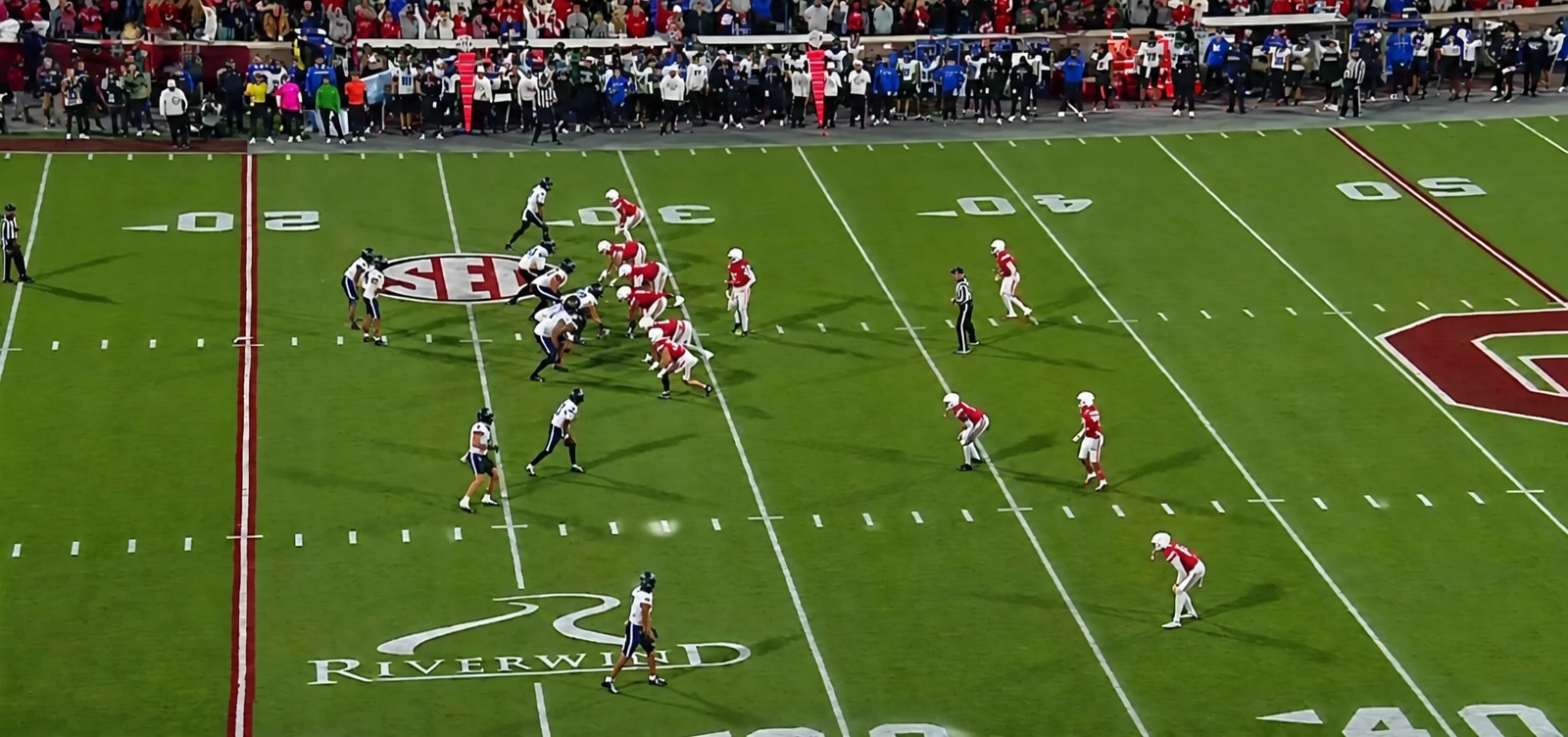
For three quarters, Oklahoma looked like the kind of defensive team capable of carrying a program through the grind of the SEC.
Kentucky struggled to move the football. The Sooners pressured the quarterback, disrupted the running game, and kept the Wildcats from finding any consistent offensive rhythm. True freshman Jake Kreul delivered a performance that should have people talking about his future in Norman, and Oklahoma entered the fourth quarter with a 13–7 lead.
The defense had done its job.
Then the game slipped away.
Kentucky scored 14 points in the fourth quarter, Oklahoma’s offense failed to deliver the response it desperately needed, and the Sooners walked off their home field with a 21–13 loss that felt considerably worse than an eight-point defeat.
The most painful part wasn’t simply that Oklahoma lost. It was how the Sooners lost.
The offense finished with 346 total yards, outgaining Kentucky by 116. John Mateer threw for 270 yards and a touchdown. Oklahoma converted third downs at a better rate than it had in its previous two games. There were stretches when the offense looked capable of doing enough to win.
But the Sooners also committed four turnovers, including three interceptions by Mateer and another on a failed fake-field-goal attempt. The late interception returned 41 yards for a touchdown by Jordan Castell turned a one-point Kentucky lead into an eight-point deficit.
That was the final blow, and it came from Oklahoma’s own offense.
Oklahoma’s defense gave the Sooners a chance to win. The offense kept giving that chance away.
The Defense Deserved a Better Ending
There is a temptation after a loss to judge the entire performance by the final score. The defense lost, the offense lost, and the team lost. Everyone shares the disappointment.
But that approach misses what happened for most of Saturday night.
Oklahoma held Kentucky to 230 total yards and just 111 after halftime. The Wildcats finished with only 158 passing yards. The Sooners’ defense also produced five sacks, giving Kentucky little room to operate consistently.
Those numbers tell the story of a defense that spent much of the game doing what it needed to do.
Kentucky scored a touchdown on its opening possession, but Oklahoma responded by tightening things up. The Wildcats struggled to sustain drives, and the Sooners repeatedly forced them to work for every yard.
The defense wasn’t perfect. It surrendered the go-ahead touchdown after a third-quarter interception gave Kentucky a short field. It also couldn’t prevent the Wildcats from putting the game away after the offense’s late mistakes.
But there is a difference between a defense that gets dominated and a defense that spends most of the evening keeping its team in position to win.
Oklahoma was firmly in the second category.
The Sooners entered the fourth quarter leading 13–7. They had allowed only one touchdown, on Kentucky’s opening drive, and the offense needed just a handful of productive possessions to give the defense some breathing room.
Instead, Oklahoma’s defensive performance became a footnote to the offensive collapse.
That is a difficult way to lose, especially for a team that has spent much of the season searching for consistent offensive production. When the defense is playing well enough to win, the offense must find a way to reward that performance.
Oklahoma did not.
Jake Kreul Was a Bright Spot in a Miserable Night
If there was one individual performance that deserved to survive the frustration of the final score, it belonged to Jake Kreul.
The true freshman recorded 2.5 sacks, the most by a true freshman in Oklahoma history. His total was also the highest by any OU freshman since Brian Bosworth recorded three sacks against Iowa State in 1984.
Kreul finished with six tackles and three tackles for loss, both career highs. Before Saturday, he had recorded just three tackles and half a tackle for loss all season.
That is a remarkable leap in production.
Kreul wasn’t simply collecting tackles after other defenders made plays. He became a disruptive presence in the backfield and gave Oklahoma another young defensive lineman capable of affecting the quarterback.
His performance matters beyond the historical milestone. Oklahoma needs young players to emerge, especially along the defensive front, where physical demands and injuries can test a team’s depth as the season progresses.
Kreul gave the Sooners evidence that their future on the defensive line may be brighter than the final score suggested.
He also illustrated the central frustration of this game: Oklahoma had players making winning contributions, but the team couldn’t put all three phases together long enough to secure the result.
A freshman defensive lineman shouldn’t have to produce a record-setting performance for his team to have a chance to beat Kentucky at home. Yet Kreul’s night became one of the few clear positives from a loss defined by missed opportunities.
Kip Lewis and Owen Heinecke also tied for the team lead with eight tackles apiece. The defense had contributors making plays throughout the night.
It simply needed more help from the other side of the ball.

Take A Deeper Dive Into Our Oklahoma Football Coverage On Our Facebook Subscription Hub
Ben Arbuckle Is Standing Behind John Mateer. Now He Has To Prove He’s Right
Seneca Driver Still Looks Solid With Oklahoma Despite Kentuckty’s Upset
3 Structural Corrections Ben Arbuckle Must Deploy Before Starkville
Help support Heartland Sports by Unlocking Exclusive, data-driven film room breakdowns, recruiting Update, high-leverage personnel matrix updates you won’t find anywhere else, and More by subscribing to our premium Oklahoma Sooners football coverage today.
The Offense Couldn’t Give Its Defense Any Breathing Room
This is where the conversation becomes more uncomfortable for Ben Arbuckle and the entire offensive staff.
Oklahoma’s offense had opportunities to create separation. It had a lead. It had productive stretches through the air. It had receivers making plays, including Manny Choice’s career-best five catches for 98 yards and Rocky Beers’ 20-yard touchdown reception.
Yet Oklahoma could not consistently turn that production into points.
The Sooners finished with 346 yards, their second-highest total of the season. That sounds encouraging until the final score is placed beside it. Oklahoma scored just 13 points and committed four turnovers.
Yardage is not the same as offensive efficiency. Moving the football between the 20-yard lines means little if a team repeatedly fails to finish possessions or hands the ball to the opponent.
The turnover margin was the most glaring problem. Mateer threw three interceptions, and the failed fake field goal produced another interception when holder Jacob Ulrich attempted a pass. Kentucky finished with four takeaways and no turnovers of its own.
That is a difficult way to win any game, regardless of how well the defense plays.
The offense also struggled to maintain its early rhythm after halftime. Oklahoma converted seven of its first 10 third downs in the first half but managed just one conversion on seven attempts after the break.
That decline matters because sustained drives do more than produce points. They allow a defense to rest, give the coaching staff more opportunities to adjust, and prevent the opponent from repeatedly taking the field with a chance to change the game.
When drives end quickly, the defense must return to the field. When turnovers give the opponent favorable field position, the defense has even less room to recover.
It is reasonable to conclude that Oklahoma’s offensive failures increased the burden on its defense. It is harder to claim that fatigue alone explains the fourth-quarter result. The evidence points to a more direct problem: the Sooners made too many mistakes in the moments when they needed to protect their lead.
The defense could not solve that problem for them.
The Pick-Six Was the Final Insult
The decisive moment came when Oklahoma still had a chance to respond.
Kentucky led 14–13. The Sooners needed a scoring drive, and Mateer was under pressure to move the offense downfield. Instead, Castell intercepted the pass and returned it 41 yards for a touchdown.
The score made it 21–13 with 1:17 remaining.
That distinction matters: Oklahoma’s defense did not surrender the touchdown that created the final margin. The offense did.
There is no way around that fact.
The defense had already allowed Kentucky to take the lead, and it needed to get another stop. But when Castell returned the interception for a touchdown, Oklahoma’s defense was watching from the sideline as its own offense put the game further out of reach.
The play was devastating because it represented the worst possible outcome for a team already short on margin. Oklahoma needed points. Instead, it gave Kentucky seven.
Mateer deserves criticism for the decision. Quarterbacks must recognize when a passing lane has closed, especially late in a game when a turnover can end the comeback. The pressure of the situation does not excuse the mistake.
But the quarterback is not the only person responsible for the offense’s performance. The coaching staff must examine the protection, the route concepts, and the decisions that put Mateer in difficult situations. The offensive line must improve its consistency. The entire unit must find a way to sustain drives and finish possessions.
The problem is bigger than one interception.
The pick-six simply made it impossible to ignore.
Brent Venables Has a Bigger Problem Than the Box Score
The most frustrating part of Oklahoma’s season is that the team has shown what it can be.
The Sooners beat Texas in dramatic fashion. They have produced stretches of high-level defensive football. They have seen young players emerge and offensive playmakers deliver career performances.
But those flashes have not translated into consistent results.
That is the challenge facing Brent Venables. He has to build a team that doesn’t require its defense to play nearly perfect football just to have a chance to win.
Oklahoma’s defense should be an advantage. It should create pressure, generate negative plays, and give the offense opportunities to play with a lead. It should not be expected to overcome a four-turnover performance every Saturday.
There is a difference between relying on an elite defense and asking it to compensate for an offense that repeatedly puts the game in danger.
The first is a legitimate team-building philosophy. The second is unsustainable.
Venables and Arbuckle must find a way to give the offense a more dependable identity. That does not necessarily mean abandoning the passing game or becoming conservative on every important down. It means creating a system that can move the chains, protect the football, and make sensible decisions when the game is on the line.
It also means accepting that a quarterback can be both talented and inconsistent, and that supporting him requires more than public confidence. Mateer must improve his decision-making, but the staff must help him operate within an offense that gives him clear answers when the defense applies pressure.
The Sooners cannot keep asking the defense to absorb the consequences of offensive mistakes.
Eventually, the defense will give up a score it cannot afford. Eventually, the opponent will capitalize on every mistake. Eventually, a game that should be winnable will slip away.
Against Kentucky, that process played out in the fourth quarter.
The Defense Can’t Be the Entire Plan
Oklahoma’s loss to Kentucky should not erase the quality of the defensive performance. Kreul’s historic night, the team’s four sacks, and the Wildcats’ limited offensive production deserve recognition.
But those positives also make the loss more frustrating.
The Sooners had enough defensive production to win. They had enough offensive yardage to believe a victory was possible. They even held a fourth-quarter lead.
What they lacked was the ability to protect that opportunity.
The offense must become more reliable. It must take better care of the football, improve its situational execution, and stop turning promising possessions into gifts for the opposition. The coaching staff must make adjustments that help the quarterback and give the team a more sustainable way to finish games.
Mississippi State is next, and Oklahoma cannot afford to spend the week simply lamenting what happened against Kentucky. The Sooners need answers, not just frustration.
The defense deserves to be part of those answers. It does not deserve to be the only one.
For 45 minutes, Oklahoma played winning defense. For the final 15, the offense made that performance irrelevant.
That is the hard truth of the Kentucky loss. Oklahoma has a defense capable of keeping it competitive against quality opponents. What it still needs is an offense capable of making that effort count.
Until the Sooners find that balance, even their best defensive performances will remain vulnerable to the same disappointing ending.