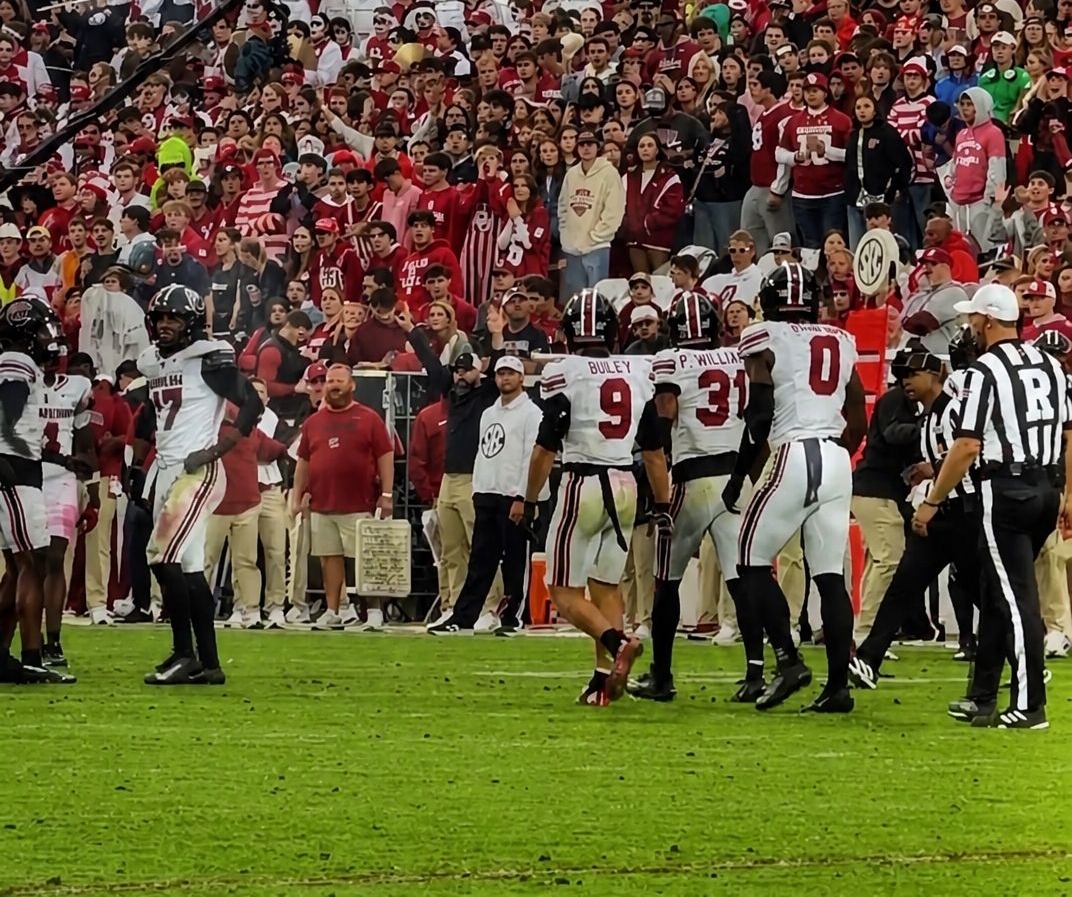
The boos started well before the final whistle. By the time Oklahoma’s offense stumbled through another possession in the second quarter, the frustration inside Gaylord Family–Oklahoma Memorial Stadium had become impossible to ignore. A blown-up screen on third-and-long brought down another chorus of boos, followed by chants of “Fire Arbuckle” that made their way through the stands and toward the press box.
The reaction wasn’t simply about one bad afternoon. It was the culmination of months of offensive frustration, and Saturday’s 42-25 loss to South Carolina gave Oklahoma fans another reason to wonder whether this offense has any answers.
The final box score might suggest the Sooners found something offensively. They finished with 359 total yards, and Ivan Carreon delivered two fourth-quarter touchdown catches on his way to five receptions for 88 yards. But those numbers require context. Oklahoma managed just 118 yards through the first three quarters, averaging 2.9 yards per play during that stretch.
The offense finally found some production when the game was effectively out of reach. That doesn’t make it progress.
For a program accustomed to producing explosive offenses, the current state of Oklahoma’s attack is becoming increasingly difficult to defend. The question isn’t whether the fan base has a right to be frustrated. It does. The bigger question is how much longer Brent Venables can allow the situation to continue without demanding significant changes.
The Overreaction Index: Separating the Noise from Reality
| Fan Reaction | Verdict | The Reality |
|---|---|---|
| “The offense found something with Ivan Carreon!” | Massive overreaction | Carreon’s production came in the fourth quarter, after Oklahoma had spent most of the afternoon unable to sustain a drive. |
| “Ben Arbuckle’s offense is broken.” | Not an overreaction | Oklahoma managed only 118 yards through three quarters and averaged 2.9 yards per play. |
| “The offensive line is the entire problem.” | Partial overreaction | Protection has been a major issue, but play design, quarterback development, and the inability to adjust all deserve scrutiny. |
| “This is a program-level offensive crisis.” | Not an overreaction | The offense has struggled to establish a consistent identity, and another Saturday passed without meaningful answers. |
| “Arbuckle is coaching for his job.” | Getting harder to dismiss | The public frustration is growing, and the upcoming November schedule leaves little room for another extended offensive collapse. |
The Garbage-Time Mirage
Ivan Carreon deserves credit for what he did Saturday. The junior receiver finished with five catches for 88 yards and two touchdowns, giving Oklahoma’s offense a much-needed spark in the fourth quarter.
But individual production shouldn’t be confused with an offensive breakthrough.
South Carolina had controlled the game for most of the afternoon. By the time Carreon found the end zone, the Gamecocks were protecting a substantial lead and could afford to prioritize the clock and limit risk. Oklahoma’s late production came in a very different game environment than the one it faced during the first three quarters.
The numbers tell the story.
Oklahoma finished with 359 total yards, but 241 of those yards came in the fourth quarter. That means the Sooners accumulated just 118 yards during the first three quarters of play.
John Mateer and the passing game spent most of the afternoon struggling to find room. The offense couldn’t consistently create favorable down-and-distance situations, couldn’t sustain drives, and couldn’t generate the kind of explosive plays necessary to keep South Carolina’s defense honest.
Carreon’s fourth-quarter performance was encouraging for the receiver. It wasn’t evidence that the offensive operation had suddenly figured things out.
If anything, the disparity between Oklahoma’s first three quarters and its final quarter makes the larger problem even more obvious.

Take A Deeper Dive Into Our Oklahoma Football Coverage On Our Facebook Subscription Hub
The Column: House of Horror – Why the Briles-Venables Chess Match Spiraled Early
Oklahoma vs. South Carolina: Key Notes and Storylines As The Sooners Welcome The Gamecocks To Norman
The Blueprint: Three Schematic Adaptations Needed to Ground South Carolina’s Edge Rush
Help support Heartland Sports by Unlocking Exclusive, data-driven film room breakdowns, recruiting Update, high-leverage personnel matrix updates you won’t find anywhere else, and More by subscribing to our premium Oklahoma Sooners football coverage today.
Forty-Five Minutes of Offensive Suffocation
The most troubling part of Saturday’s performance wasn’t the final score. It was how long Oklahoma went without looking like a functional offense.
The 118 total yards the Sooners had through the first three quarters came at an average of 2.9 yards per play. Those are numbers that leave virtually no margin for error, particularly against an opponent capable of scoring as quickly as South Carolina did.
The early-down struggles were especially damaging.
When Oklahoma couldn’t establish a consistent running game or create manageable second-down situations, the offense repeatedly found itself facing obvious passing downs. That allowed South Carolina’s defensive front to attack Mateer, putting additional pressure on an offensive line that has struggled to protect him.
The result was predictable: stalled drives, limited production, and another afternoon in which Oklahoma’s offense looked incapable of adjusting when its initial approach wasn’t working.
The frustration extends beyond the play calling. Execution has been inconsistent, protection has been unreliable, and the offense has struggled to find a dependable answer when defenses take away its first option.
At some point, those problems stop looking like isolated mistakes and start looking like a systemic failure.
The Protection Crisis: Mateer Can’t Keep Taking This Punishment
Any honest evaluation of Oklahoma’s offense has to include the offensive line. Mateer was sacked three more times against South Carolina, continuing a troubling stretch in which the quarterback has absorbed far too much pressure.
There is a legitimate debate about how much responsibility belongs to the offensive line and how much falls on Mateer himself. Quarterbacks have to recognize pressure, make decisions quickly, and occasionally get rid of the football before a play completely breaks down.
But the coordinator also has a responsibility to put his quarterback in positions to succeed.
That’s where Arbuckle deserves significant scrutiny.
Oklahoma cannot continue operating as though it has an offensive line capable of consistently protecting long-developing vertical concepts. When protection is breaking down, the offense has to adapt. That might mean more quick-game concepts, additional protection, moving the pocket, or designing opportunities for Mateer to get the ball out before the pass rush arrives.
Instead, the Sooners have repeatedly struggled to find a rhythm when opposing defenses create pressure.
The problem isn’t simply that Mateer is getting hit. It’s that the offense hasn’t consistently provided an effective counterpunch.
A quarterback can overcome imperfect protection. An offensive line can improve with better execution and communication. But when the protection problems persist and the play calling doesn’t appear to offer enough answers, the entire operation suffers.
Mateer needs to play better in certain situations. The offensive line needs to protect better. And Arbuckle needs to recognize that the current approach isn’t producing the results Oklahoma needs.
Those responsibilities aren’t mutually exclusive.
Is the Arbuckle Era Reaching a Point of No Return?
When Oklahoma brought Arbuckle into the program, the expectation was that he would help provide a modern, dynamic identity to the offense.
That hasn’t happened.
The Sooners have struggled to establish an offensive personality. There have been flashes of explosive production, but they haven’t translated into a dependable weekly operation. Too often, the offense looks disconnected: the running game isn’t creating enough opportunities, the passing game isn’t consistently finding answers, and the protection issues are putting Mateer under constant pressure.
The most concerning part is the lack of visible adjustment.
Good offensive coordinators don’t simply arrive with a system and force their personnel to make it work. They identify what their players do well, recognize where the limitations exist, and build a plan that gives the offense its best chance to succeed.
Oklahoma has to find a way to make life easier for Mateer. It has to create more manageable third downs, use the short passing game to punish pressure, and find ways to keep opposing defensive fronts from dictating every snap.
The fourth-quarter production against South Carolina doesn’t erase the first three quarters. And one or two successful drives in November won’t erase the larger questions surrounding the direction of the offense.
Is Arbuckle beyond the point of no return? That’s ultimately a decision for Venables and the administration. But the coordinator is approaching a point where explanations and promises won’t be enough.
He needs to show tangible improvement.
The November Ultimatum
Oklahoma is now 4-4, and the schedule isn’t getting any easier. The Sooners travel to Florida next, with the remaining November slate offering little room to recover from another offensive disappointment.
The crowd’s reaction Saturday should concern everyone inside the program. The boos, the chants, and the increasingly empty stadium weren’t simply a response to losing a football game. They reflected a growing disconnect between what Oklahoma fans expect from this program and what they’re watching on the field.
Coaches can survive losses. They can survive a difficult season. What becomes harder to survive is the perception that the problems aren’t being fixed.
Venables now faces a difficult decision. Does he continue giving Arbuckle time to work through the issues, or does he begin considering whether a change is necessary to protect the direction of the program?
That decision shouldn’t be made solely because of a frustrated crowd or one ugly afternoon. But it also can’t be postponed indefinitely if the same problems keep showing up every Saturday.
Arbuckle has an opportunity to answer his critics in Gainesville. Oklahoma needs an offense that can function before the fourth quarter, protect its quarterback, sustain drives, and give the defense some breathing room.
Anything less will only intensify the noise.
The Sooners don’t need another late statistical surge to make the box score look better. They need an offense that looks like Oklahoma again.
And right now, that’s the one thing they haven’t been able to find.