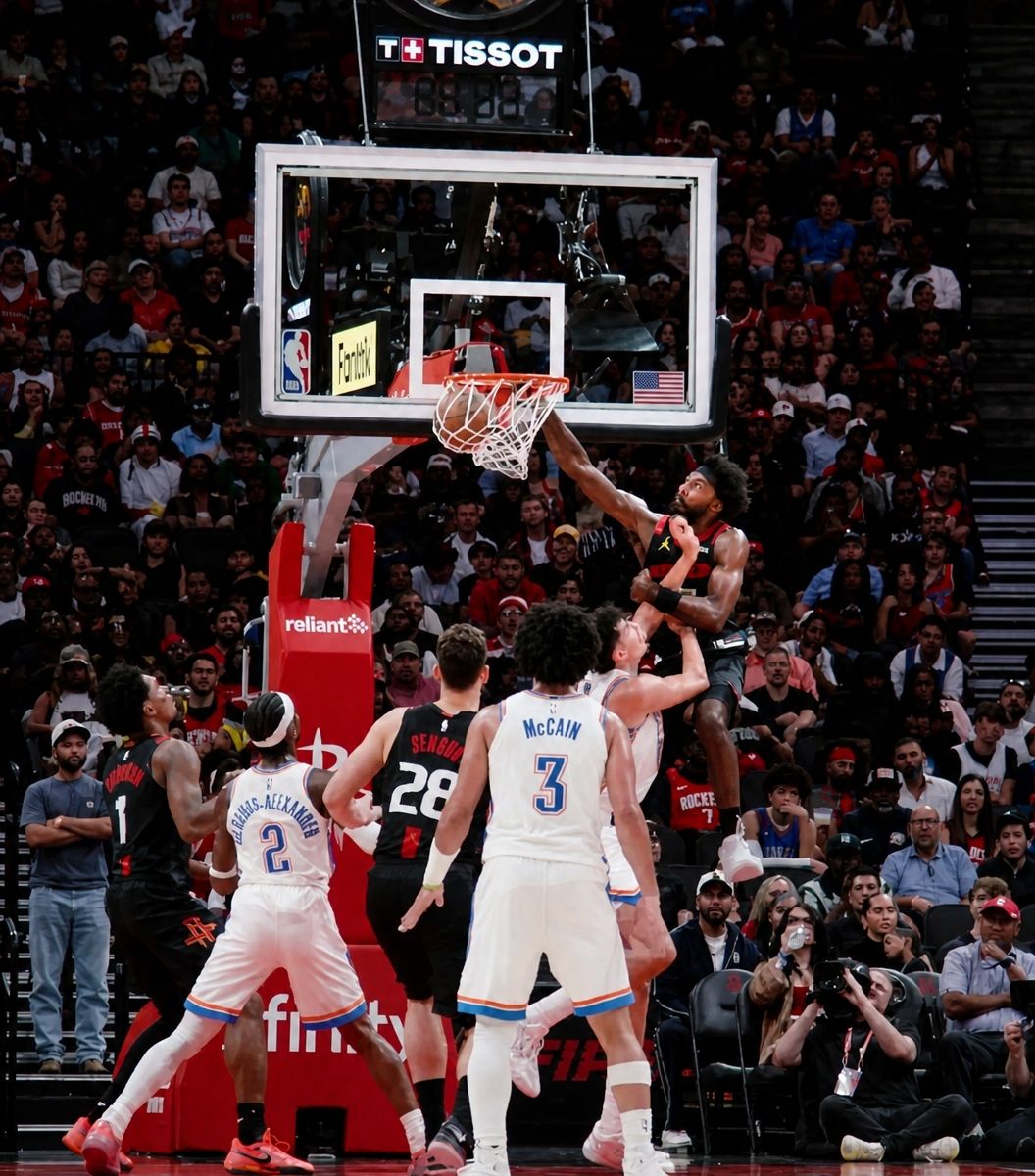
The Oklahoma City Thunder are discovering just how much one player can mean to a championship-caliber defense.
Less than 24 hours after learning that Chet Holmgren will miss eight to 10 weeks with a small tear in his right patellar tendon, the Thunder took the floor in Houston and looked like a team searching for answers. The Rockets found plenty of questions for them.
Houston attacked Oklahoma City’s weakened interior, moved the basketball, and punished defensive breakdowns on the perimeter on its way to a 119-98 victory Saturday night at Toyota Center. The loss dropped the Thunder to 4-2, marking their second consecutive defeat after a 4-0 start to the season.
The final margin was 21 points, but the more concerning development was how quickly Oklahoma City’s defensive foundation began to crack.
Without Holmgren protecting the rim and providing help behind the perimeter defense, the Thunder had fewer options when Houston attacked the paint. The, the Rockets took advantage, connecting on 18 of 41 attempts from beyond the arc and turning an early competitive game into a comfortable victory.
Shai Gilgeous-Alexander did his part, bouncing back from a difficult performance in Dallas with 26 points on 10-of-20 shooting. But with the injuries continuing to mount, the Thunder are asking their franchise player to carry an increasingly heavy offensive burden.
And right now, there aren’t enough healthy answers around him.
Houston’s Second-Quarter Surge Changes Everything
For the first few minutes, Oklahoma City appeared capable of keeping the game within reach. The Thunder scored 26 points in the opening quarter, but Houston was even better, putting up 35 and establishing an early advantage.
The game began to slip away in the second.
Leading 37-30 just over a minute into the quarter, Houston unleashed an 18-4 run that turned a manageable deficit into a 55-34 hole. Amen Thompson capped the stretch with a tip-in, and suddenly the Thunder were facing a 21-point deficit with more than six minutes remaining before halftime.
Oklahoma City responded with a 17-8 run to close the half, trimming the margin to 62-51. That late push offered a little life, but the Rockets wasted no time restoring control.
Houston opened the third quarter with eight unanswered points, pushing the lead back to 19. Oklahoma City never seriously threatened again.
The Rockets didn’t need a complicated formula. They attacked, moved the ball, and made the Thunder defend for extended possessions. When Oklahoma City collapsed toward the paint, Houston found opportunities outside. When the Thunder tried to stay home on shooters, the Rockets had the personnel to attack downhill.
It was a difficult combination to solve without Holmgren.
The Defensive Foundation Looks Different Without Chet
Holmgren’s absence is about more than losing a seven-footer who can block shots.
His value to Oklahoma City’s defensive system comes from the freedom he gives everyone else. Perimeter defenders can pressure the basketball knowing there is a legitimate rim protector behind them. When an opponent gets past the first line of defense, Holmgren can contest the shot, alter the angle, or force an offensive player to reconsider the drive altogether.
That safety net is now missing.
Against Houston, the Thunder had to find a different way to protect the paint. The Rockets were comfortable attacking the interior and using those opportunities to create advantages elsewhere. Oklahoma City’s defensive rotations became increasingly difficult as Houston moved the ball and found open perimeter opportunities.
The results were evident in the shooting numbers.
Jabari Smith Jr. finished with 30 points on 10-of-18 shooting, including six three-pointers. Marcus Smart added 24 points and connected on seven of his 10 attempts from beyond the arc. Houston finished 18-of-41 from three-point range, a 43.9% clip.
Those aren’t simply the numbers of a team getting lucky. The Rockets had multiple players capable of punishing Oklahoma City, and their ball movement helped create the space to do it.
Alperen Sengun added another dimension after returning from a two-game absence. He finished with 16 points, nine rebounds, and nine assists, giving Houston a playmaking presence in the middle of the floor.
The Thunder were left trying to defend a team with several ways to create an advantage while operating without one of their most important defensive pieces.
Holmgren’s injury does not excuse every breakdown, but it changes the equation. Oklahoma City needs to find a new defensive identity for the next two months, and Saturday showed how much work remains.
SGA’s Solitary Fight
There was at least one encouraging development for Oklahoma City.
After shooting 7-of-19 in Wednesday’s loss to Dallas, Gilgeous-Alexander responded with a much more efficient performance. He finished with 26 points on 10-of-20 shooting, adding four rebounds and three assists.
He looked more comfortable offensively and found ways to get to his spots against a Houston defense that had every reason to make his night difficult.
But the larger issue isn’t whether Gilgeous-Alexander can score. He has proven repeatedly that he can carry an offense.
The question is how much the Thunder can reasonably ask him to do.
With Jalen Williams, Cason Wallace, and Holmgren unavailable, Oklahoma City is missing three important pieces of its offensive structure. Williams provides another high-level creator. Wallace offers ball-handling and perimeter pressure. Holmgren provides another scoring option and a player who can stretch the floor.
Those absences leave Gilgeous-Alexander with fewer reliable outlets.
Houston could concentrate more of its defensive attention on him, knowing Oklahoma City was missing several players who normally punish a defense for overcommitting. Even when SGA found success, the Thunder struggled to generate enough consistent production elsewhere.
Kenrich Williams and Bennett Stirtz each scored 11 points, while Isaiah Hartenstein and Jared McCain added 10 apiece. Ajay Mitchell, who had delivered consecutive scoring explosions against Phoenix and Dallas, was held to six points on 3-of-9 shooting.
The Thunder shot 44% from the field and just 10-of-32 from three-point range. They were not able to match Houston’s offensive production or create enough sustained pressure to make the Rockets uncomfortable.
Gilgeous-Alexander’s performance was a positive. The lack of dependable secondary creation remains a concern.
The Rockets Had Too Many Answers
Houston deserves credit for the way it approached this matchup.
Jabari Smith Jr. led the way with 30 points and nine rebounds, while Smart’s 24-point performance gave the Rockets another dangerous perimeter option. Sengun’s return added playmaking and interior production, and Kevin Durant chipped in 14 points.
The Rockets also finished with 29 assists, compared to Oklahoma City’s 20.
That number tells part of the story. Houston consistently found the next pass, created opportunities for teammates, and made the Thunder defend multiple actions. Oklahoma City, meanwhile, had a much harder time generating offense when Gilgeous-Alexander wasn’t directly involved.
Houston shot 43.9% from three, controlled the game after its second-quarter run, and never allowed the Thunder to make a serious push in the second half.
This was a balanced offensive performance against a team that suddenly has very little margin for defensive error.
The Daigneault Dilemma: Finding Another Engine
The Thunder have reached an important early-season crossroads.
Holmgren is expected to miss eight to 10 weeks. Cason Wallace underwent surgery for a left shoulder labral tear and will be re-evaluated before the end of the regular season. Jalen Williams is also facing an extended absence after suffering a broken left fibula and dislocated left ankle.
Those are significant losses, and they leave Mark Daigneault with difficult decisions.
Oklahoma City cannot simply ask Gilgeous-Alexander to shoulder an enormous offensive workload every night and expect that approach to hold up over the long term. The Thunder need another source of creation, and they need to find ways to generate offense without relying exclusively on their superstar.
That could mean giving Ajay Mitchell a more consistent opportunity to initiate offense. It could mean running more of the offense through Hartenstein at the elbow, using his passing ability to create movement and open opportunities for cutters. It could also mean trusting the younger players to make more decisions with the basketball.
Whatever the solution, it needs to be more than asking SGA to do more.
Defensively, the challenge is just as significant. Oklahoma City must find a way to protect the rim collectively, improve its rotations, and avoid allowing opponents to turn every successful drive into an open three-point opportunity.
There is no replacing everything Holmgren provides. The Thunder will have to compensate as a group.
What’s Next?
The Thunder now head to Cleveland for Monday night’s matchup with the Cavaliers, looking to stop a two-game slide and find some stability in the middle of an increasingly difficult stretch.
At 4-2, Oklahoma City is hardly in crisis. But the early-season optimism has been tempered by an injury report that continues to grow and two consecutive losses that have exposed some legitimate concerns.
The Dallas game showed what happens when the Thunder run out of healthy bodies. Houston showed what happens when the defensive structure loses its most important anchor.
Gilgeous-Alexander is still capable of leading this team, and the roster still has talented players who can contribute. But the next several weeks will require more than individual brilliance.
The Thunder need answers, and they need to find them quickly.
For now, Space City offered a harsh reminder: life without Chet Holmgren is going to be a very different challenge.