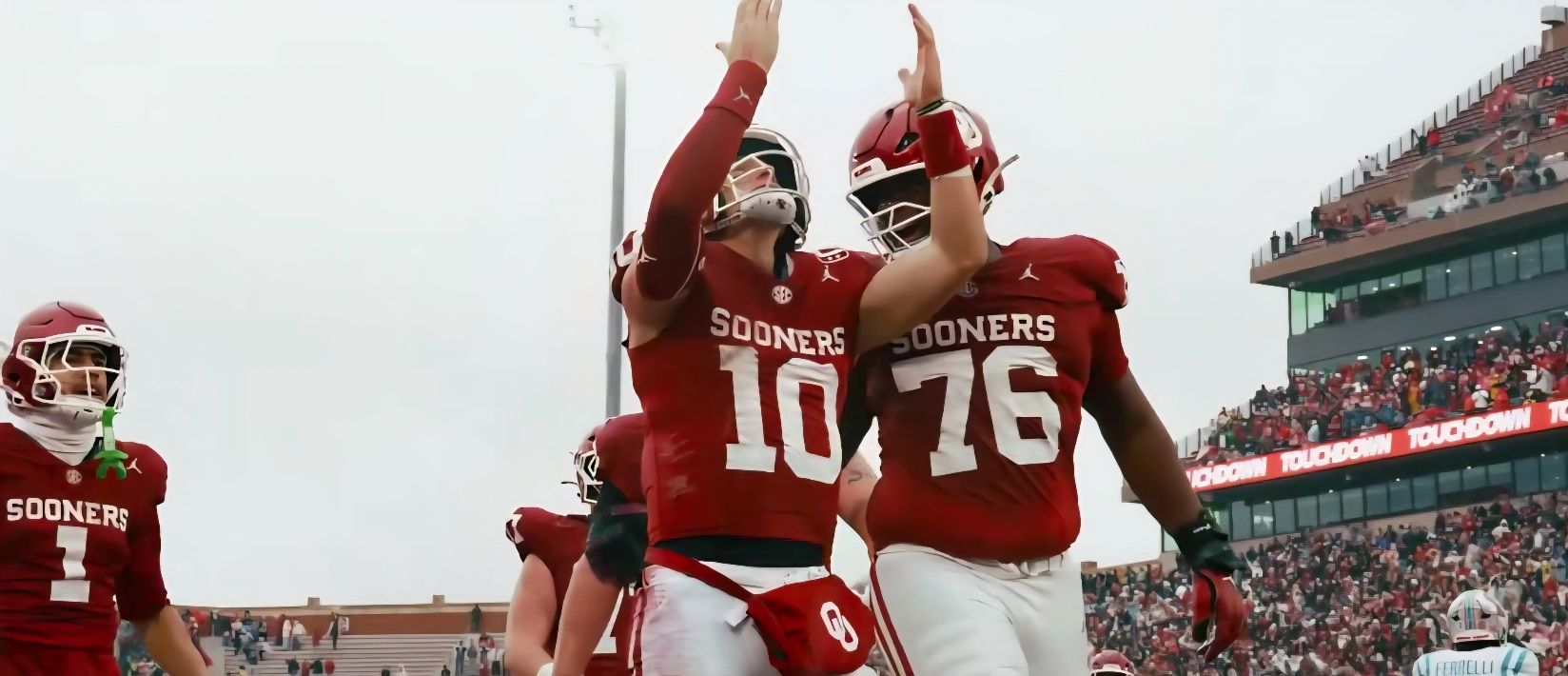
Oklahoma didn’t need a perfect performance to beat No. 19 Ole Miss. It needed the right performances at the right moments.
In a game that was pushed from Saturday to Sunday because of travel disruptions, played in cold, pouring rain, and featured swirling winds throughout the afternoon, the Sooners found a way to win a game that demanded toughness more than style points. They ran the football, controlled the clock, made explosive plays on special teams, and leaned on a defense that made life difficult for one of the SEC’s more dynamic offenses.
The result was a 24–17 victory, Oklahoma’s first over Ole Miss in four meetings, a second consecutive win, and bowl eligibility at 6–4 overall and 4–3 in SEC play.
There were plenty of reasons for optimism. Oklahoma rushed for 188 yards on 49 attempts, converted 9 of 16 third downs, held the ball for 36:31, and didn’t turn it over despite the difficult conditions. Those numbers tell the story of a team beginning to establish an identity under interim offensive coordinator Jason Witten.
But it wasn’t all positive. Tate Sandell missed two field goals, the defense allowed Ole Miss to make a late push, and the Sooners failed to secure an onside kick that nearly turned a comfortable finish into a devastating one.
So, with another SEC challenge approaching this Saturday, let’s take a look at whose stock is rising, whose is falling, and what Oklahoma still needs to clean up.
Stock Skyrocketing
Isaiah Sategna III: The Game-Changer
There isn’t much debate about the biggest stock riser from Sunday’s game. Isaiah Sategna III continues to establish himself as one of the most dangerous special teams weapons in the country.
His 75-yard punt return touchdown in the first quarter gave Oklahoma a 14–0 lead and provided a massive momentum swing in a game where points weren’t going to come easily. With the offense already having put together a 13-play opening drive, Sategna’s return put Ole Miss in an early hole and forced the Rebels to play from behind.
It was his second punt-return touchdown of the season, joining his 88-yard return against UTEP. He finished with 77 total return yards, but the impact of that one play was far greater than the final yardage total suggests.
In a rain-soaked game where the offenses had to work for every yard, Sategna provided the kind of explosive play that can change an afternoon in an instant.
His stock isn’t just rising. It’s reaching an elite tier.
Stock Trending Up
Oklahoma’s Ground Game: A Physical Identity Is Taking Shape
Perhaps the most encouraging development from Sunday’s win was the commitment to running the football.
Oklahoma finished with 49 rushing attempts for 188 yards, a season high, and consistently leaned on its ground game to control the tempo. The Sooners weren’t particularly explosive on every carry, averaging 3.8 yards per attempt, but they were effective where it mattered most: sustaining drives and converting third downs.
Oklahoma converted 9 of 16 third-down opportunities, a 56.3% success rate, and held the ball for 36:31. That was a 13-minute advantage over Ole Miss and kept the Rebels’ offense on the sideline for extended stretches.
The offensive line deserves plenty of credit for the performance. The conditions weren’t conducive to a wide-open passing attack, and Witten responded by asking his offensive front to establish control. The results were evident in the number of long possessions Oklahoma put together and its ability to finish drives.
This is the kind of offensive foundation that can travel, especially late in the season.
John Mateer: Winning Without Having to Win Through the Air
Mateer’s passing numbers weren’t particularly impressive. He completed 10 of 19 attempts for 111 yards, but the quarterback made his presence felt in the ground game.
Mateer carried the football 16 times for 70 yards and a touchdown, including the 8-yard scoring run that capped Oklahoma’s opening possession. His ability to make plays with his legs gave the Sooners another dimension and helped them sustain the kind of drives that controlled the afternoon.
There will be games when Oklahoma needs Mateer to make plays through the air. Sunday wasn’t necessarily one of them.
Instead, he protected the football, contributed to the rushing attack, and helped Oklahoma maintain control of the game. In those conditions, that was enough.
Tory Blaylock: A Valuable Piece of the Rotation
Blaylock deserves recognition for his contribution to a backfield that helped Oklahoma impose its will on Ole Miss.
The Sooners needed multiple backs to handle the workload, and Blaylock was an important part of that rotation. His physical running style and ability to work through contact fit the approach Witten wanted to establish.
The value of a running back rotation isn’t always reflected in one player’s final rushing total. It’s about keeping fresh legs available, maintaining physicality, and making the defense tackle for four quarters.
Blaylock helped Oklahoma accomplish that, and his performance is another reason to feel encouraged about the direction of the ground game.
Lloyd Avant: More Than Just a Change-of-Pace Back
Avant also deserves his own entry after contributing in multiple ways.
One of his most impressive plays came as a receiver, when he turned a short third-quarter reception into a 22-yard gain by breaking multiple tackles. It was the kind of play that illustrated his ability to create something beyond what was initially available.
His contributions as a runner and receiver give Oklahoma another versatile option in the backfield. With the Sooners increasingly committed to establishing the ground game, having multiple backs capable of creating yards in different ways is important.
Blaylock and Avant aren’t simply interchangeable pieces. They give Oklahoma different options within a rotation that is beginning to find its rhythm.
Jonathan Hatton Jr.: Finishing Drives
Hatton’s contribution didn’t come with a huge statistical line, but his third-quarter touchdown was an important moment in the game.
He finished with five carries for 18 yards, including the 5-yard touchdown run that capped Oklahoma’s 12-play, 70-yard possession. That drive pushed the lead to 21–7 and gave the Sooners some much-needed breathing room.
The ability to finish long drives with touchdowns is critical, particularly when the offense isn’t generating many explosive plays. Hatton did his job when Oklahoma needed him, and his touchdown helped establish control of the second half.
Kip Lewis: A Tackling Machine
Lewis once again demonstrated why he is such an important part of Oklahoma’s defense.
He led the Sooners with 13 tackles, including seven solo stops, and was consistently involved in the action. His ability to diagnose plays, get downhill, and finish tackles helped Oklahoma limit Ole Miss’s opportunities to sustain drives.
The Rebels were held to just 4-of-12 on third down, and while that was a collective defensive effort, Lewis was an important piece of the unit’s ability to get off the field.
His production continues to make him one of the most dependable defenders on the roster.
David Stone: Disruption in the Trenches
Stone’s stock continues to trend in the right direction.
The defensive line’s ability to create pressure and disrupt Ole Miss’s timing was an important part of Oklahoma’s defensive performance. Stone contributed to that effort with a sack, giving the Sooners another interior presence capable of affecting the quarterback.
Oklahoma’s defensive front needs to be able to generate pressure without relying exclusively on blitzes. Stone’s development and continued involvement in that effort are encouraging signs as the season moves forward.
Michael Boganowski: Versatility on Display
Boganowski is another defender whose stock deserves a bump.
His ability to contribute in different roles gives Brent Venables additional flexibility when putting together pressure packages and adjusting to opposing offenses. Boganowski recorded a sack of Trinidad Chambliss, helping Oklahoma create negative plays and disrupt the Rebels’ offensive rhythm.
His versatility is valuable, particularly against offenses that use motion, quarterback movement, and different personnel groupings to create matchup problems.
Peyton Bowen: Stability in the Secondary
Bowen also deserves recognition for his work on the back end of Oklahoma’s defense.
The Sooners held Chambliss to 127 passing yards on 14-of-27 passing, and the secondary did a good job limiting Ole Miss’s ability to generate consistent production through the air for much of the afternoon.
Bowen’s experience and communication are important components of that group. With Oklahoma facing another challenging SEC opponent, continued stability from its veteran defensive backs will be essential.

Take A Deeper Dive Into Our Oklahoma Football Coverage On Our Facebook Subscription Hub
What Oklahoma Is Getting In Kenyon Sweat: Elite Speed, Versatility, And A Homegrown Playmaker
The Film Room: Caging Chambliss-How Venables & Bates’ Defense Survived the Scramble Drill
The Column: Built For The Mud-Venables Forged a Team That Refuses to Blink
Help support Heartland Sports by Unlocking Exclusive, data-driven film room breakdowns, recruiting Update, high-leverage personnel matrix updates you won’t find anywhere else, and More by subscribing to our premium Oklahoma Sooners football coverage today.
Stock Holding / Slight Caution
Late-Game Pass Defense: The Mobile Quarterback Problem Remains
For much of the afternoon, Oklahoma’s defense did exactly what it needed to do.
The Sooners limited Ole Miss to 127 passing yards, frustrated Chambliss, and held the Rebels to just four third-down conversions. But the final stretch provided a reminder that containing a mobile quarterback for four quarters is a different challenge than doing it for three.
Chambliss used his legs to extend plays and keep Ole Miss alive. His ability to create outside the pocket helped set up a 26-yard touchdown pass to Caleb Odom, and the Rebels eventually pulled within one score.
Oklahoma’s overall defensive performance was strong, but the late-game breakdowns deserve attention. The Sooners cannot allow an opposing quarterback to turn a manageable situation into an extended scramble drill, especially when trying to protect a fourth-quarter lead.
This isn’t a reason to discount what the defense accomplished. It’s a reminder that the final few minutes matter just as much as the first three quarters.
Onside Kick Coverage: A Mistake That Nearly Changed Everything
Oklahoma had an opportunity to put the game away after Lucas Carneiro’s late field goal.
Instead, Ole Miss recovered the ensuing onside kick with 38 seconds remaining and no timeouts.
The recovery gave the Rebels an unexpected opportunity to steal a game that Oklahoma had largely controlled. The defense ultimately made the necessary stop, batting down Chambliss’s desperation Hail Mary as time expired, but the Sooners should never have been in that position.
Multiple Oklahoma players had an opportunity to secure the kick, but nobody came away with possession.
The defense deserves credit for finishing the job. The special teams unit needs to make sure that situation doesn’t happen again.
Stock Down
Tate Sandell: One Clutch Kick Doesn’t Erase Two Misses
Sandell’s afternoon was a mixed bag, and the final result shouldn’t obscure the concerns.
The Oklahoma kicker finished 1-for-3 on field goals, making a 41-yarder while missing attempts from 39 and 51 yards. He did convert all three extra points, and his made field goal was important in the fourth quarter, but the two misses were costly opportunities to put the game out of reach.
The 39-yard miss came early in the fourth quarter, and the 51-yard attempt also failed to produce points. In a game where Oklahoma was trying to create separation, those missed opportunities allowed Ole Miss to remain within striking distance.
The 41-yard make was clutch, and it ultimately helped Oklahoma secure the victory. But a 1-for-3 afternoon is not a performance that should send a kicker’s stock upward.
Sandell has the ability to be a difference-maker. Oklahoma needs more consistency from him, particularly as the season enters its final stretch.
The Bottom Line: Oklahoma Is Finding Its Formula
Sunday’s victory over Ole Miss wasn’t perfect, but it offered another glimpse of what Oklahoma can become.
The Sooners are beginning to find an offensive identity built around physicality, a deeper running back rotation, and better situational execution. They are winning the time-of-possession battle, converting third downs, and finding ways to generate explosive plays on special teams.
Defensively, Oklahoma showed that it can make life difficult for a ranked SEC opponent, even if the late-game execution still needs work.
There are legitimate reasons for optimism, particularly with the ground game and Sategna’s impact on special teams. But the missed field goals, late defensive struggles, and onside kick recovery are reminders that Oklahoma still has work to do.
The Sooners are now bowl eligible at 6–4, have won back-to-back games for the first time this season, and have an opportunity to build on that momentum against Texas A&M.
The stock is rising in Norman. Now comes the challenge of proving that Sunday’s performance wasn’t an isolated afternoon, but the beginning of something more sustainable.