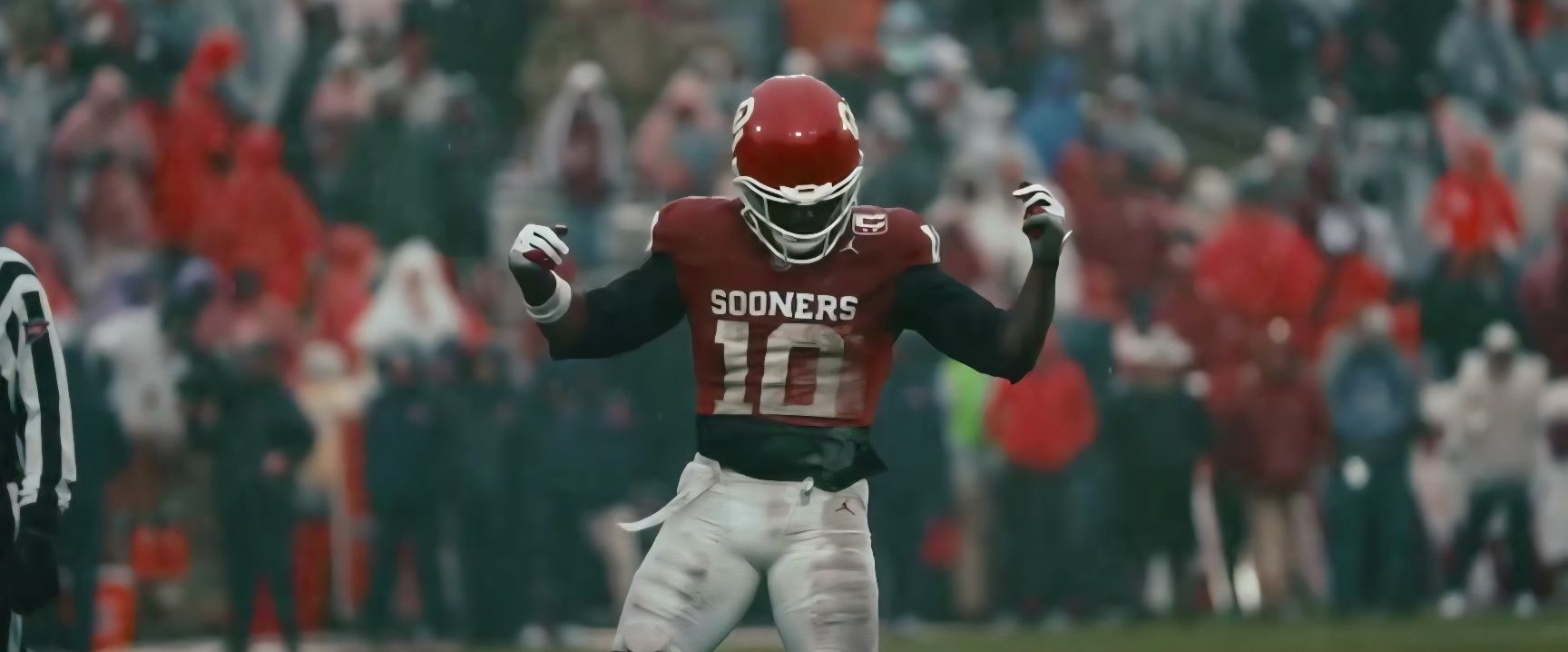
For much of the week, Oklahoma’s defensive preparation for Texas A&M centered on one problem: Marcel Reed.
The Aggies’ quarterback is a dangerous athlete who can turn a broken play into a significant gain. His ability to extend possessions with his legs forces defenses to maintain disciplined rush lanes, account for designed quarterback runs, and remain alert to the possibility that a seemingly contained play can suddenly become a scramble.
But as the Sooners prepare to host Texas A&M on Saturday, they may be preparing for a very different quarterback.
The Aggies are reportedly expected to bench Reed in favor of sophomore Brady Hart, who could make his first career start at Gaylord Family–Oklahoma Memorial Stadium. The 6-foot-4, 200-pound quarterback has appeared in seven games over two seasons, completing 19 of 34 passes for 227 yards, two touchdowns, and two interceptions.
It’s a significant change for a Texas A&M team that has lost three consecutive games and needs victories over Oklahoma and Texas to become bowl eligible.
For Oklahoma, the switch changes the defensive equation.
Hart is considered a traditional pocket passer. He offers accuracy, a willingness to work through progressions, and the arm talent to challenge tight coverage windows. What he doesn’t offer is Reed’s running ability or his capacity to consistently create plays outside the structure of the offense.
That distinction matters against a defense led by Brent Venables.
The Sooners have spent the season building one of the nation’s better defensive units, ranking 10th nationally in passing defense and third in opponent third-down conversion percentage. Now they could face a first-time starter whose biggest weaknesses align with some of Oklahoma’s greatest strengths.
It doesn’t guarantee an easy afternoon. In fact, the lack of meaningful film on Hart creates its own challenges.
But if the reports are accurate, Oklahoma’s defensive opportunity has changed considerably.
Meet Brady Hart: A Pocket Passer With Plenty to Prove
Hart arrives in Norman with an impressive recruiting background but very little college experience.
A native of Cocoa, Florida, Hart starred at Cocoa High School under head coach Ryan Schneider. He led the program to back-to-back FHSAA Class 2A state championships and finished his high school career with 8,119 passing yards, 81 touchdowns, and 19 interceptions.
Originally part of the 2026 recruiting class, Hart reclassified to 2025 and enrolled at Texas A&M in January of that year. He was a consensus four-star prospect, ranked No. 134 in the ESPN 300, and initially committed to Michigan before flipping to the Aggies in November 2024.
At 6-foot-4 and 200 pounds, Hart has the prototypical frame of a modern Power Four quarterback. After adding roughly 20 pounds of muscle late in his high school career to prepare for early enrollment, he has continued to fill out his frame in College Station to handle the physical demands of SEC football.
His college production, however, remains limited.
Hart completed five of 10 passes for 62 yards as a freshman in 2025. This season, he’s completed 14 of 24 attempts for 165 yards, two touchdowns, and two interceptions. His two touchdown passes came in relief appearances during wins over Missouri State and The Citadel, while his interceptions came against LSU and Tennessee.
Those numbers offer only a small window into what he can do as a starter.
The scouting profile is more revealing.
Hart is a rhythm-based pocket passer who relies on mechanics, timing, and accuracy rather than athleticism. He shows an ability to work through progressions, identify leverage, and attack intermediate windows over the middle of the field.
When his feet are set, he can generate good velocity and deliver the football to the perimeter. He also displays touch when layering throws over second-level defenders.
There are limitations, though.
Hart’s release can be somewhat elongated, and his ball velocity tends to decline when he’s forced off his spot. His pocket awareness against pressure remains an area for development, particularly when defenders attack from his blind side. He isn’t a quarterback who can consistently escape a collapsing pocket and turn a broken play into a positive gain.
That last point is particularly important against Oklahoma.
The First Advantage: Oklahoma Can Attack Without the Same Contain Responsibilities
One of the biggest challenges Reed presents is the additional responsibility he places on the second level of a defense.
Against a mobile quarterback, linebackers must remain disciplined. They can’t simply attack the line of scrimmage whenever they recognize a potential running lane. They have to account for the quarterback keeping the football, executing a designed run, or escaping the pocket when the original play breaks down.
That can limit how aggressively a defense attacks.
Hart presents a different problem.
With only three career rushing attempts for 17 yards, he hasn’t demonstrated the kind of running threat that forces opponents to devote a defender to quarterback containment. Oklahoma’s linebackers can be more aggressive attacking downhill, particularly on early downs, without carrying the same concern about Reed breaking outside the pocket.
That could be especially beneficial for Owen Heinecke and Kip Lewis.
Heinecke leads Oklahoma with 83 tackles, 9.5 tackles for loss, and six quarterback hurries. Lewis provides another experienced presence capable of attacking gaps and disrupting the timing of an offense.
The defensive line could benefit as well.
Adepoju Adebawore leads the Sooners with four sacks, while Jake Kreul has added three. Interior defenders David Stone and Jayden Jackson can create pressure by collapsing the pocket from the middle.
Against Reed, Oklahoma would have to balance its rush with the responsibility of keeping the quarterback contained. Against Hart, the Sooners can be more aggressive with their pursuit, provided they maintain sound gap integrity and don’t allow the Aggies to exploit their aggressiveness with designed runs or misdirection.
The objective should be simple: make Hart operate from an uncomfortable pocket and force him to prove he can consistently beat an SEC defense without the benefit of his legs.

Take A Deeper Dive Into Our Oklahoma Football Coverage On Our Facebook Subscription Hub
Key Notes & Storylines: Five Things To Watch As No. 22 Oklahoma Hosts Texas A&M
Five-Star Seneca Driver Headlines Major Recruiting Surge for Oklahoma’s 2027 Class
What Oklahoma Is Getting In Kenyon Sweat: Elite Speed, Versatility, And A Homegrown Playmaker
Help support Heartland Sports by Unlocking Exclusive, data-driven film room breakdowns, recruiting Update, high-leverage personnel matrix updates you won’t find anywhere else, and More by subscribing to our premium Oklahoma Sooners football coverage today.
Venables’ Pressure Packages Could Create a Difficult First Start
There may not be a more challenging environment for a first-time starter than facing Venables’ defense in Norman.
Venables has built his reputation on pressure, disguise, and forcing quarterbacks to process information after the snap. His defenses routinely show one picture before the play and present another once the ball is moving.
For an experienced quarterback, that can be difficult enough.
For a player with just 34 career pass attempts, it becomes a significant test.
Hart’s scouting profile suggests he is comfortable operating within structured passing concepts. He can read leverage, work through progressions, and deliver the football when the timing of the play is intact.
The question is what happens when Oklahoma disrupts that timing.
Venables can use simulated pressures to make Hart identify where the rush is coming from while also forcing him to recognize which defenders are dropping into coverage. The Sooners can show pressure from the second level, bring heat from an unexpected direction, or create confusion with post-snap rotations.
Hart’s reported difficulty recognizing backside pressure and maintaining his mechanics when moved off his spot gives Oklahoma a potential point of attack.
The Sooners have recorded 28 sacks this season, averaging 2.8 per game. Their pressure doesn’t have to result in a sack every time to be effective. A quarterback who has to move his feet, speed up his delivery, or throw without a clean platform is already operating outside his comfort zone.
That’s where the interior defensive line becomes especially important.
If Stone and Jackson can collapse the middle of the pocket, Hart won’t have the luxury of stepping into his throws. If Adebawore and Kreul can generate pressure from the edges without losing their rush discipline, the Aggies’ quarterback could find himself with very little room to operate.
The goal isn’t necessarily to blitz on every passing down. It’s to make Hart unsure of where the pressure is coming from and uncomfortable with the time he has to make a decision.
The Secondary Has an Opportunity to Create Turnovers
Hart’s willingness to challenge tight windows over the middle of the field is one of his more intriguing scouting traits.
It’s also an area where Oklahoma could make him pay.
The Sooners have allowed just 166.3 passing yards per game, ranking 10th nationally. They’ve also been opportunistic in the secondary, with players such as safety Peyton Bowen and cornerback Courtland Guillory contributing to the team’s takeaway production.
Hart’s preference for intermediate throws creates opportunities for Oklahoma’s defensive backs to be aggressive.
If the Sooners can disguise coverage and make Hart believe a window is available before rotating into a different look, they can challenge his ability to process the defense after the snap. A first-time starter may be tempted to trust what he sees pre-snap, particularly if the Aggies build their opening script around quick throws designed to get him comfortable.
That’s where Venables’ defense can become dangerous.
Oklahoma ranks third nationally in opponent third-down conversion percentage, allowing just 28.2% of attempts to be converted. The Sooners also rank fifth in opponent first downs per game.
Those numbers become even more important if the defense can force Texas A&M into obvious passing situations.
The Aggies don’t want Hart throwing into long-yardage situations against a defense that can disguise its intentions and bring pressure from multiple directions. Oklahoma’s objective should be to shut down the early-down running game, create third-and-long opportunities, and make Hart consistently demonstrate that he can identify the coverage and deliver the football under pressure.
A takeaway would be an enormous bonus.
The One Concern: Oklahoma Has Very Little Film on Hart
There is a reason Oklahoma can’t simply assume the quarterback change makes Saturday easier.
Hart has thrown only 34 career passes.
That leaves Venables and his staff with limited game film to evaluate. They can study his high school background, practice footage, and the small sample of college appearances, but there’s no extensive body of work showing how he responds to different defensive looks over four quarters.
That uncertainty can work in Texas A&M’s favor.
Offensive coordinator Holmon Wiggins will likely want to give Hart some manageable early opportunities. Quick-game concepts, screens, run-pass options, and play-action throws can help a young quarterback settle into the game without asking him to make too many difficult decisions immediately.
The Aggies could also use their running game to keep Oklahoma from unleashing its pass rush on every passing down.
That’s why the opening quarter matters.
Oklahoma must avoid coverage busts, communicate through motion, and tackle effectively in space. The Sooners cannot allow a scripted opening series to produce easy completions and build Hart’s confidence.
If Texas A&M can establish the run and get Hart comfortable with quick throws, the Aggies could make the game more competitive than the quarterback change might suggest.
But if Oklahoma forces the Aggies behind the chains early, the advantage shifts significantly toward the Sooners.
The Bottom Line: A Different Quarterback, a Different Opportunity
The reported decision to turn to Brady Hart changes the complexion of Saturday’s matchup.
Marcel Reed’s athleticism would have required Oklahoma to devote considerable attention to quarterback containment and the possibility of explosive plays outside the pocket. Hart’s pocket-passing profile presents a different challenge, one that could allow Venables to be more aggressive with his linebackers and defensive front.
The Sooners have the pass rush, secondary talent, and defensive versatility to make life difficult for an inexperienced quarterback.
But Hart isn’t without ability. He’s a former four-star recruit with a strong high school résumé, a good frame, and the passing traits to operate a structured offense. Oklahoma can’t mistake limited experience for a lack of talent.
The key will be making him uncomfortable before he can find a rhythm.
If the Sooners control the line of scrimmage, disguise their pressures, and force Hart to make difficult decisions from a collapsing pocket, they have an opportunity to turn the Aggies’ quarterback change into a major defensive advantage.
Oklahoma spent the week preparing for Marcel Reed’s ability to create problems with his legs.
Now, if the reports prove accurate, the Sooners get to hunt a different kind of quarterback.
And in Brent Venables’ defense, that could be exactly the opportunity Oklahoma was looking for.