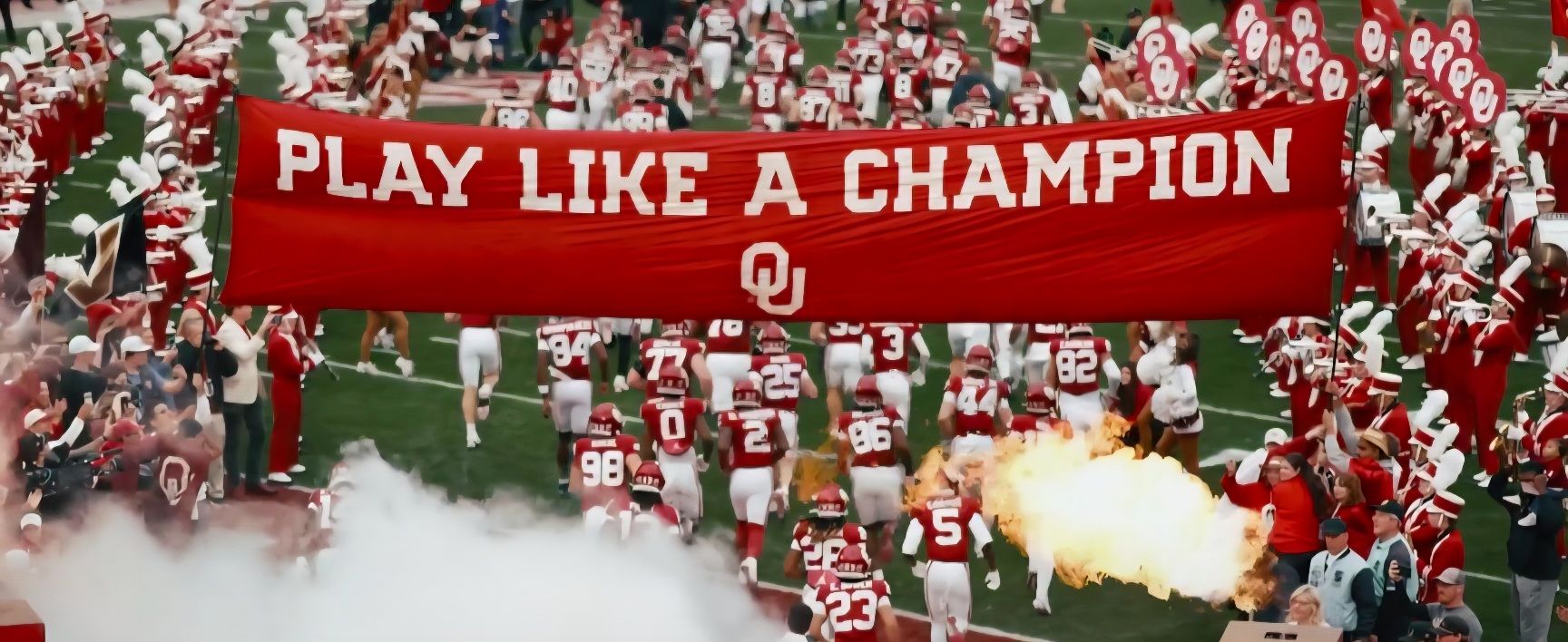
There was a point this season when Oklahoma was simply trying to find a way to get to six wins.
Four weeks ago, the Sooners were 4–4, coming off a 42–25 loss to South Carolina, and facing legitimate questions about the direction of the program. The offense was struggling to establish an identity, the pressure was mounting, and bowl eligibility was no longer something that could be taken for granted.
A month later, the conversation has changed.
Oklahoma has beaten Florida, Ole Miss, and Texas A&M in consecutive weeks. The Sooners are 7–4 overall, 5–3 in SEC play, and have already secured their place in the postseason. More importantly, they look like a different football team than the one that walked off the field after that October loss to South Carolina.
Now comes the final chapter of the regular season.
Oklahoma travels to Missouri on Saturday for a 3:15 p.m. CT kickoff at Faurot Field. The Tigers are also 7–4, making this more than an opportunity to finish the season with another victory. A win would give the Sooners an 8–4 record, a 6–3 mark in conference play, and another meaningful result to strengthen their postseason position.
The bowl eligibility conversation is over. Oklahoma has earned that opportunity.
The question now is how much more this team can accomplish.
From 4–4 to 7–4: A Season That Took a Different Turn
The turning point came on November 2, when Brent Venables relieved offensive coordinator Ben Arbuckle of his duties and handed play-calling responsibilities to Jason Witten on an interim basis.
It was a significant decision with only a handful of games remaining. Oklahoma needed more than a new voice. It needed an offensive identity that could complement its defense and give the team a reliable path to winning games.
Witten’s approach has been straightforward: establish the run, stay committed to manageable situations, protect the football, and make opponents defend the entire field.
The results have been immediate.
In his first game calling plays, Oklahoma went to Gainesville and defeated Florida 23–7. The Sooners rushed for 144 yards, controlled possession for 37:50, and converted 10 of 18 third-down opportunities. The defining moment was a 20-play, 89-yard touchdown drive that consumed 12 minutes and 45 seconds.
That wasn’t simply a scoring drive. It was a statement about how Oklahoma intended to play.
The following week, the Sooners faced No. 19 Ole Miss in a game where the weather made running the football even more important. Oklahoma responded with 188 rushing yards on 49 attempts, committed no turnovers, and won 24–17.
Then came Texas A&M.
The Aggies initially gave Oklahoma trouble, taking a 7–0 lead and forcing two early turnovers from John Mateer. But the Sooners settled down, tied the game before halftime, and took control after the break.
Oklahoma finished with 421 total yards, held Texas A&M to just 185, and scored 28 unanswered points in a 28–7 victory. Mateer threw three touchdown passes and ran for another score, while the defense forced eight punts.
Three games. Three wins. Three distinctly different challenges.
The common thread has been a team that knows what it wants to do and is increasingly capable of executing that plan.
Jason Witten Has Given the Offense an Identity
The most obvious difference between the Oklahoma team that started the season 4–4 and the one preparing for Missouri is the offense’s approach.
Under Arbuckle, the Sooners spent much of the first half of the season searching for consistency. The offense could produce explosive plays, but it struggled to sustain drives and put together complete performances.
Witten has changed the equation.
Oklahoma has rushed for at least 140 yards in each of his three games as play-caller. The Sooners had reached that mark only once in their first eight games. John Mateer has also become a more effective part of the ground game, using his physical running style to create another dimension for the offense.
The improvement isn’t limited to rushing totals.
Oklahoma’s time of possession has climbed from approximately 30 minutes per game during the first eight contests to more than 36 minutes during Witten’s three-game stretch. Long drives have become part of the team’s identity, and the benefits extend beyond the offense.
A defense that has been asked to carry a significant workload throughout the season has been able to spend more time on the sideline. The Sooners have allowed just 31 combined points in their last three games after giving up 42 to South Carolina.
That relationship between the two sides of the football is important.
Oklahoma doesn’t necessarily need to score 35 or 40 points to win. It needs to sustain drives, avoid turnovers, control the clock, and give its defense opportunities to dictate the game.
The formula has worked against Florida, Ole Miss, and Texas A&M. Now it must travel to Columbia.
The Defensive Foundation Has Remained Strong
While Witten’s impact has received plenty of attention, Oklahoma’s defensive performance has been just as important to this turnaround.
The Sooners have allowed only 17.9 points per game through 11 contests. They have held opponents to 121.5 rushing yards per game and just 163.1 passing yards per game, while limiting opposing offenses to a 27.4% conversion rate on third down.
That last number is particularly impressive.
Oklahoma has consistently made opponents work for first downs, and the defense has been effective at forcing difficult situations. Against Texas A&M, the Aggies managed only 47 yards of offense in the second half. They never found a way to regain control after Oklahoma took the lead.
Brent Venables’ defensive identity has been evident throughout the season, even when the offense was struggling.
Now, with the offense sustaining longer possessions and controlling the clock, the defense is getting more opportunities to play from a position of strength.
That will matter against Missouri.
The Tigers have enough offensive talent to punish mistakes. Oklahoma cannot afford to give them short fields, allow explosive plays, or let the running game dictate the pace.
The Sooners need another disciplined performance, particularly on early downs and third down.

Take A Deeper Dive Into Our Oklahoma Football Coverage On Our Facebook Subscription Hub
Electric Atmosphere Pays Immediate Dividends On The Trail
The Film Room: The 89-Yard Clampdown – How Oklahoma’s Front Seven Suffocated Texas A&M
OU Recruiting: What The Sooners Are Getting In Running Back Ben Rogers
Help support Heartland Sports by Unlocking Exclusive, data-driven film room breakdowns, recruiting Update, high-leverage personnel matrix updates you won’t find anywhere else, and More by subscribing to our premium Oklahoma Sooners football coverage today.
Missouri Presents One More Significant Challenge
Missouri enters the regular-season finale with the same 7–4 overall record as Oklahoma, although the Tigers are 4–4 in SEC play.
Under head coach Eli Drinkwitz, the Tigers have put together an offense capable of producing points in a hurry. They average 29.2 points per game and have several players who can create problems for opposing defenses.
Quarterback Austin Simmons has completed 63.3% of his passes for 2,693 yards, 25 touchdowns, and four interceptions. He has been productive through the air, and his ability to distribute the ball makes Missouri a difficult offense to defend when it finds rhythm.
The Tigers also have a major weapon in the backfield.
Jamal Roberts has rushed for 1,200 yards and nine touchdowns on 251 carries, averaging 4.8 yards per attempt. He gives Missouri a dependable ground-game presence and will test an Oklahoma defense that has been particularly effective at limiting opposing rushing attacks.
Through the air, Cayden Lee and Donovan Olugbode are the primary threats. Lee has recorded 940 receiving yards and five touchdowns, while Olugbode has added 796 yards and 10 touchdowns.
That combination gives Missouri a balanced offense with the ability to attack in multiple ways.
The Tigers are coming off a 28–14 victory over Kentucky, which snapped a two-game losing streak that included defeats against Texas and Georgia. They will be looking to close the regular season with another home victory.
For Oklahoma, the defensive priorities are clear:
- Make Roberts earn every yard. The Sooners have been strong against the run, and they cannot allow Missouri to establish its ground game early.
- Disrupt Simmons’ timing. Oklahoma needs pressure without sacrificing coverage discipline, particularly against Lee and Olugbode.
- Win third down. The Sooners’ ability to get off the field has been one of their greatest strengths. That must continue in Columbia.
Missouri is a capable opponent, and playing at Faurot Field adds another challenge. But Oklahoma has faced difficult environments and quality competition throughout the season. The Sooners have an opportunity to demonstrate that their recent improvement is sustainable.
The 8–4 Opportunity Is About More Than a Record
There is a meaningful difference between finishing 7–5 and finishing 8–4, particularly for a program trying to establish momentum heading into the offseason.
Oklahoma has already secured bowl eligibility, but the final result against Missouri can influence how the season is ultimately viewed and where the Sooners fit in the postseason picture.
An 8–4 finish would represent a strong response to a difficult stretch in October. It would also give the program a winning record in SEC play at 6–3, an important accomplishment in its third season in the conference.
The postseason implications matter, too.
Bowl placement is influenced by conference standings, available selections, and the overall postseason landscape. A victory in Columbia would strengthen Oklahoma’s position and give the team another quality result to carry into December.
But the significance goes beyond the destination.
This is a program that entered November with questions about its offensive direction. Now, Oklahoma has won three straight against SEC opponents and has an opportunity to finish the regular season with four consecutive victories.
That kind of finish matters when evaluating the direction of a team, the confidence of its players, and the foundation being built for next season.
It also matters for the coaching staff.
Witten’s three-game audition has given Oklahoma a compelling reason to evaluate what the offense could look like with him directing it moving forward. Another strong performance would only strengthen that conversation.
Venables, meanwhile, has an opportunity to close the regular season with a team that has responded to adversity rather than allowing it to define the season.
The Final Test: Carry the Momentum to Columbia
The biggest challenge for Oklahoma on Saturday may be maintaining the same identity that has fueled its recent success.
The Sooners cannot walk into Missouri expecting the game to unfold exactly like the previous three. Each opponent presents different personnel and different problems. The Tigers have a productive quarterback, a 1,200-yard running back, and two receivers capable of changing the game.
Oklahoma will need to be physical at the line of scrimmage, tackle consistently, and avoid giving Missouri opportunities through turnovers or explosive plays.
Offensively, the formula should remain familiar.
Run the football. Let Mateer use his legs when opportunities are there. Stay ahead of the chains. Convert third downs. Protect the ball.
And when Missouri loads the box, make the Tigers pay for it through the air.
The Sooners don’t need to reinvent themselves in the final game of the regular season. They need to continue doing the things that have worked since Witten took over the offense.
That is what makes this matchup so important. Oklahoma has finally found a version of itself that can win games against quality SEC competition. Now it has to prove that version of the team can perform away from Norman one more time.
Turning the Page
When Oklahoma was 4–4, bowl eligibility was the immediate objective. There wasn’t much room to look beyond the next opponent, and the margin for error had nearly disappeared.
Three victories later, the Sooners have earned the right to think bigger.
They have already secured a postseason opportunity. They have rediscovered a physical offensive identity. Their defense is playing complementary football, and the players have responded to a significant midseason coaching change.
Saturday offers one final chance to add to that progress.
An 8–4 finish and a 6–3 SEC record would not erase the struggles that came before November. It would, however, provide a much different ending to a season that once looked like it was headed in the wrong direction.
Oklahoma has turned the page.
Now it’s time to finish the story.
Game Information
- Matchup: Oklahoma Sooners (7–4, 5–3 SEC) at Missouri Tigers (7–4, 4–4 SEC)
- Date: Saturday, Nov. 28
- Kickoff: 3:15 p.m. CT
- Location: Faurot Field — Columbia, Missouri
- TV: SEC Network
- What’s at Stake: An 8–4 regular-season finish and a 6–3 record in SEC play