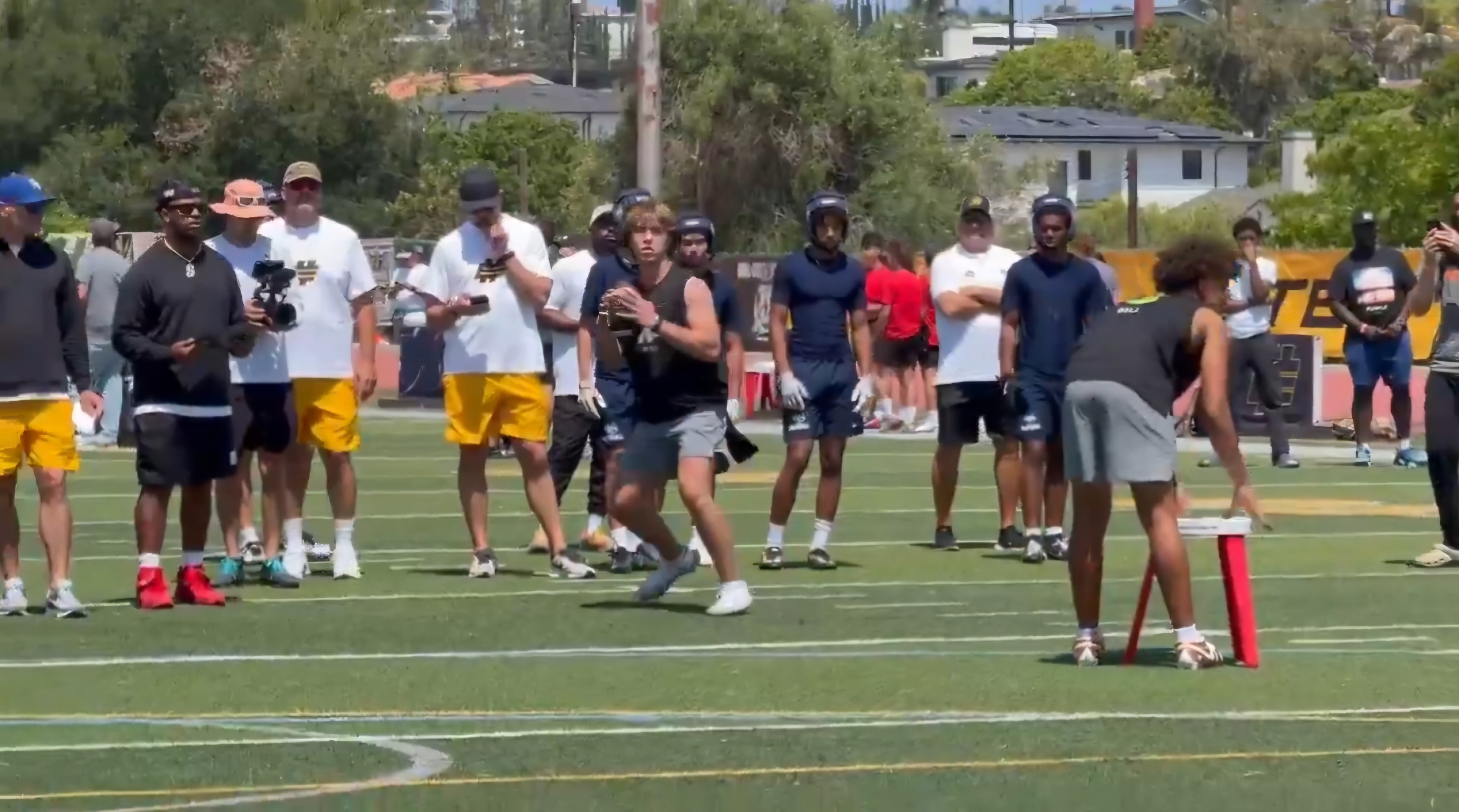
Oklahoma’s quarterback saga for the 2026 recruiting cycle reached a crescendo on Friday when Bowe Bentley, a four-star prospect from Celina, Texas, officially committed to the Sooners. His pledge came less than 24 hours after Jaden O’Neal—long considered the face of Oklahoma’s 2026 class—decommitted. The timing couldn’t have been more dramatic, or more telling. With Bentley, Oklahoma hasn’t just filled a vacancy; it’s made a statement about the type of quarterback it wants to build around in the future.
Bentley is not simply a replacement. He’s a fit—a tailor-made answer to the question Ben Arbuckle has been trying to solve since arriving in Norman: how do you marry explosiveness with efficiency at quarterback in the SEC? At Celina High School, Bentley accounted for more than 4,200 all-purpose yards and 63 total touchdowns last season en route to a Texas 4A state title. He completed 70% of his passes, threw for 3,330 yards and 47 touchdowns, and added nearly 1,000 rushing yards and 16 more scores on the ground. In short, he produced video game numbers—against real competition.
This is not a quarterback who leans solely on his legs or simply benefits from a wide-open Texas system. Bentley is a complete quarterback who processes quickly, throws with anticipation, and can make every throw required in Arbuckle’s system. At the Elite 11 Finals, he dazzled scouts, going 18-for-20 on his pro day throws and standing out as one of the top performers of the week. On3’s Charles Power noted that Bentley “excelled when things went live,” and that his quick decision-making and poise made the game look slow for him—a trait that translates well to Power 5 football.
The fit with Oklahoma and Arbuckle is deeper than just numbers and mechanics. It’s philosophical. Bentley raved about his time studying the offense with Arbuckle, saying, “It’s not just what he’s done this spring, but what Coach Arbuckle has done at Washington State and Western Kentucky.” He understands the lineage of the scheme and believes in its future. And perhaps most importantly for Oklahoma fans, Bentley has long been a Sooner at heart. “Everyone makes it feel like it’s home. I can’t really describe it,” he said. “It’s pretty amazing, dream come true.”
This level of buy-in matters, especially after months of quiet tension around the position. O’Neal remained publicly committed even as Oklahoma’s courtship of Bentley became obvious. The two quarterbacks could not be more different stylistically: O’Neal is a polished pocket passer, while Bentley brings a level of mobility and dynamic playmaking Oklahoma hasn’t consistently had at quarterback since the days of Kyler Murray. Once Arbuckle zeroed in on Bentley, the writing was on the wall. O’Neal’s decommitment may have been inevitable, but it also cleared the path for Oklahoma to fully embrace its vision.
Landing Bentley was not easy. Oklahoma beat out LSU, Georgia, and Ohio State—three programs with recent national titles or playoff appearances. And make no mistake, LSU pushed hard down the stretch. Bentley took official visits to Baton Rouge and Norman in back-to-back weeks, and by all accounts, his decision went down to the wire. That’s what makes his commitment so significant: Oklahoma didn’t just win the kid’s heart—they won the recruitment on merit, development plan, and vision.
A major factor in Bentley’s decision was the influence of current Oklahoma quarterback John Mateer, who transferred in from Washington State and flourished under Arbuckle’s tutelage. Mateer became a peer recruiter, spending Bentley’s visit by his side and offering insight on what it means to run this offense. The connection made an impact, with Bentley noting how the entire staff—from Brent Venables to offensive assistant John Kuceyeski—made him feel like a true priority.
That feeling of being wanted stands in contrast to the passive courtship that characterized much of O’Neal’s final months with Oklahoma. O’Neal had been committed for almost a year, even moving to Mustang, Oklahoma, to finish high school just 30 miles from OU’s campus. But when the coaching staff pivoted to Bentley, the relationship cooled. Florida State seized on the opportunity, and the result was a predictable split.
Now, with Bentley in the fold, Oklahoma gets a quarterback who embodies the direction Arbuckle wants to go offensively: fast-paced, creative, explosive, and adaptable. Bentley is not just an athlete. He’s a quarterback who happens to be athletic—a subtle but important distinction. He thrives in RPOs, excels at throwing on the move, and has the arm strength to challenge defenses vertically. His development still matters—he’ll need to adjust to SEC speed and complex coverages—but his upside is immense.
His background as a varsity wide receiver and return man before taking over as Celina’s starter adds another layer to his profile: he’s been an athlete his whole life, and it shows. He’s timed as fast as 10.3 seconds in the 100 meters, and also runs on Celina’s 4×100 relay team. These are not traits you can teach—they’re innate.
Bentley immediately becomes the crown jewel of Oklahoma’s 2026 class, which had dipped briefly after O’Neal and offensive lineman Will Conroy both decommitted. Now, the Sooners can rebuild momentum. Bentley gives the class a quarterback around whom others can rally. Recruits want to know who the leader of a class will be, and Bentley has the charisma and résumé to assume that mantle quickly.
In a post-Lincoln Riley world, Oklahoma is trying to reclaim its identity as a quarterback-driven powerhouse. And while Brent Venables oversees the overall direction, it’s clear that Ben Arbuckle has found his guy. This isn’t a temporary solution—it’s a foundational piece. Bentley’s commitment doesn’t just fill a need. It signals that Oklahoma is serious about adapting, innovating, and competing in the SEC.
It’s a turning point. One that began with uncertainty—and ends with the kind of clarity only a quarterback like Bowe Bentley can provide.
Follow us on Instagram