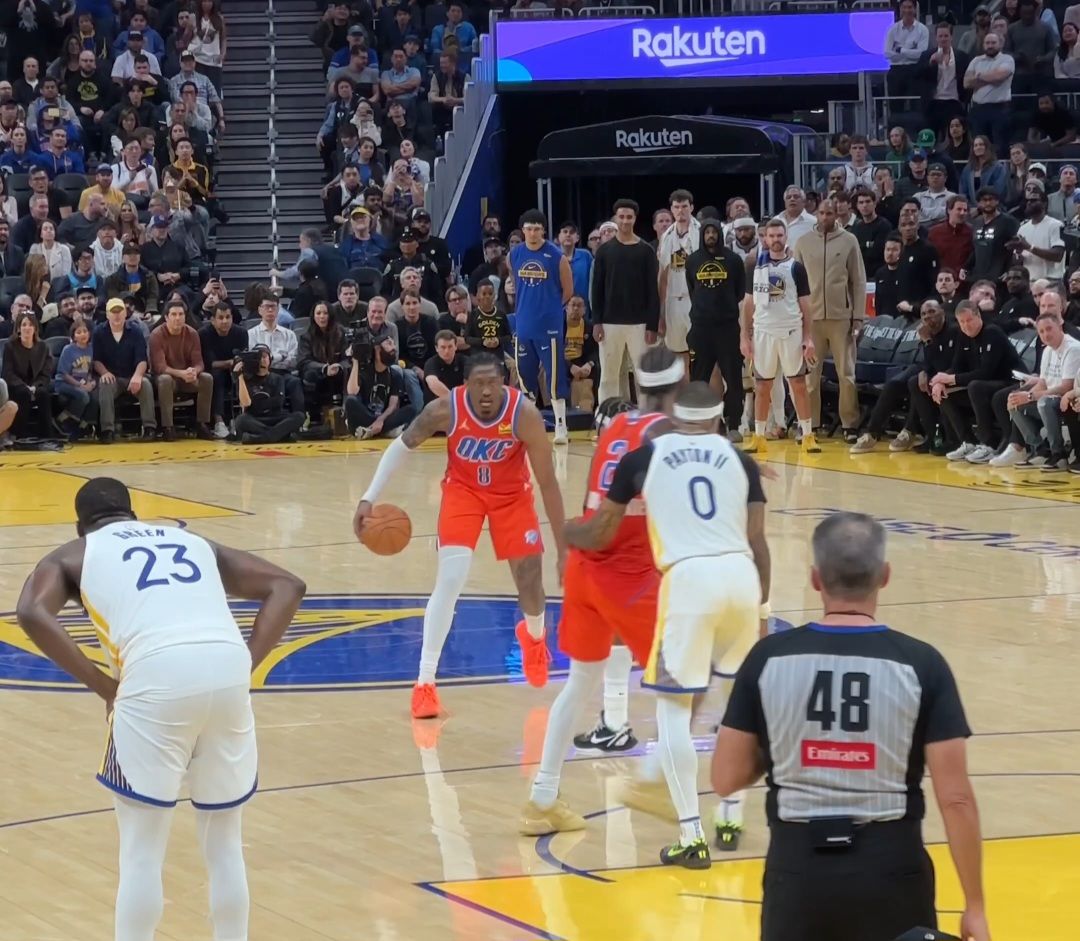
The Oklahoma City Thunder didn’t beat the Golden State Warriors on Tuesday night by overwhelming them.
They beat them by refusing to lose themselves.
On paper, the final score suggests business as usual — a 124–112 road win, another Shai Gilgeous-Alexander masterclass, another night where the league-leading Thunder kept rolling. But watching the game told a very different story. This one didn’t glide. It lurched. It twisted. It threatened to unravel.
A 22-point lead dissolved.
A hostile building found its voice.
A roster missing three of its best defenders suddenly looked vulnerable.
And for the first time in a while, Oklahoma City stared directly into chaos.
Then they took it back.
That — not the points, not the streaks — is the real meaning of this win.
Golden State entered the night short-handed, without Stephen Curry and with Jimmy Butler leaving early in the second half due to injury. On paper, it should have been a clean Thunder victory.
It wasn’t.
Oklahoma City jumped early. It looked like another rout. Then the structure weakened. The Warriors found a rhythm — not through star power, but through pressure, energy, and possession basketball. Pat Spencer, playing one of the most unexpected performances of the season, orchestrated offense with surgical calm. Seth Curry found his shooting touch. Brandin Podziemski controlled tempo.
And suddenly, the Thunder weren’t in control anymore.
The third quarter became something close to survival. Golden State hit shots. The Warriors attacked in waves. What once was a 22-point cushion turned into a one-possession game. Then a deficit. Then doubt.
This is the kind of stretch that sinks young teams.
The kind of moment where habits break, spacing collapses, and trust disappears.
Oklahoma City did not disappear.
They stabilized.
Shai Gilgeous-Alexander’s 38 points will lead every recap. His late three-pointer will dominate highlights.
But the most important part of his performance didn’t show up in a box score.
It showed up in posture.
With Oklahoma City trailing late, Gilgeous-Alexander didn’t rush. He didn’t force. He didn’t fire back emotionally.
He slowed the game until it belonged to him again.
The Thunder didn’t win that final stretch because they scored more.
They won it because they stopped playing Golden State’s game and restarted their own.
Gilgeous-Alexander entered late with Oklahoma City down. Minutes later, the pressure had reversed. His footwork, timing, and patience bent the Warriors into defensive compromise. Attraction turned into fouls. Switches became mismatches. Clean looks replaced panic shots.
And then came the sequence that decided the game — a pull-up three over a defense that backed just enough to be punished.
That shot didn’t extend a lead.
It restored authority.
From there, the Thunder didn’t just score — they orchestrated.
That is superstar leadership in its truest form: not when a game is flowing, but when it is spinning.
Shai Gilgeous-Alexander steered the car.
Jalen Williams kept it from sliding off the road.
In his third game back after missing nearly a month to begin the season, Williams put together his most complete performance of the year: 22 points, six assists, and a quiet influence that cannot be taught.
He attacked defenders in isolation. He created passing angles out of nothing. He punished mismatches without forcing attempts.
But the real story was what Golden State did defensively.
They hunted him.
Down the stretch, Oklahoma City identified defensive soft spots and kept leaning into them — not accidentally, not randomly.
Intentionally.
Williams and Gilgeous-Alexander didn’t try to beat Golden State’s best defenders.
They beat the ones they were allowed to.
That is not just intelligence.
That is weaponized awareness.
And Williams is proving he’s not just a beneficiary of Shai’s stardom — he is constructing his own gravitational pull.
There are shots that inflate scores.
Then there are shots that stabilize seasons.
Chet Holmgren’s three at the top of the arc with just over six minutes remaining didn’t electrify the building.
It calmed Oklahoma City.
Golden State had all the momentum. The Warriors had cut the lead. The Thunder were unsettled. On that possession, Holmgren did something that young players often avoid in moments like that:
He trusted his rhythm.
He didn’t hesitate. He didn’t shuffle the ball. He didn’t pass away from the moment.
He stepped directly into it.
And made it.
Plays like that don’t turn games by themselves.
But they turn temperature.
From that moment on, Oklahoma City played warmer. Freer. Sharper.
Holmgren finished with 21 points and eight rebounds — a strong statistical night. But his most significant contribution wasn’t measured.
It was emotional.
Oklahoma City played this game without Lu Dort.
Without Isaiah Hartenstein.
Without Alex Caruso.
That is not depth.
That is identity stress.
The Thunder are known for defensive dominance. For chaos. For rotation pressure. For physical resistance.
Tuesday night, none of that came easily.
The Warriors beat them on the offensive glass.
They created second chances.
They forced uncomfortable switches.
They played uglier — and Oklahoma City looked rattled briefly.
And then?
They adjusted.
Not through substitutions — through intelligence.
They controlled tempo. They picked matchups. They slowed transition. They sealed possessions. They valued the ball.
Those aren’t tactics of a talented team.
Those are habits of a seasoned one.
The Warriors didn’t give this game away.
They earned Oklahoma City’s best.
Pat Spencer played like a future rotation guard.
Seth Curry looked immediately useful.
Podziemski ran the show with poise.
This wasn’t a bad Golden State effort.
It was a better Oklahoma City finish.
When the game hit its tightest point, the Thunder responded with an 18–5 run.
That’s not surviving.
That’s delivering.
The Thunder did not dominate this game the way fans are now accustomed to seeing.
They stumbled.
They leaked points.
They lost control for a stretch.
And when it mattered?
They reasserted it.
This was not a win built on highlights.
It was built on restraint.
On awareness.
On execution.
On a leader who does not panic and teammates who follow his temperature.
Those are the wins that survive the postseason.
Every great team wins flashy ones.
Only contenders win ugly ones.
This was ugly.
It was choppy.
It was tense.
It was vulnerable.
And Oklahoma City walked out with it anyway.
That’s not just a win in the standings.
That’s progress in the soul.
Follow us on Instagram & Facebook