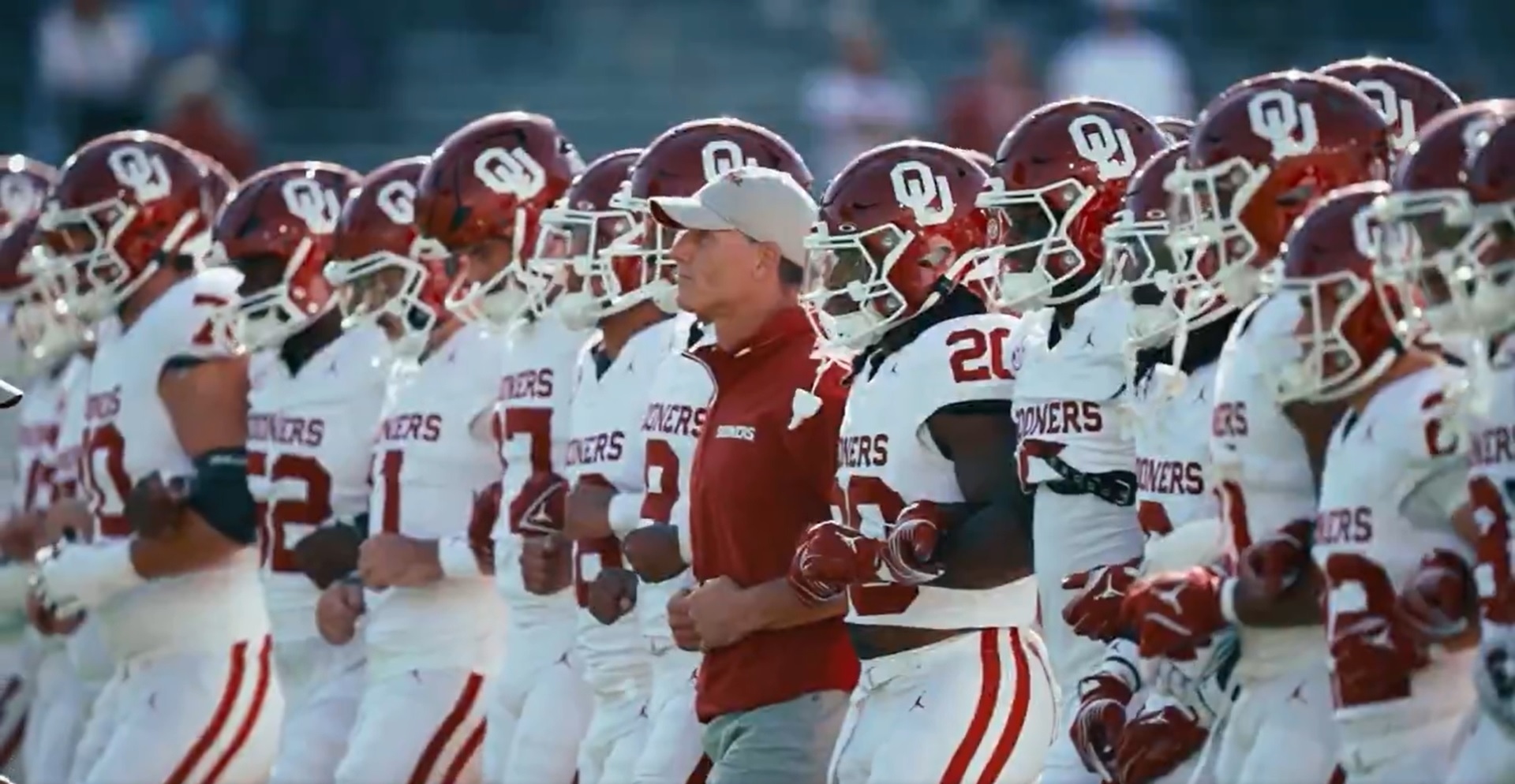
By any surface measure, Oklahoma’s 2026 recruiting class looks like another solid, top-20 haul. Ranked No. 15 nationally by the 247Sports composite and sitting in the middle of the pack among the SEC’s heavyweight recruiters, it does not jump off the page as one of the splashiest classes of the cycle. But recruiting momentum isn’t always built on fireworks. Sometimes it’s built on foundations — concrete, steel, and structure.
That is exactly what Oklahoma signed in 2026.
When Brent Venables and general manager Jim Nagy took the podium on National Signing Day, there was no hesitation in where they pointed first. They didn’t lead with quarterbacks, NIL victories, or social media engagement numbers. They went straight to the trenches, the back seven, and the locker room.
Defense is not just what this class emphasizes — it’s what it promises.
Half of Oklahoma’s 24 signees are defensive players, including five defensive linemen or ends, four linebackers, and three defensive backs. In an SEC that increasingly resembles trench warfare, Oklahoma did not merely restock; it recalibrated. The Sooners aren’t flirting with physicality anymore. They’re recruiting it at scale.
Venables made no attempt to conceal his purpose.
“Defensive linemen, D-tackles, D-ends and then again, four linebackers that have tremendous versatility,” he said. “The defensive linemen have great versatility as well.”
That word — versatility — is the backbone of this class. Gone are the days when Oklahoma could afford to carry specialists at key defensive positions. What Venables and Nagy assembled instead is a defensive unit designed for modern football survival: length on the edges, movement inside, range behind the line, and playmakers who can do more than one job.
The highest-rated defensive headliner is four-star edge Jake Kreul, the No. 53 player nationally and one of three Top 100 prospects in the class. But the crown jewel label doesn’t fit what Venables sees.
“There’s certain things that you can’t measure,” he said. “He’s also incredibly talented, and he loves and works at his craft relentlessly.”
That description could be hung above the door to the Switzer Center. This class does not lean flashy — it leans obsessive. And in a league where luxury rosters are built by Alabama, Georgia, and Texas every year, obsession remains Oklahoma’s most reliable equalizer.
It’s also why the Jandreau brothers matter.
Niko and Beau Jandreau arrive from Hamilton High School in Chandler, Arizona with 248 combined tackles and reputations as tone-setters. Venables did not describe them like developmental prospects. He described them like culture shock agents.
“The Jandreau brothers are special people,” he said. “They’re leaders and alphas and the first day they get here … they’ll be like a bunch of pigs in the mud with the guys that we already have in our locker room.”
That quote should not be dismissed as coach-speak. It’s signaling. Oklahoma did not recruit culture as an accessory this cycle — it hunted it. The defense isn’t being rebuilt. It’s being re-tempered.
Nagy drove that point even deeper, focusing not on profiles but on mindset.
“There’s some violence in that group,” Nagy said. “That’s one of the pillars of the program we’re looking for — violent players.”
Violence in football is a word often softened into “physicality” by polite analysts. Not here. Oklahoma used it intentionally. And after the past decade of living in a league that rewards disruption more than discipline, it’s an identity shift worth noticing.
The class did not just get bigger. It got meaner.
“I think the things that stand out are length and versatility and athleticism,” Nagy said. “That group got longer and more athletic. You have to be athletic to play in our front.”
That isn’t stylistic flair. It’s practical survival in the SEC. Offenses in this league run through defensive weak spots like water through cracks. The Sooners recruited against leakage.
More quietly — and perhaps more importantly — this class reflects a philosophical pivot that extends beyond the field. Oklahoma’s adoption of a front-office model under Nagy is already reshaping how the program evaluates, signs, and retains players.
“We are trimming the fat for our coaches … if we don’t see eye to eye, we move on,” Nagy said.
Translation: relationships do not override evaluation. Comfort does not supersede clarity. Oklahoma is no longer recruiting out of habit — it’s recruiting through rigor.
That tension boiled to the surface at quarterback, where OU ultimately pivoted from a prior commit and landed Blue-chip passer Bowe Bentley. Nagy acknowledged the difficulty of that decision openly.
“When we came in and evaluated some of the players and didn’t see eye to eye, we had to take some hard right-hand turns on this class,” he said. “It’s hard to go to a position coach who has put in so much work… and say… we’re going to pivot. And that wasn’t easy.”
But it happened.
That matters — because Oklahoma has not always been willing to detach emotionally from its own relationships for competitive clarity. This class proves that has changed.
The class also reflects the reality of 2025. At a moment when Venables was under pressure and Nagy had just arrived in March, stability could not be assumed. The recruiting cycle was already in motion without him. Momentum was not Oklahoma’s friend.
“Momentum is a real thing in recruiting,” Nagy said. “People were negatively recruiting… that was probably working against us. Now that we’ve had some success on the field, we had some players come back our way.”
Those ten wins became more than a record. They became oxygen.
The Sooners closed strong — landing multiple late commitments and stabilizing the class just in time. For a staff brought together mid-cycle, the finish was not just respectable. It was instructive.
“If you would have told me back in March… that we’d be standing here in December with this group, it’s pretty exciting,” Nagy said.
Most important of all, this class toughens the spine of the program.
Venables has repeated one truth for two years now, even while the wind howled against him.
“The foundation of our locker room is going to be high school players and guys who are about the right stuff… blue-collar, tremendous work ethic, guys who love to be pushed and challenged.”
That foundation is now visible in blueprints — not slogans.
Oklahoma did not assemble a class chasing headlines. It built one chasing leverage. And leverage in college football does not come from stars alone. It comes from collisions, depth, and commitment to discomfort.
This class has all three.
And in the SEC, that’s not a phase.
It’s identity.
Follow us on Instagram & Facebook