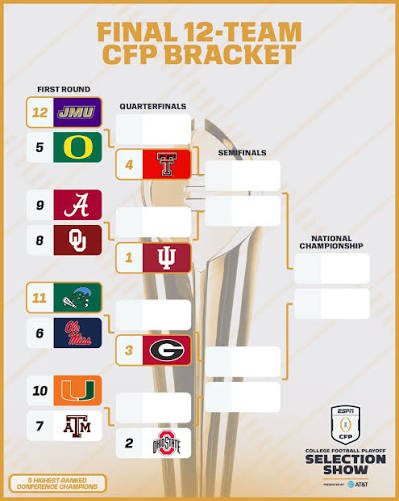
When the College Football Playoff expanded to 12 teams, it didn’t just create opportunity. It exposed something the sport has tried to hide for decades: most teams don’t actually have a championship shot.
Fans like to pretend otherwise. Administrators especially. But the presence of James Madison and Tulane in this year’s playoff didn’t cheapen the tournament — it revealed how dishonest the old system always was.
For years, access to the playoff wasn’t about merit. It was about image. Logos mattered more than résumés. Television brands mattered more than actual performance. And now, for the first time ever, some of the sport’s loudest power brokers are furious that the gates they once controlled aren’t exclusively theirs anymore.
James Madison and Tulane being included has some fans, boosters, and ADs up in arms, as if the playoff has suddenly become an act of charity instead of competition. But there is no actual evidence that these programs are worse selections than the alternatives people are championing.
There is only opinion.
And the loudest complaints this year didn’t even come from the so-called “little guys.” They came from the sport’s largest institutions.
Notre Dame athletic director Pete Bevacqua reacted to the field announcement like someone who had just lost a birthright. His grievance? That the ACC dared to champion Miami — a team that beat Notre Dame head-to-head — instead of cowering to the Irish’s prestige and independent brand.
The argument, apparently, is that because Notre Dame plays soccer and volleyball in the ACC, football records against ACC teams should magically stop mattering when it’s inconvenient.
That’s not principle.
That’s entitlement.
Meanwhile, Texas head coach Steve Sarkisian publicly lamented that leaving out his three-loss Longhorns would be a “disservice to the sport.” The language sounds noble. The purpose is not. Coaches don’t fight for justice — they fight for access and money.
And fanbases buy the talking points because that’s what fanbases do.
What never gets said out loud is this: the teams being “snubbed” don’t actually look like contenders either.
Notre Dame has already lost twice to teams in this playoff field. Texas also has two losses to 2025 playoff teams and a disastrous defeat to Florida. Those aren’t championship résumés. They’re hopeful portfolios.
Calling James Madison or Tulane “unworthy” assumes that Notre Dame or Texas are somehow different.
They’re not.
They’re just wearing better uniforms.
If the argument is really “which of these teams can win a national title,” the correct answer isn’t Notre Dame or Texas. It’s probably two teams — maybe three — total.
The sport just doesn’t like to admit that truth.
Is James Madison likely to get pummeled by Oregon? Yes.
Does Tulane have a real chance against Ole Miss? Probably not.
But here’s what nobody wants to own: Notre Dame likely wasn’t beating Texas A&M or Miami either. Texas wasn’t surviving Ohio State or Georgia again. Most of this playoff field is filler. That’s not a new problem. It’s just visible now.
Every playoff in every sport works this way.
The NBA hands out sacrificial lambs every spring. The NFL’s Wild Card weekend is a parade of mismatches. Major League Baseball includes teams every year that nobody genuinely thinks can survive October.
College football wanted this.
Fans begged for expanded access.
They asked for more games, more stories, more drama.
Now they have it.
And suddenly everyone’s surprised that not every game is elite theater.
Last year proved the math. The #9, #10, #11, and #12 seeds all lost their opening-round matchups by an average of 19 points. SMU — the #11 seed — lost 38–10. This isn’t new. It’s simply now wearing different colors.
The idea that only programs with national brand recognition get to be blown out is absurd.
Why should Tulane be excluded for losing to Ole Miss when we also already know the most likely outcome for Notre Dame?
Why should James Madison sit home while Texas plays Georgia again just to reenact a rerun nobody asked for?
Because the logo is prettier?
Because the stadium is louder?
Because the TV contract is bigger?
That isn’t competition.
That’s charity.
And here’s the part fans don’t want to confront: half this bracket never had a real shot to begin with.
The inclusion of Group of Five champions isn’t a handout.
It’s a reward.
It says conference titles still matter. It says winning your league still matters. It says playing the best teams on your schedule — and beating them — still matters.
The real charity would have been mailing invites to programs because of name recognition.
The real gift would have been placing teams in the bracket based on brand instead of performance.
That didn’t happen this year.
Instead, the sport did something bold.
It told the truth.
It admitted that sometimes inclusion is about opportunity — not outcome.
It admitted that mismatches are unavoidable.
It admitted that excellence exists in every conference, even if not every conference creates champions.
College football didn’t become broken this season.
It just stopped pretending.
James Madison and Tulane didn’t lower the playoff’s ceiling.
They exposed its floor.
And if that makes people uncomfortable, maybe it’s because the system finally stopped catering to the powerful — and started rewarding the productive.
Not charity.
Honesty.
Follow us on Instagram & Facebook