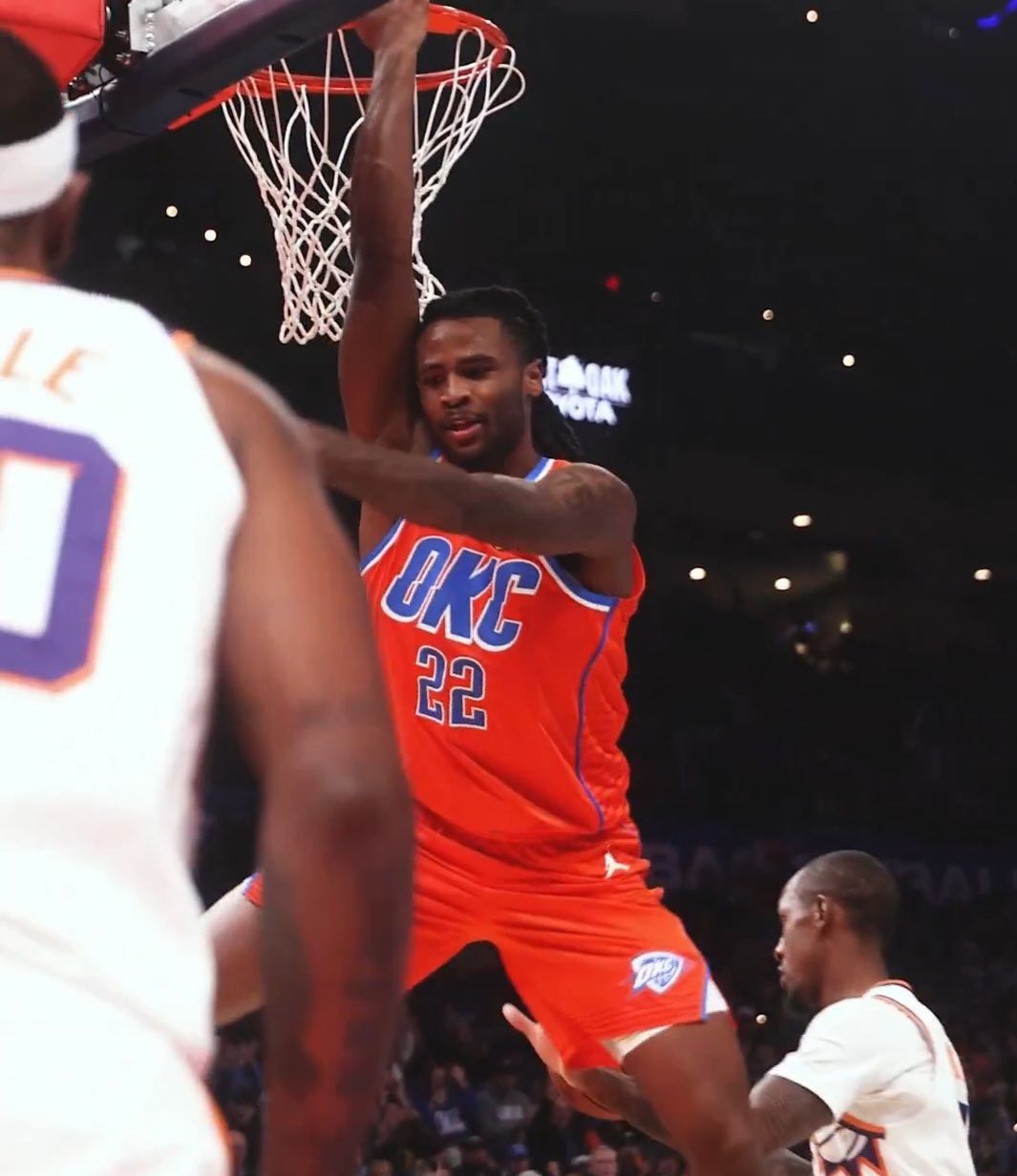
The Oklahoma City Thunder’s 138–89 blowout of the Phoenix Suns on Wednesday night was a declaration. One month after surviving a tight 123–119 matchup with the Suns, Oklahoma City came out in the quarterfinals this year on a mission: to show the league that this isn’t a streak built on luck, or opponent circumstance, or star-centric offense.
It’s a surgically precise, system-driven juggernaut that is now 24–1 on the season, matching the best 25-game start in NBA history alongside the 2015–16 Golden State Warriors.
And they eveb did part of it without their MVP.
Shai Gilgeous-Alexander’s return from left elbow bursitis was a boost on Wednesday night — 28 points in 18 minutes is nothing to dismiss — but Oklahoma City’s performance didn’t hinge on one man’s brilliance. When Shai tied Wilt Chamberlain’s 96-game streak of 20-plus points with a breakaway dunk early in the second half, it was a footnote in a game already slipping away from Phoenix.
This wasn’t a night about who scored the most. It was about how many could score — and how many ways they could do it.
When your third leading scorer with 19 points — Aaron Wiggins — is on one of his best nights of the year, your offensive ecosystem is humming at a level most teams can only dream of.
From the opening tip, Oklahoma City stamped its authority:
- 11 three-pointers in the first quarter alone — a franchise record
- Nearly 60% shooting from the field for the game
- 68% from three in the first half
- Perfect free-throw shooting in the second quarter
Jalen Williams’ triple just before the half made it 74–48 before the break, and by the time the second half started, the Thunder had already entered annihilation mode.
When Phoenix’s Grayson Allen was ejected in the third quarter after a Flagrant 2 on Chet Holmgren — who finished with 24 points and eight rebounds — it punctuated Oklahoma City’s dominance: this wasn’t sloppiness from the Suns; this was control from OKC.
What makes this Thunder team historic isn’t just great numbers — it’s great balance.
Holmgren scored efficiently.
Williams orchestrated offense and defense.
Wiggins knocked down five threes.
Branden Carlson poured in 11 points, and was a perfect 5-for-5 from the floor.
Six Thunder players finished in double figures, and every active roster member scored yet again. This was offensive variety, not one-dimensional scoring.
On the defensive end, Oklahoma City forced 17 Suns turnovers for 27 points — a symptom of pressure, anticipation, and discipline. Ten steals, constant rotation that forces ball relocation, and commitment to help-side defense are shaping this team into not just a title contender, but a full-fledged championship standard.
And this wasn’t against a flailing Suns squad — Phoenix scored 119 against this same Thunder team less than a month ago. This performance was an emphatic response: momentary adversity isn’t strong enough to shake a truly great team.
Phoenix shot under 40% from the field — resulting in a season-low point total — and turned the ball over 21 times. Dillon Brooks led Phoenix with just 16 points on 4-of-16 shooting.
Lauri Markkanen and Devin Booker were absent, yes. But 39% shooting? That’s not solely about missing stars — that’s about a Thunder defense that dictates pace, angles, and discomfort.
The Suns looked outmatched by a team unburdened by its own offensive load.
What This Win Means Beyond the Box Score
There are blowouts.
There are statement wins.
And then there’s this:
This was a historical projection of organizational identity.
A team that:
- Maintains elite balance
- Can win with or without its MVP
- Can lead by four or blow out by fifty
- Shows depth as a strength, not a luxury
- Plays with relentless defensive identity
Oklahoma City didn’t just win this game.
They owned it.
This is a team that can beat you in four different ways, and the Suns learned that through a defensive press that forced 21 turnovers and an offense that shot lights-out from everywhere.
Sure, matching the 2015–16 Warriors for the best 25-game start is history-making.
But it’s how the Thunder have done it that matters more.
They are not a collection of scorers waiting for one player to explode.
They are a blueprint of what systemic offense and defense look like when:
- spacing is elite
- roles are understood
- reads are crisp
- defense leads to offense
- every player is a threat
When every player is a threat, that’s not offense.
That’s an ecosystem.
Here’s what greatest teams do:
Great teams win close games.
Champions win ugly games.
Dynasties win blowouts.
But highest-level contenders create games like Wednesday night — where opportunity against a depleted roster is not an excuse to lose focus; it’s a backdrop for dominance.
Oklahoma City is not merely winning at a historic pace.
They are shaping a definition of excellence that might outlast this season.
The rest of the league should take notice.
Because when a team can play like this — with authority, balance, and clarity — it’s not only winning games.
It’s shaping eras.
Follow us on Instagram & Facebook